
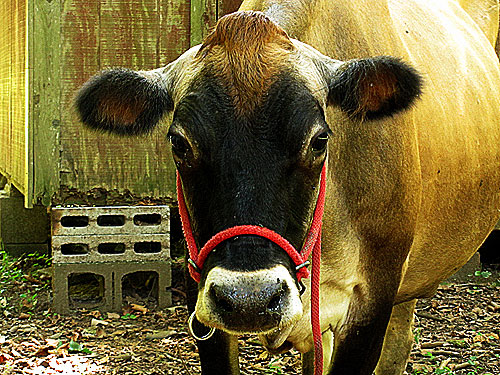
I’ve had a milk cow for over a year now. My life in the country is divided into pre-cow, post-cow. I’ve said this many times–a cow is a life-altering event. It’s an experience that will push you, even if you’re tired, and make you grow. A cow will test your will, and take you on a daily adventure. You will handle a 1000-pound animal every day. Luckily, most milk cows are pretty docile. But don’t take that too much for granted because if you’re not paying attention, they might step on your foot.
Keeping chickens has grown in popularity in recent years. More and more people are keeping chickens, even in suburban backyards. Let me be the first (?) to say that I think the family cow is the next big comeback. People used to keep cows in town! It wasn’t at all unusual in “the old days” for a family to have chickens and a milk cow in towns and even cities. Back then, it wasn’t against the law. Lots of things weren’t against the law back then, such as raw milk. The growing interest in reclaiming our food, which perhaps started with the rise in organic gardening and also in canning and other “old-fashioned” preserving is a starting point for many people, which leads to a domino effect of taking the next step, and the next. In the 70s “back-to-the-lander days, it was just “wackos” (also known as hippies) who were into it. Whether it’s the economy or the ever-increasing sophistication and digitalization of society (or a combination), taking control of our own food isn’t a wacko idea for side segments of society anymore–nor is it relegated to traditional farmers, either. It’s mainstream, and it’s what I think of as non-traditional farming (despite its attachment to tradition).
I think of myself as a non-traditional farmer. The differentiation I make there is that not every decision I make comes from a true farming perspective. Farmers who make their living solely off the land have to take a more pragmatic approach to decision-making in many regards, including the animals they keep and their production level. I keep some of my “farm” animals in a somewhat pet-like way. (My goats, in particular.) I don’t put my hens in the pot if they’re not laying as much as they used to. And heaven forbid I should have to milk my cow twice a day. I realize that the way I keep my cow is not normal. Luckily, she came that way (milking once a day) or I might have been afraid to do it. I’ve tried Googling milking once a day, and you can’t find a whole lot about it, though there are some articles out there.
An article at Hay and Forage has this to say: “The once-a-day cow is a different cow. It’s more relaxed. Being milked is like a walk in the park; it’s not a job now.”
Another article, this one at The Stockman Grass Farmer, says, “…decline in volume has been more than offset by a rise in milk solids and protein and a tremendous decrease in feed costs.”
Note that in one of the articles, the dairy farmer (who takes his entire herd to once-a-day milking) found that the most risk of mastitis was with first fresheners. If you’re starting this with a cow on her first calf, extra care should be taken in bringing the cow’s production down. One way to do this is to gradually extend the time between milkings rather than go straight to once a day. Another way is to milk twice a day every other day at first before dropping down to only once a day every day. BP is an older cow, and I took her down straight to once a day with no problem. She is now regularly giving 1 1/2 – 2 gallons a day, in one milking. (Which is still too much most of the time. Get a pig. A pig is a perfect complement to a family cow. Or share it with your dogs and chickens. Take what you need, let go of the rest.) Also note that when a dairy producer refers to a first freshener, they are taking the calf away early and they are taking cows to once a day early in their lactation. A family cow where a calf is kept with the mother six months is not in that position and will be easier to take down to once a day than a first freshener that has recently calved.
The articles cited are geared to milk producers, not the small family cow owner, but you don’t find much about this idea online in the family cow world. (I was only able to find, through Googling, a few scattered discussions on forums. Here is one example. It appears to be a concept mostly adopted by Jersey owners, though one of the dairy producers above is doing this with Holstein-Jersey crosses.) I point to the above articles just to say, this isn’t a completely insane approach to cow-keeping. It is, in fact, an idea taking hold among dairy producers who are rethinking the labor/cost vs. end product of milking two (and for dairy producers, sometimes three) times a day when they can get better milk and a better cow–at lower cost and labor–by milking once a day. And I also found enough to know that there are family cow keepers out there who are quietly milking their cows once a day. Milking once a day does require a good knowledge of your cow and a watchful eye (as you make the adjustment) for mastitis (which hasn’t been an issue for me as I’ve transitioned BP). The benefits of milking once a day include lower feed cost, less human effort and time, less milk overflow (and waste), and even possibly less stress on the cow. And it’s a total shoe-in for the milk cow serving one family. I also think it’s the wave of the future as more non-traditional “farmers” (like me, I still think of myself as “farmer” in quotation marks) consider a family cow. It’s so much less daunting to consider a cow if you only have to milk once a day. It also makes the cost more affordable as the feed bill is lowered.
I’ve felt, in a way, almost embarrassed to talk about taking Beulah Petunia down to once a day milking because it’s something that is spoken of so little–and often in opposition. (You’ll ruin the cow! I’ve been told that.) You have to milk a cow twice a day! I hear that over and over and over, online and in real life when I talk to people (especially older people who remember milking a cow when they were a kid). It’s just not true. (And you can milk once a day without a calf, too!)
I decided to write about it–because I really do believe the family cow is the next big comeback after chickens. Not suggesting a cow suits every suburban neighborhood, but there are certain types of subdivisions today that allow horses, for example. I think cows are next. Still, even people with large amounts of property in the country are often leery of getting a cow–despite their desire to provide their own milk. Cows have a bad rap. That twice a day milking thing. If you are thinking about getting a family cow and are afraid of all the work, I want you to know that you can choose to milk your cow once a day. (Another fable about cows–milking at the crack of dawn. You don’t have to milk at 6:30 a.m. Milk whenever you want, but make it regular. I milk BP around 9 or 10 a.m. If you work early, then milk later, around 6 or 7 p.m. Or whatever. Just be regular. Cows like routine, and so do their udders.)
Because BP calved in September–and she was bred when we got her, so that wasn’t my idea–I’ve had to extend the time till she’s bred again because I want a spring calf. I want her dried off in the winter. Why milk in the snow and freezing temperatures?
Here’s my milking year, and I want to lay this out so that I can show that not only do you not have to milk a cow twice a day, you don’t even have to milk it once a day except for a few months of the year.
Late December – mid-March (or so): The Dry Season. Cow is dried off. No milking. (Milk and butter in the freezer!) Vacation for the farmer. I’m planning the drying off sometime approaching Christmas. I have cookies to bake.
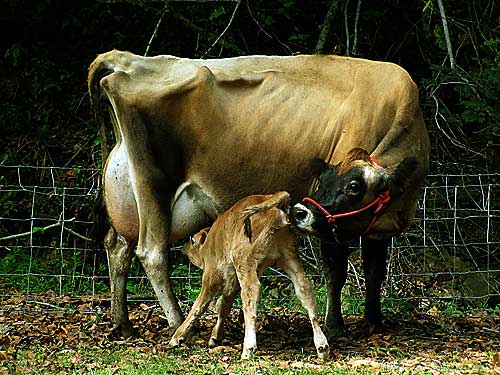
March (at some point): Calve. After calving, when the calf is little, you gotta help the cow out. The calf doesn’t eat that much. But hey, you’ve been missing fresh milk anyway. Give the calf a few weeks to a month and it’ll be a super milker!
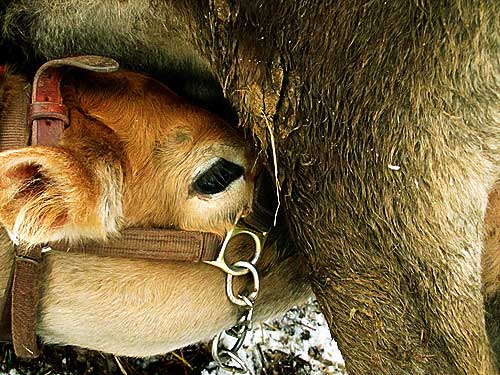
April – September: The Optional Milking Season. Keep the calf on mommy for at least six months. Once the calf is up to speed and milking the cow adequately, you can milk whenever you want. I used an every-other-day milk share with Glory Bee as she got older. In the early months, when Glory Bee needed more milk, I would trade off morning and evening milking. As the calf grows, you have to do various juggling around what the calf needs and what you want, but you can always skip a day or a week or go on vacation. Throughout this period, milking is an option you take up on days it suits you, and eschew on days it doesn’t. I didn’t always milk BP every other day. Sometimes I skipped two or three days. I got as much milk as I needed, and took off any time I wanted.
October – December: The Milking Season. Wean the calf. Milk the cow once a day. Enjoy swimming in the cream. This is the milking season! Stock up in the freezer for the upcoming drying off period. If you bred the cow in June, it will be expecting a March baby and you’ll be drying off by the end of December.
And the milking year starts all over again.
Note that the majority of the year, you are either not milking at all, or milking is OPTIONAL. You can have all the farm-fresh milk you need–without milking any more than you want.
Now that is a milking schedule I can get onboard with. And I think it’s a lot more accessible to a lot of other people, not just me, who wish they could take the power over their dairy products into their own hands but might have thought they could never handle a family cow. All that milking twice a day practically all year! I love my cow, but I don’t want to do that….. And I don’t. It’s still a life change to get a milk cow, let me not diminish that. But the balance of work (and cost) vs. reward makes a significant, positive shift when you open your eyes to once-a-day milking combined with keeping a calf on the cow for at least six months (which yields the “optional milking” portion of the year). This is a family cow that takes into account the family, and that many of us work, run around to school sports, want to take vacations, and so on along with keeping a family cow. I see this as the modern family cow, and an idea whose time has come. And according to findings so far, this system not only can benefit the family, it also benefits the cow by putting it under less stress.
I’m in the midst of an extended “milking season” because Glory Bee was born in September, but that’s all right. It’ll be over soon enough, and I try to remember to enjoy it while it lasts. I’ll never have a milking season this long again. Last week I made a stirred-curd cheddar, a Romano, a Colby-Jack, mozzarella, yogurt, ice cream, sour cream, cream cheese, and butter. The milking season has its rewards.
A family cow is about to get trendy. You heard it here first.


Granny Trace says:
Such a beautiful face..
Wow sounds like alot of work but Im sure worth it. 🙂
Hugs Granny Trace
http://www.grannytracescrapsandsquares.com
On May 24, 2011 at 5:48 am
Leah's Mom says:
Thanks for that post – it is just what I needed to hear. I’ve been struggling with the idea of getting a cow vs goats and the 2x/day milking issue has been the biggest concern for me.
I have also asked the question but haven’t seen much on the subject of milking 1X/day. I’m the type that needs to do all my research before jumping into something so this is very helpful!!!
:moo:
On May 24, 2011 at 6:44 am
CATRAY44 says:
A family cow is my dream. Thanks for sharing-if my dream comes true, this sounds like a perfect way to go!
On May 24, 2011 at 7:26 am
lwb says:
I own both a jersey/holstein cross and alpine dairy goats. I only milk once a day. Goats also seem to take to the once a day milking. I don’t take kids or calves off of the mothers for at least six months (cow) and three-four for the kids. I found it very frustrating that almost no one talks about milking only once a day. I don’t think I could stand milking all of the animals twice a day. I find that my animals are fairly flexible with the schedule. I tend to milk at 7-8 am on weekday mornings and more like 8-9 on weekends. They don’t really seem to mind. Love having the fresh milk!
On May 24, 2011 at 7:28 am
Pat says:
Suzanne, I think you can now take the quotation marks off of the word farmer. You ARE the real deal, maybe on a small scale, but a farmer, nonetheless. Just in case I ever decide to live the real life instead of living it vicariously through you, I’m archiving this information. BP is a real trooper, too. She’s lucky to be with you. :happyflower:
On May 24, 2011 at 7:47 am
ChikeeMomma says:
Suzanne — I think you are right. It is the next thing on the agenda for some of us! I have been thinking about goats or a milk cow now for about a year. Just have to get the hubby into the idea, too. 😀 Someday!
On May 24, 2011 at 8:00 am
Cheryl LeMay says:
You have totally revolutionized my thinking on having dairy animals. Prior to reading about your cow keeping, I always thought you had to milk twice a day. I figured I needed to be retired before I’d have time for that, so having cows and goats was always a “someday” goal.Now I know that’s just not so.I also love the idea of using the baby as the relief milker. Thank you for teaching us a new way to look at dairying. I may be getting a dairy animal sooner than I ever thought possible.
On May 24, 2011 at 8:56 am
JeannieL says:
I agree with Pat…Suzanne needs to give herself more credit. I also had someone tell me..”Oh if you get a cow, you will never be able to leave”… I wondered about that. I also wonder if you could “Share” a cow with another family so there is help and less waste… Alternate milking days.. hmmm
On May 24, 2011 at 9:05 am
mammaleigh says:
I can honestly say that I never wanted a cow, until I saw Glory Bee. I know that she acts stubborn, but I think that is why I like her so much, other than being so darn cute! She reminds me of, well, me. Thank you for showing me that owning a cow can be as rewarding as it is work too. Now only if you can show me how to buy my neighbors property so I can have enough land to have one!
On May 24, 2011 at 9:05 am
msmitoagain says:
I want a cow, but there is no way I can devote the time to one right now. Hoping when I retire that I might can work one in.
On May 24, 2011 at 9:08 am
Kathi says:
This info was very interesting to learn. I probably will never have a cow, but it was good to get to read about it anyway.
GloryBee is one pretty cow!
On May 24, 2011 at 9:22 am
PetalzAndFinz says:
I only milk my goats once a day. So much easier to only worry about a morning milking. I actually do like milking, but it could become a chore at twice a day. If a cow isn’t for you, a goat is a great way to have tasty fresh milk on hand. They are a much smaller animal than a cow which equals easier handling and less space needed and less feed costs. I was milking two goats that hadn’t freshened for over two years and bringing in a little over half a gallon of milk a day–more than our family of five can go through. And most people don’t realize over half the world’s population drinks goat’s milk.
~Jenny~
On May 24, 2011 at 9:34 am
Window On The Prairie says:
I work full time and don’t really have the time for a milk cow, but maybe someday when I retire. :moo: We do have beef cows though and they are nice to have around. Our freezer is full of our own beef.
On May 24, 2011 at 10:03 am
mommy6_1 says:
I bought a herd-share from an organic farm about 30 minutes from me. I live in town and I know my neighbors would not love a cow in my back yard. I’ve heard they call me Earth Mother behind my back. lol I have to pick up my milk on Mondays and take the empty gallon jar back next week and pick up more. I plan to buy more shares later on. One gallon of milk and four kids don’t add up so I do have to buy milk at the store too.
On May 24, 2011 at 10:07 am
mamajoseph says:
We have enjoyed the fresh milk from our cow(s) since they calved in January. It’s become such a delight that I can’t imagine not having it. Haven’t figured out what we’ll do when we head to the States for a few months later in the year and have to BUY milk! Oh, the horror! 😥
On May 24, 2011 at 10:07 am
ashmmorgan2 says:
I’m super intrigued by this idea! My husband and I just bought a place with two acres and have dreamed about getting a milk cow. I thought I’d have to put it off for several years until I had a schedule that would fit in twice-a-day milking. Thanks for all the info on how you manage BP with once a day (and sometime less!) milking. I hope I can get my cow a lot sooner now and start enjoying all the yummy dairy goodness that goes along with it!!!
On May 24, 2011 at 10:31 am
knititblack says:
I love that you posted this – thank you so much! I’ve always wanted a Jersey cow (as in, since I was about 5 and I’m 31 now) and everyone has always told me I’m insane, even the farmers in my family. But really, I don’t see what the big deal is. I don’t get why people are so scared of having a cow. Anyway, your post really helps outline a good way to do a family cow! I love it! 🙂
On May 24, 2011 at 10:33 am
barefootkitchenwitch says:
We’re getting more and more tempted every day to pack up, sell the house, and move to some place with more land, so we can have bigger gardens, keep chickens…goats…a cow. I have dreamed of this since I was a teenager, I think. We grow more and more vegetables every year, I bake breads, make and freeze stocks, can jams, just bought a pressure canner, and I’ve been dabbling in making cheese for a few years. And now, lots of little factors are adding up and starting to tilt things in that direction. So I have a question…how much land do you recommend, minimum, for, say, a cow, a couple of goats, a bunch of chickens, and plenty of room to grow our vegetables and herbs and some fruit? Any advice from anyone is appreciated. 🙂
On May 24, 2011 at 10:36 am
holstein woman says:
I have a friend who milks her goats once a day after the 4 children are in bed. I have someone else milking my (now) 4 cows, so I don’t worry about it so much. He does a wonderful job. :cowsleep:
On May 24, 2011 at 10:42 am
ibnsgirl says:
Thank you! You are taking the “scary” out of cow-keeping! I’ve been very interested in having a family milk cow at some point in the future (we live in town now). Since I am not close to that point, I have not started that research, but milking once a day probably would not have crossed my mind! In the past, I had horses who ate 3x per day, and even though it took all of ten seconds to grab the feed, it still meant I had to be home or find someone willing to drop by. I would still be more than willing to do that, but this seems so much less daunting, knowing that milking takes that much longer!
On May 24, 2011 at 2:35 pm
mintamichelle says:
I’ve been reading all about your experiences with BP and GloryBee. A year ago I moved my family and my chickens to the country (22 acres) with every intention on building up to a milk cow. I work full-time, commute and still have one child in grade-school. Even with the once a day milking I don’t know if I could handle it… the idea of having a “milking season” is even more eppealing because it means you could PLAN around a “busier” time….I wonder is there anyone else that has a job away from home that is able to manage? I am not saying that being home is not a full time job or even working from home is less of a full time job, I know it isn’t…. :happyflower:
On May 24, 2011 at 11:24 pm
Chicken Crossing says:
I’m so glad you posted this. I am currently milking one goat once a day (her babies take care of the other milkings) While my family loves the goat milk my one goat doesn’t provide enough milk for my whole family plus there is very little cream to skim off for butter, sour cream etc. I just explained to my kids yesterday that I did not want to milk twice a day so a cow was out of the question for us. I’m so excited that I can milk a cow with the same schedule that I do my goat. Now I need to start shopping around for a milk cow. Tnanks for sharing your knowledge with us!
On May 25, 2011 at 12:01 am
Gem says:
Suzanne, you have an uncanny way of putting exactly my life into words. Happens all the time. Uncanny, really.
On May 25, 2011 at 6:43 am
Glenda says:
I have done the ‘milking thing’ both ways. We had a small Grade A dairy for 13 years and I now have a family milk cow. I just milk her when I want to maybe three times a week.
Most average dairy cows will feed two calves and a family. I always put an extra calf on my cow so even from very early in her lactation, they can take all her milk if I don’t choose to milk.
One subject wasn’t touched on…….that is her breeding. The cow will have to be bred each year or the milking will eventually just stop. So, be sure you can either borrow a bull or have an A-I technician in your area (a bull is easier in my opinion).
My cow has been turned dry. I do this by just ceasing milking, stop a calf from nursing and turn her into a pasture….no more grain and I remove the salt a few weeks before she calves to lessen the problem of edema. For two months she can just relax, graze or if it is in winter, eat a good grass (not alfalfa) hay.
When you are commercially milking, the name of the game is more production, not less. I am amazed at any dairy milking just once a day. Lots of them milk three times a day following the theory that the cow tries to replace all you remove with more milk. But with a family cow all you want is enough. I don’t feed alfalfa hay (too expensive), I do feed a high quality grain mix and keep salt out. In grass season, she just grazes our normal pastures which is a mix of grasses and legumes.
I still milk by hand and it just takes me about 30 minutes from getting to the barn, prepping everything and milking.
I don’t freeze milk and am forced to drink milk from the store…I do but I don’t enjoy it!
I will be happy to answer anyone’s questions about how I do my milk cow. I think Suzanne milks more often than I do, but there is just the two of us and I don’t do cheese except for cottage and mozzarella. I have recently been making the most delicious yogurt. Most everything else is very similar to what she is doing.
On May 25, 2011 at 6:57 am
Suzanne McMinn says:
Glenda, there was a question yesterday about how much property you need to keep a cow. (Sorry, I had seen that question then gone out to milk and then forgot!) I’m not sure how to answer that other than to say that the more, the better, LOL, because you can pasture the cow yourself and save money buying hay. We don’t keep BP on a huge amount of acreage–less than 10 acres (though we have more and plan to fence more gradually). I have no idea what the standard recommendation would be.
Oh–and I like your method, too, and it’s a great one for anyone who doesn’t mind the extra calves. That’s a good option. I’m just not wanting to deal with the extra calves around so devised another method for me.
On May 25, 2011 at 7:10 am
Crafty Farm Girl says:
I have been wanting a cow – a Jersey just like your BP, for over a year now. I recently bought the book “The Family Cow” for some light night reading to brush up on the subject before I approached the husband with the idea. I found this post just fascinating – who knew you could only milk once a day? But it’s brilliant and certainly makes it a more appealing idea. Thanks. Love your site.
On May 25, 2011 at 9:52 am
Jersey Lady says:
Our Jersey cow has a pasture of about 1-1/2 acres to graze.She gets grain mix at milking time.In the winter she gets hay too since she can’t graze.She could do with way less area but would need more hay.We are working on improving our pastures from pretty good to excellent so she does have access to some hay even in summer but mostly she likes to work her pasture.
On May 25, 2011 at 10:16 am
Jersey Lady says:
Hi Mintamichelle: My husband and I both have taught school and milked for years. It is very doable. We have things set up so chores are not a chore. We love spending time with our animals but we (and our kids) do all the regular stuff too-even vacations.
On May 25, 2011 at 10:44 am
Glenda says:
How much land is required for keeping a cow is a little tricky.
A great deal depends on the land and forage available on that land, the weather (especially rainfall) and amount of trees for shade, etc.
5 acres would be ideal, but in Missouri they tell us to allow 3 acres of grazing land per cow. I think we could get by with 2, but 3-5 is safer. the more grass, the less you have to spend for good hay which isn’t cheap. The goal is to graze most of the year.
For me that is April through November or December because we have cool season grasses.
On May 26, 2011 at 5:36 am
Runningtrails says:
Now you have me thinking about a milk cow again! The desire for one seems to come and go with how busy I am!LOL!
On May 27, 2011 at 7:19 pm
trippticket says:
Just want to share this story really quick, as probably one of the more bizarre dairy “routines” out there. Please note, I’m not encouraging this sort of behavior, I’m just putting it out there that owning a family cow isn’t the tedium everyone makes it out to be.
We are in our first season of homesteading at an old farmhouse in south Georgia on a 300 acre family farm. About 3 months ago we basically had a 3 year old Jersey cow who had lost her calf to breach dumped on us. We weren’t ready for a routine, and we haven’t developed one yet. We are trying to make a living market gardening, and cutting our living expenses down to the bare minimum, but we love raw milk and really enjoy having regular access to it. Or, irregular access, is maybe a better phrase. I pretty much milk Anna whenever I can. She runs with a couple dozen Angus cows on 40 acres of mixed oak, pine, cypress, and pasture. Mostly pasture. I milk her in the woods, in the old pig barn, in the separation corral, wherever. I have feed tubs and makeshift stanchions set up all over the place. It’s a hike to some of the distant parts of the land she roams. Mostly I’d say I milk her every other day on average, and I get about 2 gallons of incredible creamy milk each time. But plenty of times it’s been 3 days. This week I was deathly sick with some nasty intestinal flu, and I wasn’t able to milk her for 6 days! But today I went out and got her, and we sat down and milked like old times. I’ll try to get on a better schedule very soon, but we have had zero issues with mastitis, really no problems whatsoever, milking her so randomly.
Crouching in the swamp, cow tied to cypress “stanchion,” I can’t help but feel a bit like a paleo-hunter-gatherer, being one of the first to try to lasso a mother cow who lost her calf, and get the milk for himself. And it’s so worth it. I agree with Suzanne about the family cow being the next “thing.” (Fresh homemade Jersey butter is exquisite.) Though dairy goats will probably figure just as prominently, if not more so, just because of their more favorable metabolic upkeep for smaller lots.
Anna!! Random Man is here to milk you again! :dancingmonster: Come on, cow.
On May 28, 2011 at 6:57 pm
LK says:
I posted about this last year on CITR and recommended a book. Ah, here is the link: https://chickensintheroad.com/forum/the-old-barn/once-a-day-milking/?value=2044&type=9&include=1&search=1
It works well and we will do it again. We enjoyed the milking in the morning and having the freedom in the evenings. The book I recommended back then was “The Family Cow” by Dirk van Loon, Storey Publishing. It is a great book for those wanting good, solid and fairly comprehensive information on owning a dairy cow.
On June 4, 2011 at 4:18 pm
Contadino says:
I am a new cow owner and have a similar situation. We have a 2 year old Jersey with her first calf, born in September and hoping to change that cycle to Spring calving. We are currently milking once a day, separating the calf at night. I am curious about what you are feeding your cow. Ours is very reluctant to eat local grass hay and seems only to want alfalfa which is outrageously expensive. We do provide grain during milking.
On December 13, 2011 at 5:54 pm
Suzanne McMinn says:
Contadino, I feed my cow regular grass hay and she eats it just fine.
On December 13, 2011 at 5:57 pm
brooke3344 says:
I absolutely LOVE this post. I am currently a college student in North Dakota, and grew up on a farm. We farm about 1500 acres and we just got a family cow named Bessy and her calf who is too knew to have a name. We have been stuck in that thinking that you MUST milk you cow twice a day because that’s how it was when my grandma grew up. I love that you explained that it isn’t true, especially with calf at side. I love having a cow and I’m so glad my younger siblings get to grow up on the goodness of whole, raw milk. Please continue your posts, I never subscribe to anything, but I read this and loved it!!
-Brooke
On October 11, 2012 at 6:50 pm
Margot says:
Fantastic story, thank you for this. I am dreaming of having my own source of raw milk – time is not right just yet but maybe it will be soon. Was thinking about goats but you have convinced me that cows are the way to go.
On February 2, 2014 at 12:22 pm
Rachael says:
Hi, I have been milking a 5 year old Jersey twice a day for almost 2 months now this year. We bought her as a 3.5 year old who’d calved and was freshened (but they did not sell the calf with her) and I hand milked twice a day for 9 months, gave her 2 months off and she calved last spring on Mother’s Day! I kept her calf on her and only milked once a day or when needed. We added an orphan calf and we still had all we needed. The orphan calf was older and I took her off when 6 months old and then her calf, 2 months later, when he was a little over 6 months. I have been milking, though, twice a day since after Thanksgiving – some days so cold! – though I have used a little hand milker this year. I am getting more than we need (2-2.5gal/day for a family of 3 is too much even with cheese making!) I’d love to go to once at day but how to transition at this point? Just skip this morning and go to an afternoon milking and no evening milking and then adjust the time to best convenience? Help! I’d appreciate your input! I think her teats could use the break too in the cold and windy weather – they got chapped and I can’t seem to get them healed up! Thanks in advance.
On January 25, 2015 at 10:14 am
Suzanne McMinn says:
Rachel, to transition to once a day from twice a day, start stretching the hours between milking, a little at a time. Take several days to a week to stretch it, until you’re only milking once a day, 24 hours apart.
On January 25, 2015 at 4:15 pm