
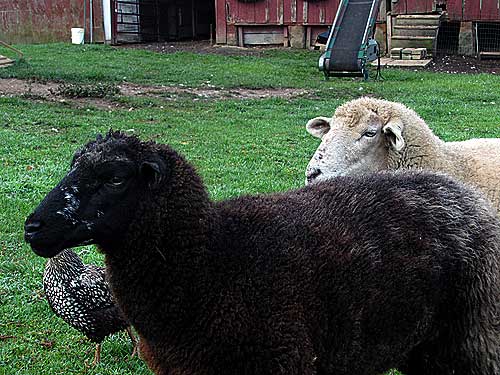
Since the incident, I’ve spent a lot of time considering my future in sheep. I’ve had sheep for several years now and know the ups and downs. At one point, lambs and all, we had a high of a dozen sheep at Stringtown Rising. We didn’t have enough pasture for that many (or hardly any) sheep. Sheep require a lot of pasture. Before moving to Sassafras Farm, I took the sheep flock down to one young ram and three ewes, and that is close to the max number I would want to keep here. I had thought of adding one more ewe, but that’s it. All lambs would be sold or butchered. Cute as they are, I like lamb meat, and since I wouldn’t be keeping lambs anyway, might as well keep one for me. Growing my own meat is part of creating a self-sustainable life.
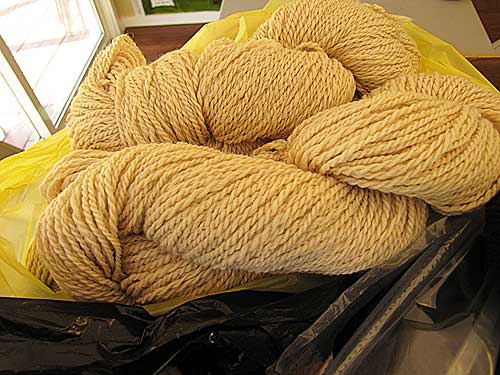
I’ve also always been interested in the wool. In the past, I’ve sold raw wool, which isn’t worth much. This year, for the first time, I sent wool to be processed. Skirting raw wool and turning it into roving and eventually spinning it into yarn is a very time-consuming process. I’ve tried my hand at it and know roughly how to do it. Spinning is a true skill, not something you can pick up and put down at random will and expect to be proficient. I made a decision some time back that it wasn’t something to which I could commit the time required. It is, however, quite expensive to have done. Whether it’s worth it or not is not something I’ve decided yet. I haven’t even been able to commit to selling the yarn I had processed.
Partly because in order to make my money back and even a small margin of profit, I’d have to sell this Cotswold/Jacob wool for $40/skein. And who is going to pay that?
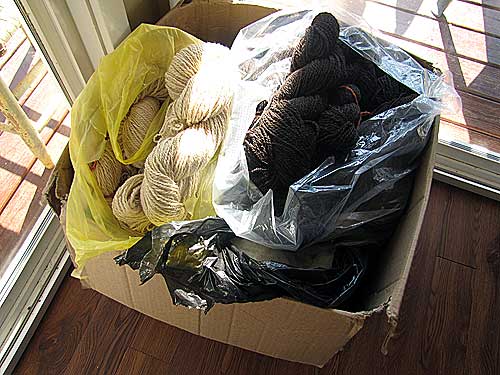
This dark wool is Crazy and Crazy Junior’s.
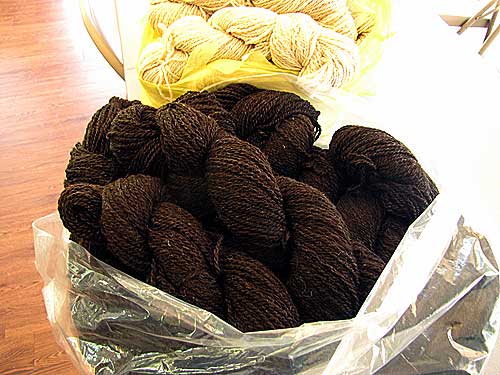
And partly because this is Minnie Belle’s wool and I’ll never have Minnie Belle’s wool again.
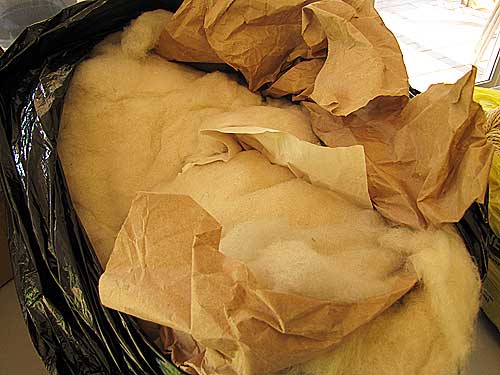
I had Annabelle’s wool made into batting.
My sheep were “fired” from the place where their wool was processed because there were a lot of burrs in their wool. I’m pretty sure the burrs came from Stringtown Rising, not here, so I don’t think that is a problem for the future. I can also put sheep coats on them, just to make sure. Or did I just want to forget about the wool?
I’ve thought over the different paths I could take with sheep in the future. I could just keep Crazy and Annabelle as long as they live, as pet sheep, and eventually close my journey with sheep. I’ve been keeping the two of them with the goats, and even Crazy has become more friendly. Lately she’s been greeting me with funny high sheep bounces when I come out in the morning, eager for me to open the gate to let them all out from the barn yard into the goat field for the day.
I don’t feel done with sheep. I enjoy them and would not like to think of my farm someday without them. So…. I could move ahead with sheep and source a new ram and a new ewe or two.
If I were to take the second option, what kind of sheep?
I looked into Katahdin. They are great meat sheep and shed their winter wool each spring. No shearing!
Or I could get serious about wool sheep and go for a true fiber breed. I’ve never really been attracted to those soft, soft luxury fibers of the popular wool sheep, though. I’m a texture person. I really love the Cotswold/Jacob yarn–crimpy, curly, not too soft. There’s just something substantial about it. It has hand-feel. In the same way that I gravitate to rustic soap from the hot process method, I prefer a rustic wool. But at the same time, I wasn’t really sure I wanted to get new Cotswold and Jacob sheep. I felt like I needed a fresh start with sheep–a true new chapter where there was something new to learn and experience, not a repeat of the past. I started researching breeds and pondering which were the right sheep for me. Often when simmering ideas, the universe will offer a ray of synchronicity.
A few days ago I met a local sheep farmer. His sheep are Tunis (also known as Tunisian Barbary). Tunis sheep are an ancient breed–they are the “fat-tailed sheep” of the Bible. They have cream-colored wool with cinnamon-red faces. (The lambs are born tan or red and the body wool later grows out creamy, leaving the red faces.) Not surprising for an ancient breed, they’re multi-purpose. They provide flavorful meat and wool suitable for spinning and crafting, and as a bonus, they’re heavy milkers. I hadn’t really been thinking about that last point, but the overall potential of Tunis sheep is really intriguing to me. The pure Tunis sheep are beautiful and interesting, and they would make fascinating crosses also with Annabelle and Crazy. You can see some photos of Tunis sheep here.
I was introduced to a local spinner who has worked with Tunis wool and so was able to give me her recommendation on the quality of the yarn. And I tucked her phone number away as a future source of less expensive and local processing.
This fall and winter, I’ll continue to run Annabelle and Crazy with the goats and Great Pyrs. The sheep field still lacks a winter shelter and a covered hay feeding station. I also need to figure out my livestock guardian setup for the sheep. A number of people commented about keeping a Great Pyr pair together as the strongest protection, and I agree. I want to keep Coco and Chloe together with the goats. But what about the sheep? Before turning a flock out into the sheep field, they need protection. Most likely, this is going to mean acquiring another working dog or even a pair, chosen specifically to work with sheep. I’ll be pondering this issue over the next several months. If you have any suggestions, let me know. (Note: I’m not interested in a llama. I also don’t believe donkeys are the answer, at least not my donkeys. A donkey pair, such as Jack and Poky, bonds to the pairing. A sole donkey could bond to a flock, but I don’t want to separate Jack and Poky or acquire another donkey. I feel strongly about dogs as the best guardians for my situation. What kind of dog or dogs is the question.)
I’ve reserved three pure Tunis sheep for the spring–one ram lamb and two ewe lambs. I’m starting over with sheep.


CATRAY44 says:
It would be neat to have something special made of Minnie Bell’s wool. I am so excited and happy that you are ‘starting over with sheep”!
On August 12, 2012 at 10:49 am
Mim says:
I had the same problems with processing cost v’s selling price for my alpaca yarn. I too have yarn from my llama that I can not make myself do anything with. (Llama had to be put down just shy of his 2nd birthday). Have you considered angora rabbits? …. Might try to locate someone locally to check out this out… but who knows, I might change my mind tomorrow or even as soon as I hit submit. :pawprint:
On August 12, 2012 at 10:55 am
Dawn says:
:hug: still sad about the sheep you lost – its nice you have some wool from her – maybe you could find someone to knit you a garment or create a wall hanging from the wool using some of the dark wool that you like as well. as a rememberance.
On August 12, 2012 at 10:58 am
patricialynn says:
I don’t know much about farming dog breeds….but I do know a lot about pit bulls, and am wondering if you have considered them? Most people just hear of their reputation and write them off, but in reality they are incredibly protective of the weak as well as deeply focused on defending their territory.
Our pittie is just over a year old, and has already shown protective instincts in caring for a baby bird that he found in the yard, as well as giving the squirrel he caught a full-body bath before releasing it (neither the squirrel or bird was harmed). And he showed his protectiveness by chasing an intruder from our yard when he was only nine months old – deep scary barks and bellows but never attempted to bite the person.
People used to get pit bulls as companions for their children, they were called nanny dogs for two hundred years before they became known as fighting dogs.
On August 12, 2012 at 10:59 am
yvonnem says:
My first thought on a dog was the Australian Shepherd.
On August 12, 2012 at 11:10 am
EMarie says:
Yay!!!! :sheep: I agree with yvonnem about the Australian Shepherds. And the Tunis breed is beautiful.
On August 12, 2012 at 11:31 am
Blessings says:
I agree with comment from yvonnem! Acquire a pair of Australian Shepherd’s ( herding dogs) you will find that they are exactly what Sassafras Farm needs as an addition to the Great Pyrs to protect You & Your animals..
~~Blessings~~
On August 12, 2012 at 11:34 am
Suzanne McMinn says:
I’ve had Australian Shepherds before. They ARE great dogs (and beautiful–I had two blue merles), but wow, they will try to herd anything and everything. That’s a good thing in the right situation, and maybe this is that right situation. I’ll have to think about it. My mindset re Australian Shepherds is slightly biased by my previous experience with them in a suburban situation, which is definitely the wrong situation for them, LOL, but left me with some MEMORIES of Australian Shepherds herding passing joggers, the UPS man, cars, and so on. I’m not sure how my chickens will feel about being herded….
On August 12, 2012 at 11:38 am
GA_in_GA says:
Glad you plan to continue with sheep!
On August 12, 2012 at 11:56 am
Stick Horse Cowgirls says:
Oh, don’t give up on sheep –or using the wool. Spinning is very labor intensive, but there are rug hookers like me who LOVE rustic wool, because it is just the kind of texture we like to use. Many hookers use fleece also–it makes beautiful skies–especially clouds! There are some cooperatives that have a subscription for yarn from their sheep–I’ll try to find the articles about it–the new issue of Victoria Classic Magazine “Inspirations” has a lovely article about Natasha Lehrer and her yarn hand dyed and spun at Esther’s Place–She won a USDA value-added grant and used the funds to establish a studio where women gather to work together. Kristin Nicholas has a website and be sure to click on the link to her blog–She is a knitting designer and she and her husband have a sheep ranch where they raise sheep for meat and wool. She also has wonderful workshops and retreats. You would like her blog and might glean some useful ideas!
On August 12, 2012 at 12:22 pm
HomesteadJen says:
I just shrieked with happy jealously a moment ago. (I am a daily reader, but rarely comment.) I have been wanting Tunis sheep for a few years now, but am not sure that my small property could support them. But if, when, we do get sheep, they will be Tunis. Now I can happy live through your Spring babies until then!
I am glad you are moving forward. That is what farming is about, IMHO.
On August 12, 2012 at 12:34 pm
SweetPug says:
Suzanne, if it were me, I’d first consider what I’m dealing with before I chose the dog. Here in NC it would be coyotes, local dogs, and the ocassional bobcat maybe. Aussies would be great detterants for those critters, but you are dealing with a mountain lion…maybe several that travel those mountains. Wolves could easily be in your area as well. A marauding bear would more likely be in the river fishing. They don’t usually hunt livestock unless some poor schmuck ended up tripping into their paws or something,AND they’ll be hibernating in winter. IMO, I think you need a BIG sheep dog, something that might intimidate a big cat or a wolf. You already have the best sheepdogs known to man in the Great Pyrs. If you just want a different dog, I’d go with something just as big, a St. Bernard, a Bernese Mtn dog, an Old English…or even a Belgian sheepdog. Adding two more huge dogs to your feed bill may be a little counter productive too. So you might consider using the Pyrs to protect the sheep, and using Border Collies or Aussies to protect the goats who are closer to your house and need less formidable protection. Just my thoughts.
Best of luck to you.
On August 12, 2012 at 12:36 pm
Suzanne McMinn says:
SweetPug, well, I hadn’t thought of that (not sure why other than I’ve always associated my Pyrs with my goats), but moving the Pyrs to the sheep field and getting the new protection for the goats is another option. I want the goats to be just as well protected as the sheep, though, of course.
On August 12, 2012 at 12:40 pm
Andrea.tat says:
Pits are great dogs, but not livestock guardians. Their coat leaves them very susceptible to the elements, and they tend to be very people oriented. Also, most pits aren’t that big. Great dogs though, when trained and socialized (like any dog), and there are always tons of them in shelters. They’re very hard to adopt out between their reputation and finding a place to live that allows them. (going on a shelter volunteer tangent… anyway) :shocked:
What about a Caucasian Shepherd Dog or a Karst Shepherd? I’ve always admired those breeds for their poise and really awesome fur. Though Great Pyrenees is probably the best bet, since you already know a breeder.
On August 12, 2012 at 12:39 pm
Goldenval says:
Yes, I sure do agree about keeping the Pyrs together, especially since you know there is at least ONE big predator in those woods. I think you should contact “the crazy sheep lady”, as she could surely help you. She even has contacts who raise different types of guardian dogs….not to mention all her sheep who have names. LOL She’s in Kentucky. Go here to read her blog. https://myfavoritesheep.blogspot.com/
For that back pasture I feel the bigger the guardian, the better. I’m in love with all those dogs, they are amazing!
On August 12, 2012 at 12:44 pm
joykenn says:
Had you considered a Komodor (those large white dogs that look like mops)? They are considered gentle with people but excellent guards for sheep and goats. Their dreadlocks protect them from bites and they don’t shed. I’m fascinated by them but don’t own any. Any readers have experience with these dogs?
On August 12, 2012 at 12:53 pm
Cheryl LeMay says:
You have some beautiful skeins of yarn from your sheep. I’m very glad to hear you’re continuing to raise them. How about a Komondor dog for protection? They look like sheep and are also large dogs. What did the DNR say about that mountain lion?
On August 12, 2012 at 12:57 pm
Suzanne McMinn says:
The DNR didn’t come out here. Their standard position is that there are no mountain lions in West Virginia. I have no way of verifying for certain what type of animal got the sheep, only suspicions based on the evidence.
On August 12, 2012 at 1:10 pm
oct4luv says:
“Often when simmering ideas, the universe will offer a ray of synchronicity.” I love that!!! I think you should crochet a beautiful afghan with those yarns; the different colors you have would look great together!
On August 12, 2012 at 2:25 pm
enjay says:
If it’s not too obtuse of a question, why not run all of the sheep in with the goats and let Chloe and Coco protect them as one larger flock? Most of the people that I knew that kept sheep and goats did just that.
On August 12, 2012 at 2:39 pm
Suzanne McMinn says:
enjay, I may do that (run the sheep and goats together) though it does have some pitfalls. Sheep need a lot of pasture, so I’d at least have to run them in another (connecting) field during the day then bring them back in with the goats and dogs at night. Also, sheep shouldn’t have copper while goats need copper. Not impossible to manage, just problematic. Getting another pair of working dogs is also problematic, so it’s something I’ll be pondering……
On August 12, 2012 at 2:52 pm
DancesInGarden says:
I have no recommendations for guardian dogs. But I have to say that those cinnamon coloured babies are the most adorable things! Add that to a puppy personality and you would have some pretty irresistable sheep!
On August 12, 2012 at 3:01 pm
SarahGrace says:
I hope you don’t stop with sheep. I like the idea of the Tunis sheep. We have considered Katahdin and if we do sheep, that’s probably the way we’ll go. However, you do like texture and I’m not sure you’d be content without having wool to use too. 🙂 As for dogs, I agree with one poster about not going with a Pit Bull. I think they are great farm dogs, but not to be left outside to the elements during the winter. Their coats aren’t made for that. I love our SweetiePie and I’ve used her to herd our chickens and goats. From my research, farmers used to like them because of their strong jaws; it’s what they’d use if they have to pit a dog against a bear. If you didn’t go with GP again, consider a Bermese Mt. Dog.
On August 12, 2012 at 3:56 pm
Vicki in So. CA says:
I don’t know that much about dogs, but after a little research I found that the Maremma is similar to but smaller than the Pyr, and is particularly good against wolves. Maybe a good choice for goat-guarding. The Komondor’s coat helps it blend in with the sheep, and it is downright fierce – even taking on bears. That coat looks like a bear to take care of though!
The Tunis are beautiful, and they seem like the perfect sheep, seeing that they are multiple use. Wool, meat, milk – definitely a ray of synchronicity. (Besides, I can’t wait to see pictures of those babies in the spring!)
On August 12, 2012 at 6:04 pm
farmershae says:
I love the Tunis sheep. They look pretty awesome. I’d keep looking around for LGD’s with traits that would combat a lion 🙂 You know what your are dealing with, so get the tools to deal with it!!
On August 12, 2012 at 6:29 pm
emit says:
Suzanne you need to talk to Debbie M Farmer she has Jacob and coopworth sheep. she lives near Glenville wv Also I think there is a wool show next month up at WVU. She show, sells wool. My wife bought two coopworth sheep in the spring She choose the coopworth because of the wool.
On August 12, 2012 at 7:27 pm
yvonnem says:
I understand what you said about the Australian Shepherd in a suburban location, but I think they may be ideal for your new farm. But, I only had a half breed. He was a wonderful dog, very friendly and very protective as well. He loved to play with children, as he had no sheep or goats to tend, and he never harmed the children, but was very watchful and guarded them.
On August 12, 2012 at 8:04 pm
denisestone says:
Suzanne,
I have had 3 Katahdin sheep (wethers) for about 4 years now. I love them! And it it wonderful that I don’t have to shear them. They are all pets who mow my 5 acres. Although you don’t shear them, sometimes you have to help them along by pulling gently on their coat. One of them, Shamrock, always has a mohawk every year behind his ear where it takes forever for him to lose his wool. LMAO.
On August 12, 2012 at 8:26 pm
Aedrielle says:
Suzanne,
Have you thought about hiring a local 4-H kid to spin your wool? I’m sure there’s one local to you that’s spinning wool for a 4-H project. Perhaps you could check out some local 4-H clubs and see if there’s such a thing? I was in 4-H as a kid and there were girls in my group who spun wool and had a booth at the fair and whatnot.
Just an idea! :purpleflower:
On August 12, 2012 at 9:23 pm
outbackfarm says:
Wht not just put the sheep up in the barn at night? I have to put my sheep back in their sheep yard at night around here most of the time. I did just hear coyotes all around tonight. My dogs are barking at them.
I also have goats. I do have my buck in with the 3 rams right now but have to take the buck out to feed him his food and the rams get theirs. Takes extra work but it’s ok.
I am happy for you about the Tunis sheep. They sure are pretty and would be a nice fit at your farm.
On August 12, 2012 at 11:00 pm
UlrikeDG says:
First, you seem to “suffer” from Can’t Get Just One Syndrome. I think it’s important to keep that in mind as you’re searching. If you go with something new, you’ll probably end up with at least two of them. (Not that there’s anything wrong with that.)
The suggestion I wanted to make was: Technology. They sell doggy doors that have RFID scanners. You put a chip on the dog’s collar, and the door will only unlock if it senses the chip. Maybe you could use something like that between the goat field and the sheep field, so that your LGDs could access both fields without letting the goats or sheep in/out. If you did that and got a 3rd Great Pyr, they might be able to cover the entire area without leaving any one dog isolated from the others.
From the reading I’ve done, Great Pyrs do seem like the best fit for your situation. Livestock Guardian Dogs (LGDs) are very different from herding dogs, and the other common LGD breeds tend to be less friendly to people, which would be an issue for your workshop attendees.
On August 12, 2012 at 11:13 pm
Suzanne McMinn says:
I’m leaning toward this option now–keep the sheep and goats all under the guardianship of Coco and Chloe. I really don’t want to get more dogs–I just want the sheep to be protected. It’s definitely problematic for several reasons, but might be the best plan anyway and worth figuring around the issues so that I don’t have to get more dogs. Thanks for all the feedback! It helps me think.
On August 13, 2012 at 6:17 am
kdubbs says:
Our neighbors, who have a large flock of Shetland sheep, have Anatolian Shepherds as their livestock guardian dogs.
On August 13, 2012 at 11:40 am
Linda Goble says:
Here in upstate New York the DEC. Says no mountain lions in our area but people have seen them and live stock have been killed. People say they did this secretly to help control the coyote problem we have here. One family I used to clean for took pictures of 3 that were in a barn. I don’t go for walks anymore by myself between mountain lion, bears and coyotes. I feel bad for you losing your sheep. They sure do make cute babies. Good luck in your decision.
On August 13, 2012 at 6:09 pm
summerwindfarm says:
One way you can run your sheep and goats together is to get a loose mineral that’s safe for the sheep and then bolus your goats with copper boluses. The copper boluses are more effective than copper in their loose minerals and no risk to the sheep. Most vets don’t know much about goats or sheep but you can find info on copper bolusing online. Many dairy goat owners are going that route because of it’s effectiveness at preventing copper deficiencies.
On August 14, 2012 at 8:51 am
summerwindfarm says:
Btw I raise katahdin sheep and love them! They eat much more like goats than wool sheep do!
On August 14, 2012 at 8:53 am
danpat1 says:
I first was introduced to the Great Pyrennes dog breed on an excellent outdoor/farming series by a (I want to say) Montana tv station. The gentleman being interviewed owned a farm with about 30 sheep. He said when the dogs are born they are raised with the sheep — as they would be in Italy where they were bred. They are part of the herd. He believed three dogs were enough to guard the 30 sheep. These dogs are not meant to attack a predator, but, they will bark loud enough to keep one at bay until he gets there. He said they are no match for wolves . . that was what he was guarding from. Their size is the deterrent. Sounds like you lost you sheep to a smart cat. We have a Border Collie on one acre. He is very smart and quick to learn, but he is very much like the Australian Shepherds. He gets very protective, but is not big.
On August 22, 2012 at 4:48 pm
usagikitti says:
Suzanne,
I am sorry about the incident with the sheep – made me cry really, that Minnie Bell was adorable as a baby. It must have hurt your heart so much when she was taken.
As for a breed of dog that is suited for herding, I put in my vote for Border Collie – they are natural herders very much like the Austrailian but will not nip at the sheep. They have this awesome ability to “stare” that is almost unnerving when you are caught in it. But yes, they also have the proclivity to “herd” anything but are fiercely protective and loyal to their herd. Also they are natural herders for sheep – they are the Irish/Scottish version of your Austrailian – in fact they are cousins!
I say Border Collie also because they are also attached to their human (Namely, YOU) and they are active but yet good with people. They can be hyper when they are not working, but they are very good and very hard workers – and very intelligent. Of course I say this all from experience because we have a Border Collie – Zoe who is 10. She only started showing her age (she is not a worker dog) at age 9 but I also think that the loss of our Beagle, Sam, saddened her.
That is my recommendation any way – Honestly can’t go wrong with Border Collies (that and they look like little cows when they are puppies – ADORABLE!)
On August 22, 2012 at 4:54 pm
mplwy says:
Keeping the sheep and goats together with both Pyrs is an option. If you separate them, you will probably want at least two dogs per herd/flock. I would definitely suggest staying within Livestock Guardian breeds instead of going with herding breeds or those traditionally used for carting, etc. If there is a big cat around, while Pyrs can handle it, Anatolian Shepherds have been used in Africa for guarding against Cheetahs. Traditionally in Europe and elsewhere, packs of LGDs were used to sufficiently guard. Of course the number of LGDs would depend on the number and types of predators, the number of livestock and the size of the area, not to mention the cost of feeding, etc. Also, while Chloe and any new dogs were still “pups”, keeping everyone close to the house at night would help. By the way, I’m very happy to see how Chloe is turning out, it looks like she’s getting very big, though I did think she would keep those markings better. 🙂 I can’t wait to see her once she’s mature in mind and body.
On August 23, 2012 at 2:54 pm