
I have a new obsession. Baby cheese. Not cheese for babies! I mean smaller cheeses. One pound cheeses. Cute little baby cheeses.
Technically, baby cheese refers to cheeses made with a shorter aging time, meant to be eaten “young” and relatively mild. They’re often sold in smaller packages as well. Longer aging gives a sharper flavor to most cheeses. You can age a so-called baby cheese just as long as their larger counterparts, of course, when you’re making your own at home.
The advantages to “baby” cheesemaking are myriad! Making small, one pound cheeses means you only use a gallon of milk. You can use a smaller pot.
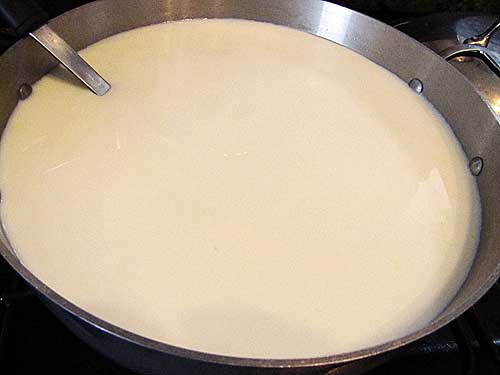
The weight of the milk and the weight of the pot is cut in half. If hefting around big pots and curds from two gallon recipes has been putting you off cheesemaking, baby cheeses are for you! A one pound cheese can be eaten more quickly, more freshly, as well. Sometimes opening a two pound cheese is just too much. I can’t always use that much cheese. (You can, by the way, cut a waxed, aged two pound cheese in half or thirds and re-wax the portions you don’t intend to use right away to maintain freshness. However, re-waxing is extra work. Make baby cheese instead!)
Big cheese, little cheese.
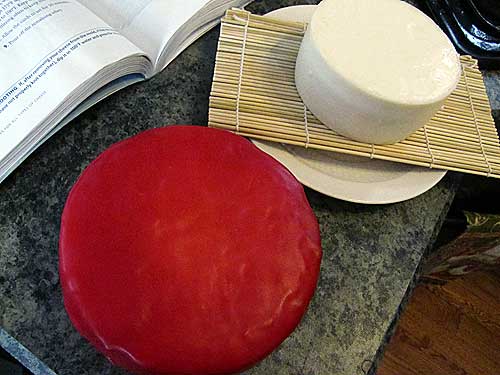
My big cheese pot compared to my cheese pot I use for one gallon (one pound) recipes.
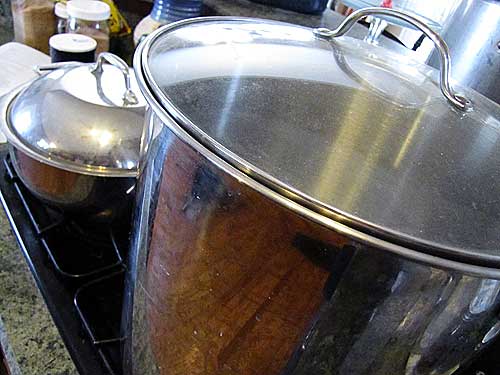
I don’t like hefting that big, heavy pot around. The pot I use for making soft cheeses (which often use one gallon of milk) is a 5 1/2 quart pot. The pot I use for hard cheese recipes calling for two gallons of milk is a 22 quart pot. Obviously, that’s a larger pot than I need. I really need something like a 12 quart pot for two gallon recipes, and I’m on the lookout for one, but even so, the pot and the curds for two gallon recipes still make for some heavy lifting.
Another benefit of making one pound recipes is that I feel more free to experiment. I’m putting less milk on the line when I try something different. Why didn’t I think of this before?!
Cut everything else in half in the recipe along with the milk. Starter packets come tuned to two gallon recipes. Just open the packet onto a little plate. Divide it in half with a butter knife.
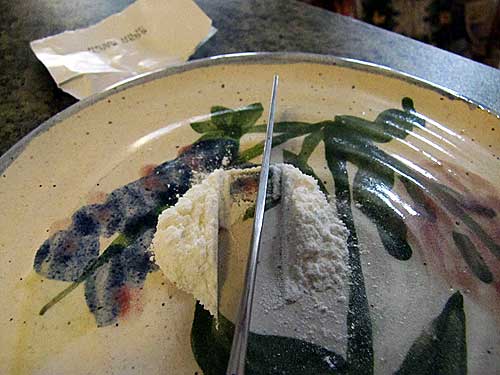
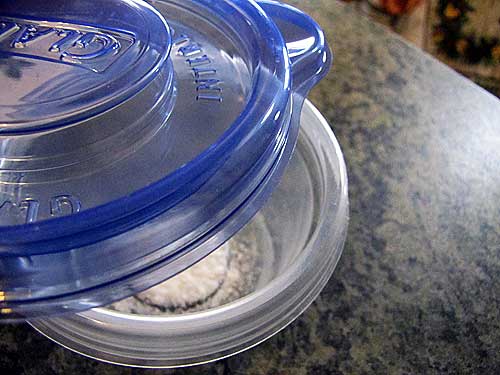
Use half in the cheese you’re making right away and save the other half for later. I use little plastic containers. Just dump the remainder in there and return it to the freezer for storage. (If you think you’ll forget what’s in there, you can stick the labeled packet in there with it to remind you.)
Press as directed, but you may need shorter pressing times. Experiment and explore–after you try a halved recipe once, you’ll know how long it takes to press in the smaller size. (Make a note in your recipe book for the next time.)
My two pound mold (food grade polypropylene) and my four pound (stainless steel) mold.
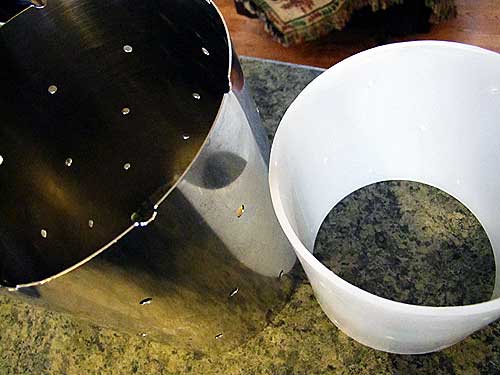
I can’t ever fit my two pound cheeses into my two pound mold so I use the four pound mold. It finally occurred to me that there might be a reason for that. I weighed one of my finished cheeses recently made with two gallons of milk, which should have yielded a two pound cheese. The cheese weighed three pounds. That BP!! She makes some mighty fine curds. So I’ve actually been making three pound cheeses. No wonder I think the pot of curds is heavy. So actually my one pound baby cheeses are a pound and a half. I use the two pound mold for them.
One gallon cheese recipe going into the press in the two pound mold.
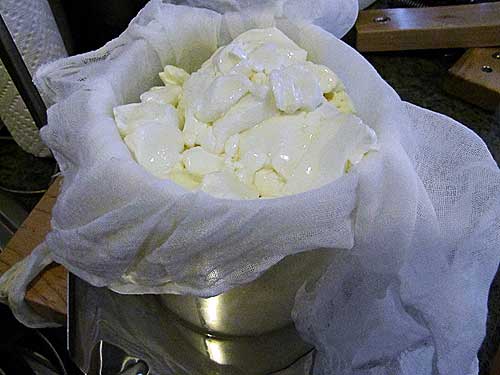
As the cheese presses down, it gets too low so I have to put in some risers on top of the follower so that the pusher can apply pressure.
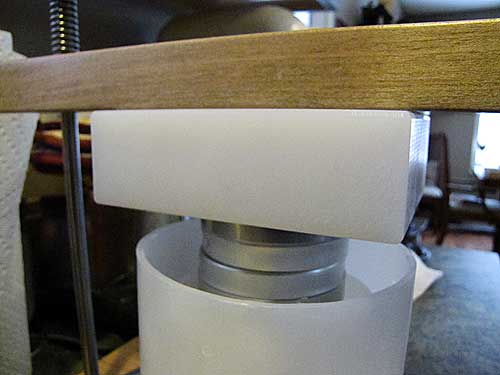
What I use are several of these little canisters of book darts, stacked till it’s high enough to meet the pusher.
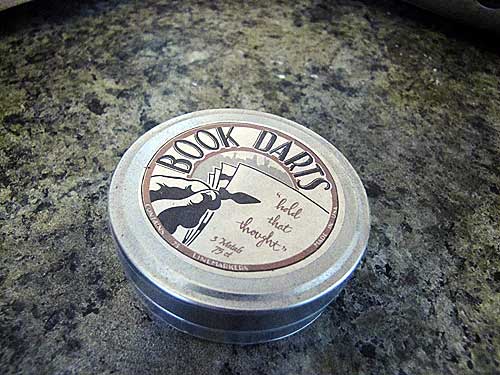
“Risers” can be anything you can find around the house that’ll do the trick.
Now that I’ve conquered my dry curd problem and am coming up with smooth, shiny perfectly-knit surfaces to my cheeses, I’m getting really picky. I don’t like the cheesecloth imprint, especially since I want to try some natural rind cheeses, and no matter how neatly I try to fold the cloth, it makes a wrinkle print. So now when the cheese is nearly finished pressing, I take it out, remove the cheesecloth, and put the cheese back in the mold without the cheesecloth. I put it right down on the drip tray with the follower on top, for an hour or so of final pressing. Only trouble with that is that, without any cheesecloth to contain them, the cheese presses out a little bit into the drain holes on the sides of the mold. It makes my cheese look like it has warts.
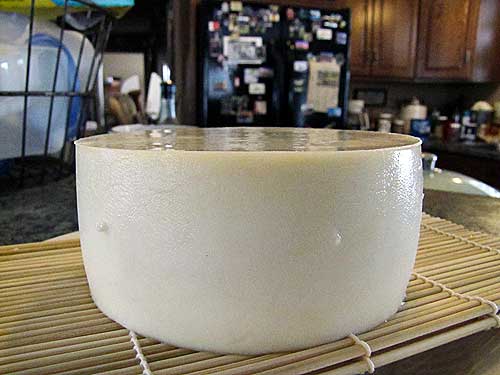
I can’t have warty cheese!!! So now (in the final stage of pressing) I line the mold with parchment paper–no warts.
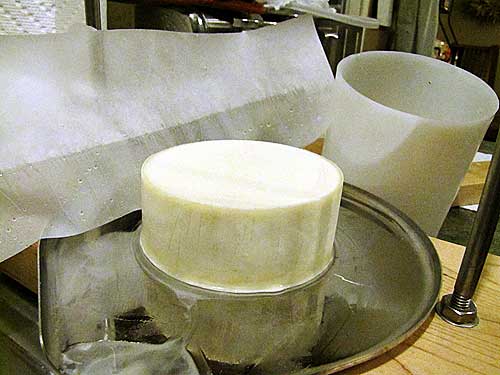
Just look at that cute little baby cheese! (This one’s a baby gouda.)
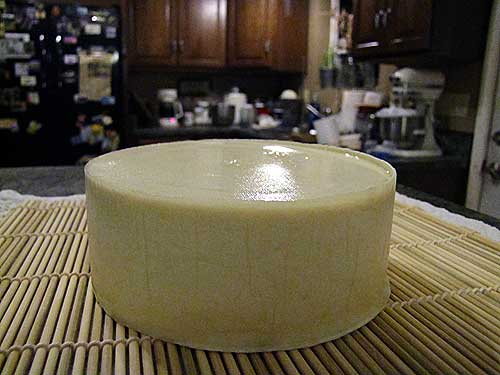
I think I’ll name it Felicity Jane. It’s a girl!!
Our Little Bundle of Joy! Born: January 8, 2011
Weight: 1 1/2 pounds
Length: Five inches
Hair: Off-white
Eyes: Holey
Parents: Suzanne McMinn and Beulah Petunia
of
Stringtown Rising Farm


Tricia Gilliland says:
Looks yummy! The starter packet that you mentioned – is that Rennet (spelling)?
I have a goat herd (mostly Boer that we sell for meat), and one of the goats is a Saanen. When she kids, her bag is HUGE and I end up milking her out of fear of mastitis. I have considered making cheese or yogurt, but to date have been afraid of the unknown. Thanks for taking the time to make this blog and remove some of the mystery/
On January 9, 2011 at 8:21 am
Suzanne McMinn says:
No, though rennet is used also in hard cheese. I use liquid rennet. The starter I’m referring to is such as mesophilic or thermophilic and other starters for special cheeses. It comes in dry powder form in packets.
On January 9, 2011 at 8:33 am
Rose H says:
Your cheeses look fabulous to me – warts an’ all! 😆 One day I’ll pluck up the courage and have a go at making some soft cheese.
Just a thought – please don’t shoot me Suzanne, are you going to have a go at some ewe’s milk cheese when there’s milk available, or is the ‘milking a sheep’ just too much? (I’m sure you’ve already mentioned goats cheese).
On January 9, 2011 at 8:22 am
Suzanne McMinn says:
Rose, I don’t think the sheep would be real cooperative, LOL.
On January 9, 2011 at 8:33 am
holstein woman says:
You’re up on me some cheeses, I haven’t made aged cheeses yet. I am having too much fun with fresh cheese. Are you flavoring any of your cheeses with herbs or vegie pieces? I have used chopped mini bells in Mozzarella, and BO liked it best besides your Lactic and Velveeta which I have made twice.
I think your cheese are great looking and I have learned from you. Thank you.
Package forthcoming!
On January 9, 2011 at 8:29 am
windspiritwhimsies says:
What a darling baby gouda! Congratulations on your little bundle of joy! :eating:
On January 9, 2011 at 8:46 am
KentuckyFarmGirl says:
Adorable little cheese!!!
On January 9, 2011 at 9:08 am
Kacey Kay Pickens says:
Those look great! Love the baby cheese size. Baby swiss is one of my favs.
On January 9, 2011 at 9:20 am
Urbanite says:
Thanks for the suggestion on how to get cheeses without the cheesecloth marks. I, too, can’t avoid those marks no matter how carefully I fold the cloth. I’m planning to make cheese next weekend and will try your new method.
On January 9, 2011 at 9:43 am
CindyP says:
LOVE the baby cheese! Looking beautiful! It would make it helpful doing it in smaller portions, especially for beginners and all the different varieties to be tried 🙂
On January 9, 2011 at 9:51 am
wvhomecanner says:
Awwww what a beautiful baby. Can I keep her for a couple of days ??
😆
dede
On January 9, 2011 at 9:57 am
Suzanne McMinn says:
Dede, I’m afraid you might “harm” her in some way, LOL.
On January 9, 2011 at 10:01 am
Pam says:
Ah! i made my first cheddar on 2 January and I had the same thought about the size of stuff–the pot, the cheese, all that. I live alone. I delighted to see you successfully do this. Yes! I’ll do that next time. Thanks Suzanne. You are a delight.
Pam
On January 9, 2011 at 10:03 am
Pam says:
Oops–ought to have shared the link on the cheddar–referenced you a couple of times in it, with links. https://pam-wiley.posterous.com/
On January 9, 2011 at 10:05 am
Victoria says:
Congratulations on your new baby, she’s adorable.
On January 9, 2011 at 10:16 am
texwisgirl says:
Love the birth announcement! Glad Beulah Petunia got her due! 🙂
On January 9, 2011 at 10:21 am
Deb says:
I actually usually cut each wheel of cheese into 4 pieces before waxing, that way I only have to open a small portion of it each time we want some. I am however really NEW to hard cheese (I’m talking so new, that we haven’t tried any aged yet LOL), so maybe I shouldn’t be doing that for some reason…have no idea if it will make the flavor different or not.
On January 9, 2011 at 10:28 am
Suzanne McMinn says:
Deb, I was told by the people at New England Cheesemaking that is better to age a cheese first then cut and rewax portions rather than cut it right away and wax separately. Or just make smaller cheeses to begin with, such as one pound recipes. If you cut pieces too small and wax them first off, it does interfere with flavor in the aging.
On January 9, 2011 at 10:35 am
Whaledancer says:
Your gouda is beautiful, just perfect! Are you going to save some gouda for aging? Aged gouda is one of my favorite cheeses. Yum.
On January 9, 2011 at 10:30 am
Suzanne McMinn says:
Whaledancer, yes, I’ll be aging it.
On January 9, 2011 at 10:36 am
lilac wolf says:
Your blog makes me laugh…I also have added cheesemaking to my to do list when we get our patch of land. 😀
On January 9, 2011 at 10:54 am
Shelly Messier says:
That still looks like a lot of work but wish I could taste some. Can you give birth to some blue cheese please, with crackers… :hungry: :hungry: :hungry: :hungry: :hungry:
On January 9, 2011 at 11:34 am
bonita says:
Congrata on your new arrival, may you have many more!
On January 9, 2011 at 12:17 pm
ticka1 says:
You are into these babies aren’t you? Baby cheeses, baby goats and baby calf(glory Be)!!!
Have fun!
On January 9, 2011 at 1:13 pm
Grammie Earth says:
MMMM Your lil bundle looks wonderful! Have you tried Brie or Camembert yet?
On January 9, 2011 at 2:33 pm
Barbara W says:
Looks like fun.
On January 9, 2011 at 3:35 pm
glenda says:
Now you’re talking, Suzanne!
A smaller cheese. I would have to milk more to get two gallons plus enough for us…..One gallon I could handle easily. I may try cheeses now. I think my new maslin pan might be ideal for cheese making. It is very wide at the top so cutting the curd would be easier.
On January 9, 2011 at 5:07 pm
ChicagoGal4Ever says:
I’m so jealous! I love gouda! I can just imagine how good it would be on fresh baked bread with spaghetti sauce sprinkled with basil! Yummy!!!
On January 9, 2011 at 7:28 pm
Deaonna says:
When are you going to have any cheese making classes?
On January 9, 2011 at 7:42 pm
Shar says:
CONGRATS to you and BP for the making of Felicity Jane, baby gouda extrodinare!
On January 9, 2011 at 10:20 pm
andrea pierce says:
Your cheeses are really looking fantastic. You’ve made great progress in making them look just perfect! Although I still like your rustic, slightly lumpy cheeses. They had character.
On January 10, 2011 at 2:11 pm
Ramona says:
I like those!
On January 11, 2011 at 1:29 pm
Window On The Prairie says:
I’ve never made cheese, but the more I read here, the more tempted I am to give it a try. Thanks for all the helpful how-to’s!
Suzanne
Window On The Prairie
On January 13, 2011 at 4:36 pm
Pat says:
I see you have made a “baby cheese” but I am wondering if you have ever attempted to make a Laughing cow type “babybel” cheese yet. I have kids who love eat these little very expensive cheese balls and would love to make them myself but not sure how to mold them and how to make the opening “tab.” One of my next projects is going to be “sting cheese” for the kids lunch boxes.
On April 29, 2011 at 4:21 am