
My farm is covered in sassafras trees. Sassafras trees are native to the United, from the mid-west to the east coast, and from Florida to Ontario. They’re usually found in open woods and along fences or in fields. Sassafras is an aromatic tree whose roots and root bark can be used to fragrance soap and make tea and root beer. It’s called the root beer tree (and when you smell the roots, they smell like root beer)–but sassafras was banned for use in root beer in 1960 because it contains safrole, which was found to cause cancer and liver damage in laboratory animals. Sassafras tea was eventually returned to the market, but root beer had already moved on without sassafras–except for home brewers.
Root beer on the market today is commonly flavored by artificial sassafras, vanilla, wintergreen, cherry tree bark, licorice root, sarsaparilla root, nutmeg, flowers, juniper, herbs, berries, hops, ginger, anise, molasses, cinnamon, cloves, and honey.
The Spanish believed sassafras to be a cure-all beverage, and a lot of people in the country still drink it every day and swear by it.
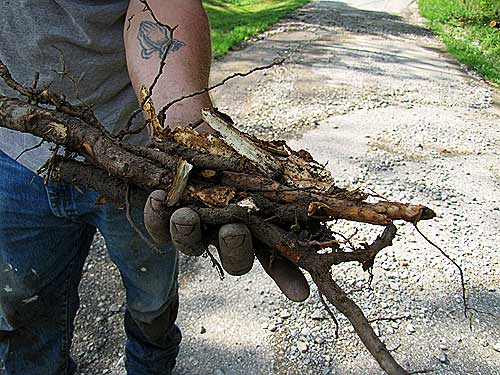
I asked Adam to dig me some sassafras roots. This is Sassafras Farm, after all. It’s time for me to be one with my sassafras.
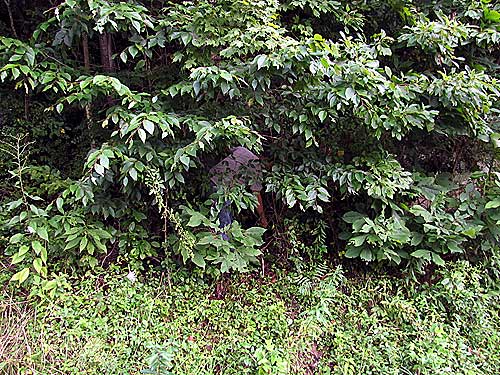
When I moved here, I was told by the previous owners that there was sassafras on the hill, along the upper pasture. Turns out, there’s a lot more sassafras than that. It’s across the road–along the road and up the hill. It’s along the fence to the side of the studio. Yes, it’s up the hill along the upper pasture, but it’s also across the ravine and going up to the ridge. It is, in fact, everywhere. This is, indeed, a sassafras farm. Big trees, small trees, and everything in between. I have so much sassafras here, I could go into business harvesting and selling roots. (Uhhhhh….. There’s a time issue there.)
In any case, I felt super silly for buying a sassafras tree to place in the yard by the gate. Which is, by the way, the only tree I planted this year that died. That’ll learn me. I’m pretty sure I will not replace it.
Adam told me that one of my sassafras trees along the fence by the studio is one of the biggest sassafras trees he’s seen in this county. I set him to digging sassafras roots and teaching me to make the tea.
The best time to dig sassafras roots is actually in the winter, when the sap is down in the roots. This time of year, the sap is running up the tree. Spring, summer, and fall, you’ll need more roots to make tea than you will in the winter when the sap in the roots will be stronger. It’s fine to dig them any time if you have a hankering for tea or root beer, but if you want to harvest seriously to save the roots for later use over the year, wait till winter. Just be sure you know which trees are sassafras trees. (Though if you dig up the wrong trees, you’ll know by the aroma test.) Saplings are easiest to dig (and plentiful), but you can cut small side roots from larger trees if you’re careful and not kill the tree.
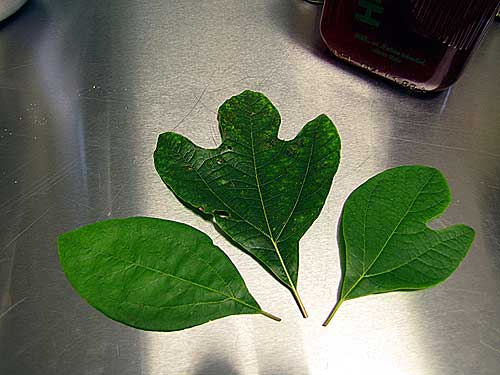
Sassafras trees have three types of leaves on the same tree.
If you want to dig them in the winter (when there are no leaves to help you), you can mark the trees. (Paint, tags, ribbons, etc.)
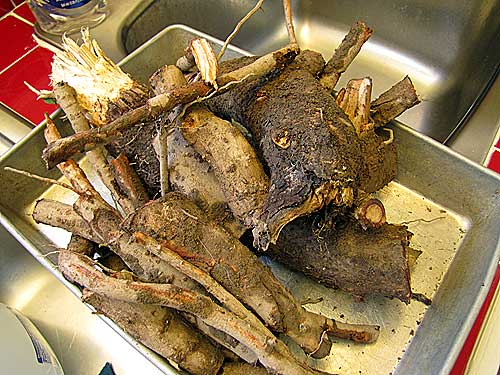
Scrub the roots with a brush to clean them.
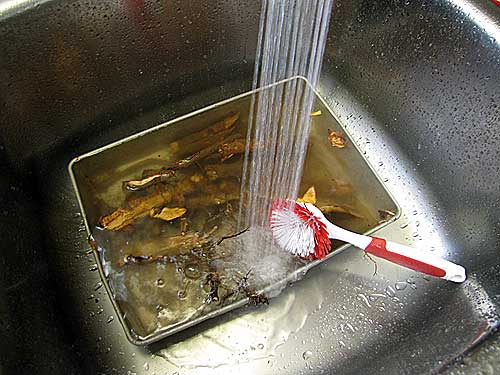
Clean sassafras roots:
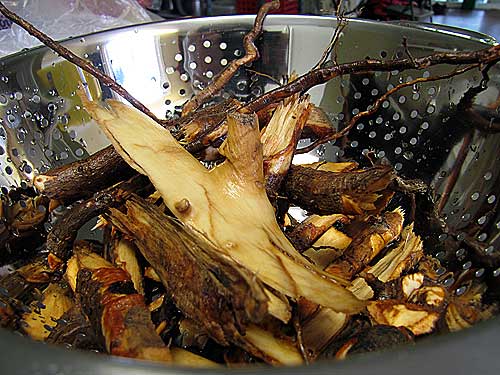
Cut the roots up into smaller pieces to release more aroma and flavor. For this amount of roots, about enough to cover the bottom of a big pot, add a gallon of water. Bring to a boil then simmer until the tea darkens. You can make the tea as strong or weak as you like, so this part is up to individual preference.
I simmered mine until I had a nice rich red tea, which I filtered using the same filters I use to handle milk.
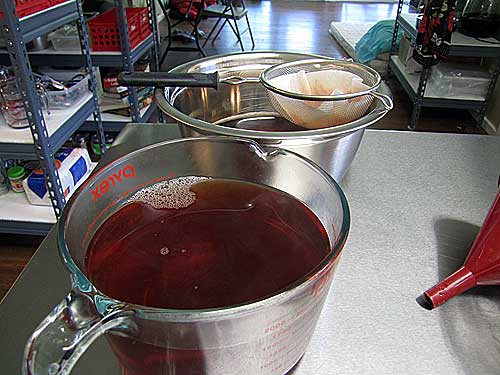
Sweeten to taste.
I ended up with 3/4 gallon of sassafras tea.
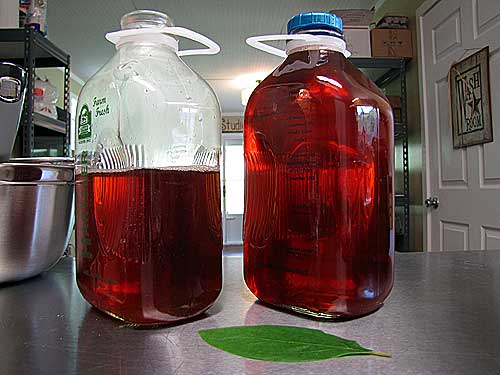
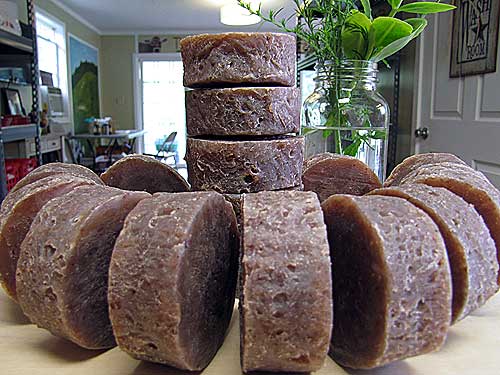
I used some of the tea to make sassafras tea soap with honey and pine resin. (I have my soap up on my Farm Store page here.)
This is the natural color of the soap made with sassafras tea. The reddish tea turned into purplish soap.
The rest of the tea was for drinking. But I didn’t stop there. Oh, no, I wanted to make homemade root beer next!
So I made Adam go get me some more sassafras roots.
Remember our common root beer ingredients above? Artificial sassafras, vanilla, wintergreen, cherry tree bark, licorice root, sarsaparilla root, nutmeg, flowers, juniper, herbs, berries, hops, ginger, anise, molasses, cinnamon, cloves, and honey.
I have real sassafras, neener-neener.
Root beer manufacturers make root beer by their own individual recipes, based on the above ingredients, and so should we. I’ll tell you how I made mine, but you can make your own, your way. Traditional root beer is fermented, which is where the “beer” comes from. Home brewing was a staple in many households in the past, and home brewers still make fermented root beer today, but there is also a simple non-fermented method that has been crafted for years in country households.
Note that most of the following measurements aren’t that specific. It’s really not necessary–if your concoction isn’t strong enough, simmer it longer to concentrate the flavor. Like the tea, root beer is very individual. Taste test until you like it, and make it as strong or weak as you like. What follows are general directions.
Start with enough sassafras roots to generously cover the bottom of a large pot. I had more sassafras than I had the first time, so I started with a gallon and a half of water to cover the roots. Based on the ingredients above, I added about a half dozen cinnamon sticks along with a half cup of a mixture of anise, whole allspice, and whole cloves. I simmered the mixture until it concentrated to a dark tea. (You could also make a spiced sassafras tea and stop right here!) When the tea looked right (dark enough), I filtered it then placed it back in the pot. I added about a pint of molasses, brought the mixture back to a boil, and simmered for 15 minutes. Then I experimented with sugar until it felt “right”–adding four cups of sugar, simmering to dissolve. The sugar is to taste, so use this as a guideline. Combine some of your syrup with club soda and taste test till you like it. Simmering with this much sugar makes the spiced sassafras-molasses tea into a syrup. This is far too sweet to drink as a tea now–but you’re not going to!
Chill the syrup then transfer to bottles. I ended up with almost a gallon of “root beer” syrup.
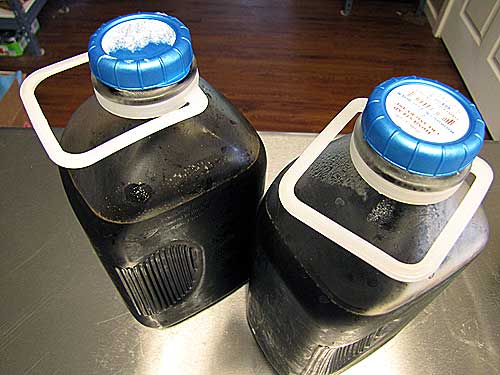
Keep refrigerated. To serve, pour equal parts root beer syrup and club soda over ice. Now you have root beer! Note: Root beer from the store is strong and very sweet. If you like it that way, you may want to adjust the 1:1 ratio. Taste test small amounts until you decide what you like. You can also throw in a splash of rum.

I’m so rockin’ the Sassafras Farm name now!


bonita says:
Yeah! home made root beer. Yipee! Have you got one of those home CO2 dispensers so you can control the amount of fizz? I’m imagining a black cow (root beer and vanilla ice cream) made with your own ice cream. mmmmmmmm
A yummy reward for your hard work.
On July 30, 2012 at 3:38 am
Rose H says:
I had heard of sassafras many times in the UK but really had no idea what it was until you moved to the farm Suzanne! I’d love to taste the tea, it looks lovely. Thank you for sharing the processes with us, because even though I’ll.probably never know exactly what it tastes like it’s a fascinating process 🙂
On July 30, 2012 at 4:58 am
twiggityNDgoats says:
I was able to sample that root beer this past weekend at the workshop and it was yummy. It was very nice to sit on the porch overlooking the barnyard and sip sassafras tea and eat grandmother bread sandwiches.
On July 30, 2012 at 5:32 am
easygoinglady says:
So many things to do with sassafras. I am going to scour my woods and look to see if i have a sassafras tree out there. Might be and just didnt know!
I recently saw a beautiful cane made from sassafras wood, strong and lightweight. I got a picture of it and he explained to me how he got it to grow in that shape.
On July 30, 2012 at 7:19 am
rurification says:
This is awesome! We have loads of little sassafras trees and just this year realized that the bigger ones produce berries. Who knew? I’ve always loved the smell of fresh cut sassafras wood. I’m going to get some root today to make some of that tea.
On July 30, 2012 at 8:30 am
Cheryl LeMay says:
I live at the northernmost range where sassafras grows, so it is uncommon here. I planted one a couple of years ago and it’s doing well. After seeing your post I want to plant a lot more. I wouldn’t worry about the safrole issue. I heard they tested it using a dosage many many times what you’d ever ingest in a lifetime. I’d love to find a sassafras wood spoon to use in cooking.
On July 30, 2012 at 8:49 am
Alexandra says:
Suzanne, please be careful about your sassafras infusions. I remember reading that long term drinking of sassafras tea can cause all sorts of nasty things to your organism. I love home made teas and infusions, but please find out as much as you can about it, before you give it the ok.
On July 30, 2012 at 9:16 am
Country Girl @ Heart says:
And when will the syrup be available in the farm store? I can’t wait to try it!
On July 30, 2012 at 9:53 am
shirley T says:
WOW! This farm is going to really pay off for you. Resin and honey salve, Sassafras soap and tea and root beer syrup. I do believe Adam was God sent~more ways than ONE.
On July 30, 2012 at 11:33 am
mds9 says:
I remember my grandmother using a press when she made root beer. I don’t know why.
Michael
On July 30, 2012 at 1:00 pm
Joell says:
:happyflower:
I love sassafrass tea! For many years I would buy sassafrass chips packaged in little packages and brew tea, when you add a few drops of cream, the tea turns a beautiful purpley color. It was touted that sassafrass tea was a spring tonic to cleanse the body from the winter, what ever it does, it tastes so good.
On July 30, 2012 at 2:41 pm
denisestone says:
I know I mentioned this on another post, but you should really consider making sassfras hard candy as well.
On July 30, 2012 at 3:45 pm
whaledancer says:
Here’s a link to the complete information section on sassafras at drugs.com: https://www.drugs.com/npp/sassafras.html
I’m not saying that you shouldn’t make sassafras tea, just that this way you can make an informed choice. It is, however illegal to sell sassafras tea, or food containing sassafras, or sassafras root (because of the FDA ban). Wouldn’t want you to get in trouble.
On July 30, 2012 at 8:32 pm
Suzanne McMinn says:
I’m not planning to sell any sassafras food items. Sassafras tea is sold legally, by the way–manufactured safrole free–which is not how you make it homemade, but it’s like anything else, you’re not going to consume the quantities involved in tests on lab rats. I was just joking about selling the sassafras roots!
On July 30, 2012 at 10:15 pm
holstein woman says:
When I was a small girl in Virginia my Grandmother used to grind sassafras bark to the finest she could then she would use it for flavoring for frosting on molasses cookies. Oh I can just smell them and taste those light 1/4″ thick cookies with sassafras frosting on top. We only got one or 2 for lunch every day at school, but oh what a treat.
On July 30, 2012 at 11:03 pm
Andrea.tat says:
Probably less dangerous than many of the drugs the fda does approve. Lol. All things in moderation and dependency on none. (Tell that to the hunk of dark chocolate sitting in my fridge that I go crazy without)
On July 30, 2012 at 11:54 pm
bonita says:
Joell, now that you mention it, I remember those bags of sassafras chips. The tea was special and yummy. Too bad I never added the cream.
On July 31, 2012 at 1:34 am
joykenn says:
Yes, sassafras tea was supposed to be a spring tonic–“good for the blood”. My mother mentioned taking it every spring. When I was a kid someone heard her story of drinking it each spring and we were gifted with a batch. She didn’t like it–drank it every spring and didn’t want to drink it any more and she never would drink root beer. I drank it and thought it was great but then I always loved root beer.
My husband’s family in Chicago tells the story that they used to brew their own root beer. Sometimes they got the proportions a little wrong and one year as they were sitting on the stoop there was this loud band from the cellar. Seems the root beer they had bottled exploded. For some reason my husband LOVED that story as a kid and always wondered what had happened to their homemade root beer recipe.
I wonder if sassafras has any folk remedy uses as a “spring tonic”.
On July 31, 2012 at 11:09 pm
kathy says:
Has anyone suggested making file? Pronounced “fee lay” down here in the south. It is dried sassafras leaves, ground into a fine powder used to thicken gumbo or just sprinkled on top for a bit of flavor. It is a Cajun stable. I remember our family friend (sooo south La.) harvesting it in the fall, hanging it in the hall closet to dry, then right before he would grind it, he’d put it in the bright sunshine for a day or two. He said he only used “female” leaves. He stored it in an old dark green bottle with a cork stopper in the frig. Something to ponder.
“
On August 4, 2012 at 5:19 am
louis491 says:
I know you said you were joking about selling sassafras root – but I’m trying my luck. I cannot get it in my next of the woods – Alberta, Canada. I brew beer and wine and looking to brew Root Beer. Any chance we could work something sending some in the mail?
On July 24, 2013 at 4:27 pm
Peculiar Cat Mama says:
We have a whole mountain full of sassafras trees at our cabin in northern Arkansas. My husband is a bourbon man – he puts a stick of sassafras root into his bourbon (Beam) and Mt. Dew (yes, that’s the way he likes it). It tastes smoother with the sassafras root soaking in it. Cheers!
On July 30, 2013 at 2:02 pm
JimTamMid says:
:sheepjump: Have you ever tried making essential oil out of the Sassafras roots? I want to make sassafras soap and I want it scented I have made it once by using tea that I made but I wanted the scent to stay. Thank you for your time
On February 2, 2017 at 11:49 am