
Add some crunch, sparkle, and pop to your baking with natural sugars! Most recipes call for white sugar, brown sugar, or confectioner’s (powdered) sugar, but there’s more to the world of sugar than refined. There are the natural sugars, or what are sometimes called “raw” sugars. The three most popular natural sugars are turbinado, Demerera, and Muscovado (also known as Barbados).
Both Demerara and turbinado sugars are made straight from the raw cane juice, thickened by evaporation. The resulting syrup is spun into coarse, pretty crystals rich in the molasses that is removed from white and brown sugars in the refining process. (While molasses is removed permanently from white sugar, it’s actually removed then put back in brown sugar. Why do they take it out then put it back in? For uniformity of the product. Of course, all that processing takes away from the flavor as the molasses is stripped.)
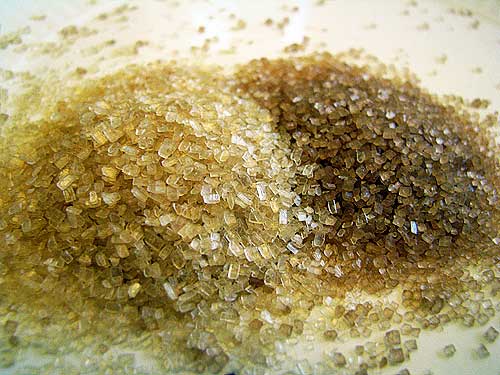
Left, turbinado sugar. Right, Demerara sugar.
Turbinado sugar is the lightest of the natural sugars. It has a nice hint of molasses flavor, but not too much. Demerara is much bolder. Both turbinado (named for the process of spinning the cane syrup in a turbine) and Demerara (so-called for the location in Guyana where it originated) make great sweeteners in coffee or tea. Either can be used as cup-per-cup replacements for white sugar in recipes and will add extra flavor and crunch to cookies and cakes. Demerara can also be used to substitute in recipes calling for light brown sugar. Consider turbinado a strong “white” sugar and Demerara a strong light brown sugar when it comes to recipe flavoring.
Muscovado is the strongest of the natural sugars and is made by a different process. It’s steamed dry rather than spun. It’s quite dark and can be used cup-per-cup in place of dark brown sugar (consider Muscovado a very strong dark brown sugar when it comes to recipes), but it can be difficult to find because it’s not nearly as popular (due to its strength, which some people find too overpowering) as turbinado or Demerara. I don’t have any Muscovado sugar right now, though I’m on the lookout for some. It’s rough living in the boonies sometimes. Those of you with access to more shopping venues can probably locate it easily. (Luckily, I have no problem finding turbinado or Demerara, even in the country.)
These “speciality” sugars are more expensive than regular ol’ refined sugars, so I most often use them frugally as a finishing touch (though I will be posting some special recipes where I actually do use them in place of regular sugar–I save them for special when it comes to cup-per-cup substitution). Natural sugars are great for rolling cookies or adding sparkle to the tops of cakes or pies, and occasionally, when I’m in the mood, in my coffee. Because of the coarse granules, they’re also gorgeous sprinkled over fruit, and, of course, they’re just plain fun, another fabulous, cheap thrill in the kitchen.
And if you’re not having fun when you’re baking, you’re doing it wrong!
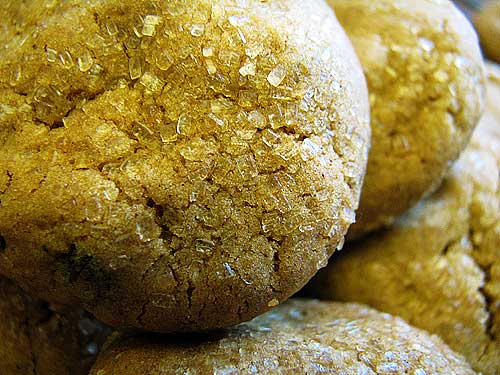
Soft Ginger-Raisin Cookies rolled in turbinado sugar. How fabulous is that? (Want the recipe?)


NorseCookie says:
Ummm… YES!!!
🙂
Sounds and looks fabulous – I’ll be running out to get cane sugar as soon as the recipe is on my desktop!
On January 11, 2009 at 1:24 am
Minna says:
If I make those cookies I’m also going to need some candies that contain different kind of sugar, xylitol. That particular sugar is actually good for your teeth.
On January 11, 2009 at 2:10 am
jan-n'-tn says:
Yes,Yes,Yes,OH PLEEEEEASE, yes!
On January 11, 2009 at 2:28 am
Stephanie says:
I’ve never actually cooked with the “fancy” sugars. I’m excited to see your recipes. I love to top baked goods with it though…
On January 11, 2009 at 4:20 am
robin says:
I have been using Jamaican sugar….wonderful stuff. Looks a lot like your photo of turbinado…real good flavor and not processed like our sugars…and readily available in the little Caribbean food stores all over our area. Made from sugar cane and of course that leads into Jamaican rum!
On January 11, 2009 at 5:24 am
CindyP says:
hmmmmm, really. I guess I have never seen these, will have to check my local grocery stores (down home grocery stores here, no big chains) then go from there! They look interesting! Thanks, Suzanne! :woof:
On January 11, 2009 at 5:47 am
Diane says:
You have to ask if we want the recipe??? Are you crazy girl. Please please yes I want it. lol. I love a good sweet reason to try something new.
On January 11, 2009 at 7:06 am
Kathryn says:
I’d love the recipe. I was wondering if you know of a tried and true recipe for making the lovely vanilla sugar. The crystals are large, and just tinged with vanilla. Super on cookies, and so expensive you practically have to sell a kidney!
On January 11, 2009 at 7:08 am
Clarice Shriver says:
Please, can we have the recipe?
On January 11, 2009 at 7:55 am
Pam says:
I had no clue there were other sugars out there. How sweet! LOL
On January 11, 2009 at 7:57 am
Linda says:
Have always wondered about those sugars when I saw them in the store. Thanks for the info. I’ll have to try them.
On January 11, 2009 at 8:33 am
Pete says:
Thanks for the info. Have been wondering how to reproduce the sugar effect on top of a double crust peach pie forever. This should work!
So how do these compare to the cones of sugar you can buy in Mexico and South America? And in stores in the US which cater to those pallets?
On January 11, 2009 at 8:40 am
Becky says:
Thanks for posting this, Suzanne. I have often wondered about those coarse sugars and where to get them.
On January 11, 2009 at 8:58 am
Jane says:
Recipe Recipe Recipe please! Those look good enough to eat as a meal!
I’ve loved turbinado sugar for years, and lucky for me so does my boss, so its all we keep in our staff kitchen =)
I live similarly rural as you do, but I’m in the desert in SW NM. I need to look for demerara sugar now. Thanks for the great info!
On January 11, 2009 at 9:05 am
Sharon says:
I definitely want the recipe. They look amazing! :catmeow:
On January 11, 2009 at 9:33 am
Suzanne says:
I have one of those fancy cakes pans shaped like a sand castle. Turbinado sugar makes the best “sand”.
– Suzanne, the Farmer’s Wife
On January 11, 2009 at 9:49 am
Matthew Burns says:
I love iced green tea with turbinado sugar. It’s a stample in our home. Yes, the raw sugars are much better and have a completely different taste than regualr refined sugar.
Matthew
On January 11, 2009 at 10:28 am
Melissa's Cozy Teacup says:
I LOVE demarera sugar cubes in my tea. White sugar tastes weird to me now in my tea. It tastes, ‘flat’. I think the molasses flavor adds dimension to the tea. I know, I’m weird that way. lol
On January 11, 2009 at 10:29 am
Annie says:
The photo of the cookies rolled in sugar just about put me over the edge, running screaming into the night. I have this weird thing. I can’t stand the feel of sugar. In my mouth, on my hands, or even the sound of it, like fingernails on a chalkboard. I hate regular granulated sugar sprinkled on top of cookies or pies, it makes my mouth go into a weird shape. I can’t imagine what turbinado sugar would do to me. I know, I’m a freak.
On January 11, 2009 at 10:46 am
CATRAY44 says:
I would love to have that recipe, please (with sugar on top!)
On January 11, 2009 at 10:54 am
Pat in Tennesse says:
Oh yes please post the ginger raisin cookie recipe……….they sound yummy. Pat
On January 11, 2009 at 12:22 pm
Lola-Dawn says:
I’ve been using turbinado sugar for EVERYTHING – baking, canning, jams, etc – for several years now. I don’t like store bought white bread, and I don’t like store bought white sugar! However, occasionally someone has a cup of tea at my house, and looks very suspiciously at the non-white stuff in my sugar bowl!
On January 11, 2009 at 1:00 pm
catslady says:
I’ve come across it in some of those small packets that they give you with coffee but I’m not sure where. I don’t use sugar in my coffee so I usually add it to my sugar bowl. I like how it looks on top of your cookies!
On January 11, 2009 at 1:03 pm
kd (small caps) says:
Yes, of course we want the recipe! Haven’t found anything but “delicious” in your postings yet!
On January 11, 2009 at 1:40 pm
Estella says:
Please!
On January 11, 2009 at 2:31 pm
Susan says:
Did you really have to ask? :no: It looks to me like Clover, Honey, and Nutmeg just want the Soft Ginger-Raisin Cookies. 😆
On January 11, 2009 at 2:46 pm
Barbara Watkins says:
Thank you so much for the tutorial on raw sugar. I loved it, but I’m confused…(this happens a lot). With the picture of the two raw sugars it says “Right, turbinado sugar. Left, Demerara sugar.” But your description says that the turbinado sugar is the lightest and the demerara is the darker in flavoring. I’m just wondering if the picture is labeled correctly because visually the sugar on the right is darker and the one on the left is lighter colored. Is this all clear as mud? LOL! Thanks again for some great info.
Smiles, Barbara
On January 11, 2009 at 3:07 pm
Toni Anderson says:
They look delicious!
On January 11, 2009 at 3:17 pm
Alison says:
Silly lady. 🙂 Of course we want the recipe. It looks wonderful. :hug:
On January 11, 2009 at 3:19 pm
Brandy says:
My Mom used to buy turbinado sugar when I was young, which was actually odd back then. Thanks for reminding me and for the differences in the sugars themselves.
On January 11, 2009 at 3:40 pm
lola falana says:
You can buy muscovado sugar online. Cheftools.com seems to have the least expensive, according to my quick Google search. :chicken:
On January 11, 2009 at 4:24 pm
Suzanne McMinn says:
Barbara! Thank you! Yes, I’m a moron. Turbinado on the LEFT. Fixed it now. THANK YOU!
On January 11, 2009 at 5:57 pm
Kris says:
Turbinado atop fresh, homemade blueberry muffins – Oh my. Oh my. Oh my. Oh my. ‘nuf said
On January 12, 2009 at 2:33 pm
Becky DeSantis says:
Why is turbinado sugar more expensive than demerara? In my local grocery store (western PA) the demerara is about half the price of turbinado. Thanks for your site.
On March 12, 2010 at 11:46 am
Sheila says:
Definately (Please) 😀
On November 8, 2010 at 11:24 pm
Ulla Laage says:
OOOH, I would LOVE to bake these soft cookies !!! Love ginger and the combination of ginger and the softnes sounds absolutely delicious. PLEASE save my day :shimmy:
On January 3, 2011 at 2:28 am
Sheila says:
I saw the turbinado sugar at lowes the other day , it was 6.50 a box , but I think as soon as my hubby gets paid again I may get some , I’d like to try it in some of the things I like to bake 🙂
On January 8, 2011 at 11:51 pm
amylentz says:
I just found this post while doing a search on demerara sugar for canning. Thought I’d let you know that I have just started using demerara this canning season and I think that my jams taste better than ever.
I found that our local Winco will order a 50lb. bag for me at a cheaper rate, so this is an affordable option. Also, I use the Pomona pectin low sugar recipe, which only uses 3/4 c. sugar for 4 cups of fruit. I suppose that you could add more sugar if you wanted a sweeter jam, but we prefer to taste the fruit instead of sweetness in our jams. Anyway, thought I’d pass this along for people who don’t want to use processed sugar in their canning.
On July 21, 2011 at 12:56 pm