

This was Beulah Petunia when I first met her.
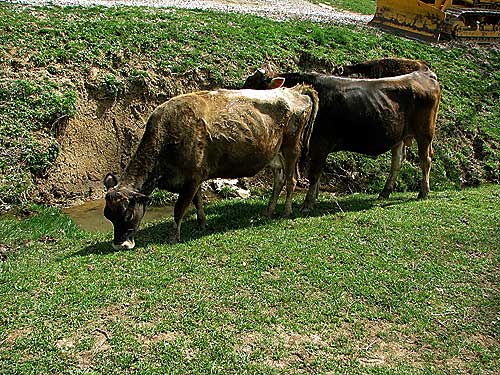
She was living with a few other cows in Ohio.
If you missed it, you can read all about it in A Gift in Ohio.
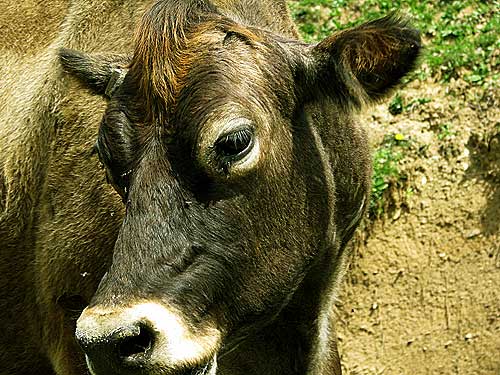
Here she is contemplating whether she really wants to move to West Virginia with a nincompoop.

There was an adorable baby there. They said she was a Jersey, but I think she looked like a Brown Swiss. But what do I know.
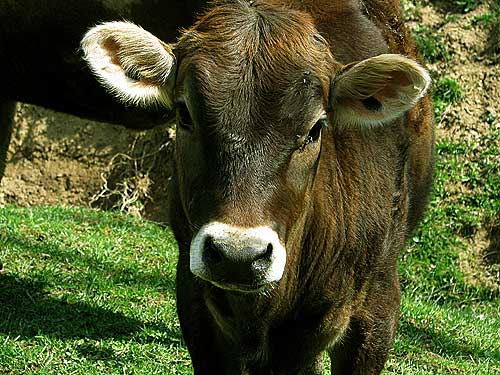
She was cute, either way. They wanted a bunch o’ money for her, and BP was a bargain and a twofer. (They baby’s mother was another cow that they had, not BP.)
This was how they were milking BP, by the way.
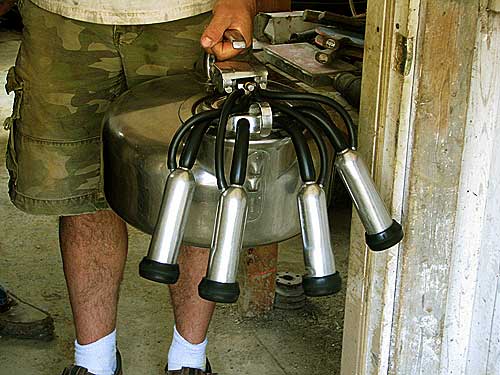
Portable milking machine. They demonstrated milking BP. They had her milked out in two minutes flat. It was amazing. Anyone out there ever used one of these things? I wonder about them now and then, though they are very expensive (so not really an option right this minute). I wonder if I would miss hand milking if I had one of those things. I like milking. Eventually, I’ll have to go to twice a day milking if Glory Bee stops nursing at some point, though, and that’s time-consuming, so sometimes I ponder the future possibility of a milking machine to help out.
The reason I posted these pictures, though, really, was to show off this big boy for those of you who may have missed this post and have wondered about Glory Bee’s daddy:
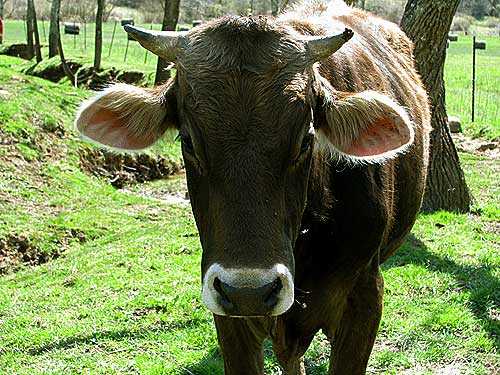
Say hello to Papa! This Brown Swiss bull was BP’s boyfriend in Ohio. They had been living together for several months when we took her. He was very friendly and seemed quite tame. I’m not big on going around bulls, but we were all walking around there with him and he was very gentlemanly. Looking back on these pictures makes me wonder where Glory Bee got her coloring because she doesn’t look much like mommy OR daddy to me.
Wish I’d gotten a better photo of him. The light was all wrong the way I took them. He was a gorgeous animal.


texwisgirl says:
Awww. Cute boy. Maybe GB will (eventually) inherit his mild manners.
And yes, I’ve used one of those milking machines. Back in much younger days in Wisconsin, I dated a farmer and often helped with milking and chores. Got to milk in a barn with the cool automatic milk lines too that take the milk directly from the udder cups through the pneumatic lines to the bulk tank. But those kinds of dairy farmers with large herds need all the help they can get! As I’d imagine you’d like as well!!!
On November 19, 2010 at 11:59 am
prayingpup says:
BP is such a beauty and, believe me, she looks healthier and happier now that she lives with you. Dad’s a pretty handsome boy and, hopefully, little miss GB will turn out like Mommy and Daddy. She’s just going through her “terrible two’s” . . . :cowsleep:
On November 19, 2010 at 12:21 pm
Heidi says:
Maybe the lighter coloring was lurking around in BP’s Jersey genes and happened to punch through like in a Mendel’s peas experiment. From what I hear, you should just keep inbreeding parents and grandparents and children until they pop out with golden trophies in their mouths.
On November 19, 2010 at 12:38 pm
Eliza says:
That portable milking machine looks like it could be in a sci-fi TV show. I wonder if the cows have a preference. I love the photo caption of BP contemplating her new “nincompoop.” 🙂
On November 19, 2010 at 12:39 pm
Dawn Carrica says:
GB looks like a typical Jersey to me. I dream of milking machines but when I find myself on my stool, snuggled up to the belly of my beast I smile. I love milking even in the snow and cold. It’s a part of the day that I can’t rush even though I often try. It’s a still moment between me and my cow. She tells me about her day and I tell her about mine. I thank her for the milk and she smirks with cockiness and slobbers on my shirt sleeve and wanders back to her pasture.
On November 19, 2010 at 12:59 pm
Ramona says:
I wonder if calves change colors like colts?
On November 19, 2010 at 1:40 pm
Darlene in Ks says:
First thing that struck me when I saw the pictues is how much healther and happy BP looks now. She is thriving under your care and I really think she would rather have your hands on her than that machine. She can feel the love! Just a side note, and I don’t know how BP is, but in the wintertime when I milked…if I didn’t rub my hands together to warm them up before touching her..I got a good little nudge on my arm. Then I felt guilty, lol!
On November 19, 2010 at 1:42 pm
Helen says:
To me, BP looks like a Brown Swiss, while GB looks like a Jersey. And I agree with Darlene…BP looks so much healthier since you have her…she has filled out and her hair, or fur, or whatever its called on a cow, is sleek and shiney, compared to being rough and dull in her “before” picture. So long story short, good job with your cows, Suzanne :woof: . Even though you are a novice cow owner, the love and care you have for them shows very clearly :yes: .
On November 19, 2010 at 1:56 pm
Jersey Lady says:
I can milk by hand but I love my milker. MinnieCow gives 7-8 gallons a day. We milk twice a day. My DeLaval milker pail stands on the floor and takes 8 minutes. I sit by her side while she milks out. She eats and I pat or brush her or we just “talk”.
One advantage to the milker is that, if need be, someone else can milk MinnieCow, although that rarely happens. Our milk hose is clear so we can see when no more milk is coming. I feel each quarter to be sure everything feels OK.
Clean up is quick and easy. We have a tiny hot water heater in the barn so that helps not having to take the pail and hose over to the house, but we did not always have it, and we got along fine that way too.
A milker is consistant,never in a hurry or a bad mood,and protects the milk from dirt or spilling. In our 30 yrs of milking we have not seen teat or udder damage from the milker. Our oldest cow lived to be 18 years old and still had a nice udder.The cows never seemed to be bothered by the sound or feel of the milker.
We got our first milker when we had more than one cow to milk and we were both teaching school.It did speed things up.Now we just have MinnieCow but I still use my milker.I think as I get older, hand milking might get harder so I am glad that I have this option.
On November 19, 2010 at 2:43 pm
Jersey Lady says:
Oh, by the way, regarding BP and GB’s Jersey coloration. The Jersey breed has more variation than the other dairy breeds. Some are so pale that they are creamy colored and others range down through the fawns and browns to almost black. Some have spots of white and can have black or white switches. The variety does not come from cross breeding, it is just how they are, and adds to the charm of the breed.
On November 19, 2010 at 2:54 pm
Jersey Lady says:
Ramona-Yes, Jersey calves grow into their adult coloration. Also, the cows’ summer and winter coats may look quite different-usually darker in winter and lighter in summer.
On November 19, 2010 at 3:13 pm
Connie of Ohio says:
You can find surge milking machines on ebay.
On November 19, 2010 at 3:15 pm
lola23 says:
They are all very skinny, which may account for their overly subdued nature.
On November 19, 2010 at 3:33 pm
Grammie Earth says:
Papa is handsome. I agree the BP looks much better now. She’s feeling your love.
Go Raiders!! Have fun!
On November 19, 2010 at 3:41 pm
Emma Filbrun says:
Calves change color as they grow up. Also, a milker is a pain to clean. If you only have one cow it’s more trouble than it’s worth, if you ask me. Anyway, if you hand milk you get more time to enjoy being outside!
On November 19, 2010 at 4:31 pm
Barbee' says:
I guess that decision is totally subjective, and not really an option right now, unless Santa brings you one. Kinda big to go into your stocking, though. (It might fit into an extra large glove :devil:) If it makes no difference to the cow one way or the other, it’s up to what you need for your fulfillment. She was used to a machine before. Does seems pretty impersonal, but might be better for you — unless you are getting younger. 🙂 That calf pictured above looks a lot like GB to me.
On November 19, 2010 at 6:08 pm
Jan says:
I had to start using a milking machne this year for my goats. I really hated to do it as I enjoy hand milking, but blew out both my wrists. None of the girls (even my skittish one)mind the machine at all. Mine is a smaller version of the one in the picture and there are no long lines to clean, just the belly pan & the inflations that you see there. You handwash the inflations & the belly pan goes into the dishwasher, easy as can be.
On November 19, 2010 at 7:07 pm
Whaledancer says:
Wow, the improvement in BP’s condition is obvious when you look at these older photos. She looks much healthier and contented these days. No wonder she likes you; she must feel like she’s landed in a cow spa.
On November 19, 2010 at 7:51 pm
Bev says:
You have done a very good job with your cow. she was very thin and the condition of her coat indicated she was not well taken care of. Same thing about the bull. BP is lucky she found a forever home. Good job. :sun: .
On November 19, 2010 at 7:53 pm
Connie W says:
Milkman … er, um, hayman’s baby perhaps?
On November 23, 2010 at 10:17 pm
Jeanne says:
I think if you looked for a used bucket milker the cost would be much more reasonable. You would probably need to get new inflations (the black inserts) and hoses. Maybe you could even run a want ad as just among family I know of 5 of these sitting around covered in dust. I even have one in the basement in hopes that some day I’ll get a chance to use it again. The expensive part is the pump to run it. The type of machine Jersey Lady described is much easier on the udder as it is lightweight, and on you for carrying. Those bucket milkers are hefty and cumbersome especially when full.
The heifer above looks to be way more Brown Swiss than Jersey. The broad head, light hair in the ears, the larger body, white band around the muzzle, she looks a lot like the bull. Baby Brown Swiss are born almost white in color most of the time, they often have a darker undercoat that sheds out into a tone of their adult color. Brown Swiss can range from the dark chocolate above to a grey, almost white color, with some having the coppery cast to their coat. They are not suppose to have any white markings other than the muzzle band, ear hair or small spots on the underside of the belly. They are never to have any white hair in their tail or white spots, if they do their papers are stamped OCS (off color spot). It is an undesirable trait. My theory is that back in the day there was some Jersey blood introduced in the Brown Swiss breed to either dairy them up in looks or to kick up milk production. That’s where the undesirable white coloring slipped in. Because other than the white spots and the distinctive faun colored calves the Jersey and Brown Swiss breeds share a lot of coloring types. Brown Swiss were originally a dual purpose breed, one you could milk or butcher for meat. The breed was then bred into a dairy type. They are still a large boned, sturdy breed of cattle. Oh and opinionated too.
On November 27, 2010 at 7:49 am
Lisabeth Olson says:
Suzanne, I have one of those silly things and use it twice a day on my two cows. If you decide to get one buy it used. Mine is older than the hills (1910) or so. Really, in the winter I keep a heat lamp on it and if the claw gets frozen up I bring it into the house every night when it is freezing. My hands won’t let me milk by hand anymore. I actually only started milking a year and a half ago and did it alot like you do only I had 3 calves on my holstein and then milked her some so I didn’t have to buy it. Then I made the mistake of my life NOT REALLY. I sold a gallon of the stuff and then I sold so much I had to have ANOTHER COW then I had to ANOTHER COW. Now I am back to two Holsteins and I love both of them. They actually like to be milked better with the machine because they both have longer udder hair and they are just like us. They don’t like their hair pulled. Whoops it is time to go play with the girls, milking and putting the chickens up for the night. GOD BLESS YOU
On November 27, 2010 at 9:03 pm
Lisabeth Olson says:
Contiinued: Anyway back to the milking machine. There are several brands. When you buy one if you get the kind that sits by the cow instead of the strap that you have to put over the cows back you will be better off (for you). The cow won’t care, however you will when you have to lift that thing off full of milk plus the weight of the bucket and claw. Milk weights 8.4 pounds per gallon plus the weight of the bucket which isn’t light and then the claw which will add another pound or so. Am I trying to scare you, NO/YES. No because the machine is the best thing I have for quick work of that chore, (which I don’t mind for the extra little bit of money and the milk in the house). Yes because that thing will probably be too heavy for you, and your son or daughter won’t be around to help you lift it off BP. So, if you get a machine buy the one that has the hose and claw only that you connect to BP and the bucket sits to the side so you don’t have to lift it off of her. Also, take into consideration that you will have to have electricity and HOT or very warm water in the barn or carry it with you so you can do a daily cleaning of the machine (twice a day actually).
It isn’t hard, I take about 2 gallons of water to the barn in the bucket I am bringing the milk back to the house in. When I clean the machine I have 2 pans (large enough to dip the claw cow attachments into without kinking the lines). One is for the bleach water (about 6 tbls or caps from the bleach bottle) dip the claw into the cold water first for just long enough to get the water to slosh because that way the claw will be clear and not get over cloudy from the constant hot water. Then dip into the hot water for a few sloshes. That cleans the milk out of it. Now put it back into the cold water for a few sloshes. That is done, take the lid off the milk bucket and pour out the dirty water, clean the lid by sloshing it into the hot then the cold water pans. Pour our the hot water you are done with it. Pour the leftover cold water into the bucket and slosh it around VERY GOOD. Pour out the water and you are finished. Except for the deep cleaning you have to do on the claw, bucket, and hoses once a week. That is another lesson. You see the milking with a machine is WONDERFUL, but do you have time for the constant cleaning and if you decide you do TAKE CARE OF YOU. You still need electricity and I know that in WV it freezes just like Oregon. The heat lamp is a great savings when you don’t find a frozen machine to have to worry with. One more thing, you will have to change the oil in the Vacuum Pump every 3 months. It isn’t hard, however the oil is $14.00 per gallon from Mobil, It is called Mobil Vacuum Pump Oil. If you buy it from a milking supply house or repair shop or Grainger it is upwards to 14.00 per quart. I bought the first I bought from DeLaval and it was about $64.00 for 2 1/2 gallons. Also the parts for the machine, just the spare parts for the claw (the kit from DeLaval) was over $125.00. I hope this will help you decide what you want to do.
On November 28, 2010 at 12:19 am