

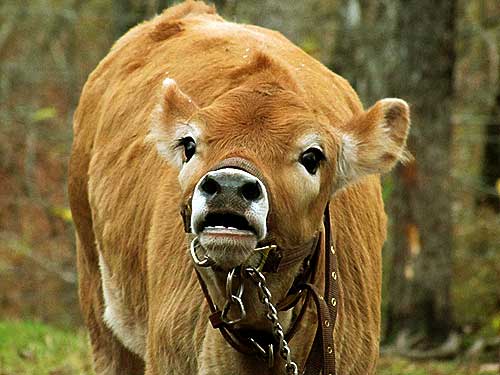
I have no idea what I’m doing.
Here are the problems:
1) She’s wild. I can’t control her.
2) She’s bumping BP’s udder so hard, she’s hurting her.
If it weren’t for #2, I’d be tempted to just put her back with BP, let her be wild another month or two (I mean, she’s wild already, what’s another month or two), then catch her and go through what I’m going through now (albeit with an even larger calf). As it is, BP’s sore is healing (there’s a big scab on it now), and if I put Glory Bee back with her, BP is going to end up with a bloody udder and maybe mastitis. Is this normal for a two-month-old calf to be that hard on its mother? Is Glory Bee bigger and stronger because she’s half Brown Swiss? I understand that beef calves are often left with their mothers for six months, but protecting a beef cow’s udder isn’t on the same level of critical as protecting a dairy cow’s udder.
I didn’t really want to start milking BP twice a day already, nor did I want to take Glory Bee away from her this early, but I’m afraid to put Glory Bee back with her. I can’t stop Glory Bee from hitting her udder so hard.
So that takes me back to what to do with Glory Bee. Thank you so much for all the comments with advice! Sometimes it’s confusing because the suggestions are wide-ranging and sometimes opposing, but I need to hear it all. I’ve tried to look at what seems to be the most common advice combined with what I’m capable of doing in our current set-up. I can’t do a whole lot about changing our set-up at the moment, and I also can’t take back the mistake of not getting Glory Bee to take a bottle or drink from a bucket earlier. I can’t seem to get her to take milk from me now. One suggestion was to mix it with calf starter to make a sort of mash, and I’m going to try that today. She does love the calf starter and eats it eagerly. She also eats hay, and will drink water from a bucket.
Today, we got her tied out to a tree again, differently so that hopefully she can’t break away from the rope. She’s tied shorter, and tied high. Though she did have enough rope to walk around the tree so she’s kinda tied low now even though she was tied high. (Sigh. This is a work in progress.) She’s right out in front of the house so I can check on her frequently.
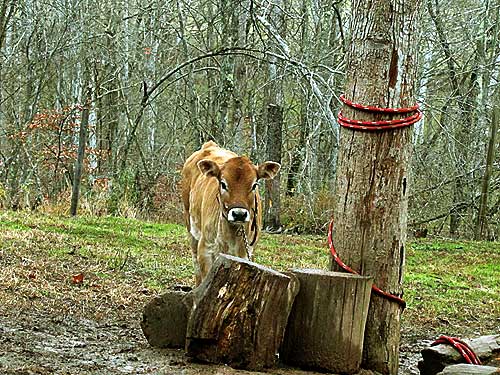
She’s not real happy.
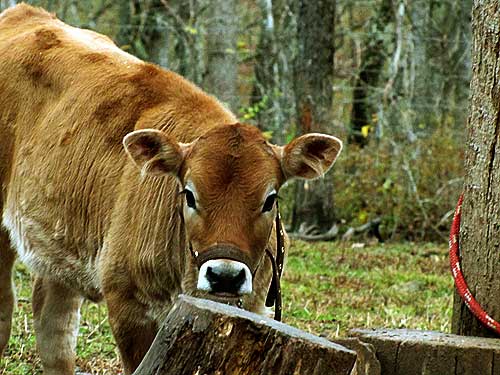
I’m going to bring her food and water, and sit with her, then take it away. Rinse and repeat throughout the day so that she sees me as her food source.
More suggestions? Have I mentioned I don’t know what I’m doing?
Goal: I want a docile milk cow who can be walked when needed and who will come to me rather than run away.
I’m trying to get the darling 4-H’er, Amanda, to come over this weekend or sometime early next week to give me some tips on how she works with her calves. (Amanda? AMANDA!)


Jeannie says:
Just tell Amanda you need your hair braided. 🙂
On November 17, 2010 at 8:22 am
SandyCWV says:
The cow’s milk in a bottle was FabHub’s idea last night, but since she is butting BP, she will very likely butt that right out of your hand too, if you could get her to take it. Milk mixed in with the starter seems to be the best option now. That and hay for roughage and water should do it. Maybe someone has a cheaper option than the starter mix? The cost is probably worth it to get a good milk cow though. Good luck with that! 😕
On November 17, 2010 at 8:33 am
Valeria says:
Sounds like you’re working really hard to find a good solution which is the best thing you could do. Mixing the milk GB needs with the mash she likes seems very sensible, and protecting BP’s udder is crucial. So, good for you! Getting a knowledgeable cow-handler out there to help you work with Glory Bee will help her feel less lonesome. You’re right she misses contact with her mom, but let’s face it, mastitis could kill BP.
I’ve seen a friend have amazing success with clicker training. She’s trained dogs, ferrets, horses and probably everyone in her family with the clicker. It might help make your communication with GB clearer to her.
On November 17, 2010 at 8:37 am
glenda says:
OK.
One step at a time.
The calf bumping her hard will not cause mastitis. Mastitis is caused from bacteria enter the teat canal from the opening. Period.
I have know a cow injured by the calf bumping her agressively.
The sore is caused because of either GB’s sharp teeth or chapping from the slobbers drying in colder weather. I use udder balm of some sort in the winter time.
If you want to be able to lead GB and gentle her I would keep up with that tying process. It will take a while…….
If you are serious about bottle feeding her. Here is my technique…understand it was with three-day old babies. Back them into a corner, straddle them and put the bottle into their mouth….once the milk trickles, normally they will begin to nurse.
(may have to wait for the next calf on this routine).
Training to the bucket (which I really don’t like). Dip your fingers into the milk bucket, let GB suck on them if she will, then slowly lower your hand into the bucket with her sucking the fingers the whole time….gently withdraw fingers….sometimes this also takes a while but can be done.
If it were me and I didn’t want to milk each day twice a day or spend money for very expensive milk replacer I would allow the calf to nurse in the evenings or even mornings when I didn’t need the milk.
Can you lead BP? That would make it easier, but if not, she should come to the baby eagerly. Let her in, allow the calf to nurse. Attach lead to BP to tie her up while the calf is nursing.
Remove BP from calf lot. Dry her udder and apply udder balm to sore teats. Then give baby her grain. They are still excited and in the eating mode and will usually jump right on it.
It would make it easier on you, if GB had a separate pen from the other animals at least during nursing and/or eating. Maybe cattle panels or a hot wire.
I leave the calves on Willow until she is ready to turn dry. By then just allowing one calf to nurse. It makes for really healthy calves….remember most beef calves are not weaned until the are 7 months old. If you do that you will save on your grain bill greatly. I would still give some grain, but very little.
A young calf should not be weaned until it is eating at least 2 lbs. of calf starter daily.
Hope this all makes sense. I wish I live down the holler and I would help in person. I love the milk cows/calves and the whole process…………as long as it doesn’t take over my life!
On November 17, 2010 at 8:42 am
Jen R. (emeraldsunshine.org) says:
I’m so glad that you are going through all of these struggles and being the guinea pig so that someday when I have my farm, I’ll be able to look back through all of this for support and motivation!
I wish I had advice for you, but I’m just a city slicker.
On November 17, 2010 at 8:47 am
Tina says:
Boy, that first picture of GB bawling her head off is a good one! You are driven and strong, Suzanne! I sure do admire you for all the things you tackle…sounds, too, like you have a lot of friendly input to help you along. You WILL triumph!!
On November 17, 2010 at 8:54 am
Ramona says:
Sorry can’t help you out with any cow questions. Hopefully all is going to work it’s way out soon.
On November 17, 2010 at 8:55 am
ljhoward says:
I would recommend talking to the FFA teacher at the high school or call your county extension agent. They should be able to give you some advice. Good luck.
On November 17, 2010 at 9:37 am
Jersey Lady says:
I asked my Vet, and yes, a cow can get mastitis from an udder injury if there is damage inside the udder that prevents proper drainage of milk.
On November 17, 2010 at 9:41 am
ulli says:
Maybe this was already mentioned, but have you tried calling a large animal vet or one of the universities that have a big vet program and ask? Knowing less about cows than you do, I ‘feel’ she might need to be with BP longer, but if she’s hurting her (out of frustration maybe?) that isn’t good. Good luck and keep us posted.
On November 17, 2010 at 9:44 am
Heather says:
As far as tying goes, she needs to be tied short enough that there is no way the ‘belly’ of the rope between GB and the post can reach the ground. So, The rope needs to be only a few feet long between her and the post. Another way to judge that is to tie the rope to the tree first, and make sure the clasp end hangs about 6 inches above the ground. That should give you an idea of the length of rope needed.
On November 17, 2010 at 9:45 am
jackie c. says:
Taz calf :dancingmonster: will be okay. She is eating and drinking.You really are doing a good job. I know this is tougher on you than it is on her. Calf mush for her sounds good. She will like it.
That stuff smells good enough, I would like it.
:moo:
On November 17, 2010 at 9:58 am
texwisgirl says:
I liked the idea of the FFA teacher maybe offering advice. Maybe he can bring his class out to your place! Every day. For several hours a day. Until she’s manageable. 🙂
On November 17, 2010 at 10:03 am
Rose H says:
I think you need a :hug: right now Suzanne. Hope things will get better, quicker for you, BP & GB.
On November 17, 2010 at 10:40 am
Pete says:
It may not seem like it to you while in the middle of it, but it looks like you ARE moving in the right direction, Suzanne! Some hands on advice from some folks who know what they are talking about would seem to be the next step. The Ag teacher, some good 4-H’ers, and the county extension agent are all good options.
On November 17, 2010 at 10:42 am
Other Martha says:
I thought you might be interested in seeing how “trained” some cows can be. My niece is in the Peace Corps in Moldova. In the small villages everyone has a milk cow. Each morning all the cows are gathered (not sure by whom) and led to the edge of town to graze. At the end of the day the cows go home for milking. My niece walks to the school where she teaches, and follows behind the cows. Here’s a photo – scroll thru the post. https://wherescate.blogspot.com/2010/10/memory.html
On November 17, 2010 at 10:45 am
Michelle says:
You are completely moving in the right direction. BP thanks you for keeping this unruley child from hurting her! Keep her tied, continue to be her only source of feed and water, and touch her/rub her every time she eats until she associates you with comfort. As for teaching her to lead, never lead her by yourself until you are completely certain she will not try to break free. Always lead with two people. These lessons are all much easier now that in a couple of months when she weighs 400 lbs! Keep up the great work!! :moo:
On November 17, 2010 at 10:59 am
Leesa says:
I read a lot of the previous comments and I don’t want to stir up anything, but there is NO scientific evidence to suggest that taking a calf away from it’s mommy and raising it without her, will in ANY way shorten it’s life span, or health, That is just made up information, with no basis in fact. Before you worry about it ASK YOUR VET. We have raised many bottle babies that went on to live 14 years or more. I REFUSE to cull anything I have hand raised, they live a good live and die of old age here 🙂 As long as she is eating her starter well, and it sounds like she is she will be fine physically.
Your much larger problem is taming her, it sounds like she is a wild girl. But don’t worry people have tamed larger breeds than her and lived through it. Have you ever been face to face with a Holstein? lol. Your idea of associating you with her food, and making you the only source of that food is a good one.
On November 17, 2010 at 11:07 am
morningstar says:
Sorry, not a cow person, but one thought comes to mind: Veal!
(not to make light of what you’re going through at all, but sometimes it’s good to start over if all the other suggestions don’t pan out)
On November 17, 2010 at 11:14 am
mintamichelle says:
Oh My…:)
I am no help, I am looking for a source of my own cows now (Beef and Dairy)I wont be getting them until spring when we can erect some new fencing…..awesome, awesome, awesome posts!!
You are amazing and strong and you will persevere!!! Hugs!!
On November 17, 2010 at 11:37 am
sal says:
Couple of suggestions. Start mixing a small amt. of milk with the water that she will drink. Get her used to the taste of milk from a bucket. Add more as tolerated. Then offer her a bucket of milk along side the water bucket. Try approach and retreat method of grooming, touching or petting GB. You scratch/brush along her neck until she resists, then you back off into the area she accepts. Don’t stop, just retreat. Next time brush the same way but go a teeny tiny farther into the area she resists then back off to the ‘acceptable’ area. You need to make total acceptance her decision not yours. Don’t scold yell cuss threaten while handling her. Make it an entirely casual event. Be a post to her shenanigans. (Deaf dumb and unmoving) Animals are more persistent than humans, they aren’t on a time schedule or in a hurry. They can outwait you. Approach and retreat works. (It’s a Pat Parelli technique he uses with horses). Good luck, you WILL win. She’s only a calf!
On November 17, 2010 at 11:38 am
InHiminTX says:
She looks healthy thus far. I can empathize with you. We have beef cows and when there is something wrong with a calf, it is a huge hassle trying to help! The mother is protective and BIG and forceful and the calf is unappreciative, schizoid and perverse! But, I think that if you can get her to eat out of a bucket (and I’m betting she will once she’s hungry enough,) she’ll bond with you better and you’ll have better control of both her and BP than you can have with them together. You have already gone through the hardest part of weaning her. A day or two of them hollering will probably be the end of it. The main thing is to get her to eat and drink. You say she is drinking. That’s good. I think that starting with a mixture of the starter and just enough milk in it to make it soft. Just a handful first. Then, go put a little more of each and try again. By the time you get to the third serving, (these are small servings back-to-back) you can get it soupy. Once she realizes that is her Mom’s milk; she’ll scarf it. She’s old enough to learn to to do this. She is not old enough to be taken off milk, but plenty of milk calves are raised on a bucket. Some from just a few days old. You might want to make yourself a little holder for the bucket, slightly raised, firmly anchored so that she won’t knock it over. The head butting of the udder is definitely a calf behavior that is hard to watch. With beef cows we just let them do it. But, with a milk cow I guess it would be best to prevent damage to the udder. One reason she may be so rough is because she’s gotten so hungry between feedings, but that doesn’t matter; you are committed to separating them. I think you’ll achieve it. Eager to see how it goes!
On November 17, 2010 at 11:40 am
Jane says:
Sounds confusing! You probably don’t need another opinion but I can’t help myself! I would take BP to GB to milk in the morning and evening (apparently, it’s the calf that cleans out the udders the best to help PREVENT mastitis), and keep her tied up close the rest of the time with lots of contact and feed coming from you as a treat. I read that the bunting (what they call butting) is normal and that the mother will naturally discipline the calf if it’s being too rough: https://familycow.proboards.com/index.cgi?board=cow&action=print&thread=36563
If it’s feasible, I would also move BP down the road if possible -just for a bit – to get her out of GB’s line of sight during the day. That may be too much though.
This is my opinion based on the advice of some of your readers plus what I’ve read on the internet. NOT personal experience.. so take with a grain of salt;)
On November 17, 2010 at 11:44 am
Mz E says:
Hang in there Suzanne! This has to be accomplished now so Glory Bee is tame/civil enough to remain a part of your farm.
On November 17, 2010 at 11:47 am
Sheila Z says:
Keep at it you will tame that calf eventually. Milking twice a day is a lot of work. Does your neighbor still milk part of the time or are you all on your own now?
On November 17, 2010 at 11:47 am
Suzanne McMinn says:
Sheila, no, I do all the milking.
On November 17, 2010 at 12:34 pm
Jane says:
Oh, and another thing I read is don’t let the calf associate you only with food. So maybe treats one time, a brushing the next, just a talking to and rub down the next, etc etc.
On November 17, 2010 at 11:59 am
Beth says:
There are plastic nose clips that hang from the calf’s nostrils and prevent them from nursing. This allows the calf to remain with the mother and prevents stress.
On November 17, 2010 at 12:25 pm
twoturkey says:
:moo: What you need Susanne is advice from a farmer….must be someone near you that is raising cows. Go to them directly….state your problem…ask for advice from them…they’d be the expert in the matter. It’s got to be difficult for you to be so close to the problem and not be able to solve it. I rented a small house on a farm years ago and watched the farmer… once a new calf was born …even when still wet from being born to begin the touching and rubbing and even hugging that calf right then and doing it daily. What about Frank…does he have cows? Could he help you in any way? Just my opinion…it’s probably wrong advice…but we all want to help and we’re all so far away.. 😥 Mrs. Turkey
On November 17, 2010 at 12:41 pm
glenda says:
S0rry, I have never known of a cow injured by her calf bumping for letdown. After re-ready this it sounds sort of bossy; I don’t mean that at all. This is just the way it works for me and I tried to cover each point. I don’t mean to offend at all. I am with you 100%.
On November 17, 2010 at 12:46 pm
Donna Mc says:
I’ve enjoyed following the Great Taming of the Calf saga!
My only experience has been years ago with my mare & her filly, so I don’t have a lot of calf advise. I know when we halter trained my filly we tied to to a tree with a much shorter rope. (3-4 ft at the most, tied at about her eye level…you don’t want her to get a leg over it & get tripped up or tangled/hurt/panic.) The idea was for her to learn that fighting the rope/pulling back wasn’t fun & didn’t feel good, but a step forward released the pressure which felt better. We didn’t leave her tied all day, (just short 30 minutes +/-) per training session. We never released her when she was fighting the rope, only when she was calm & cooperative. She learned pretty quick, but persistent, patient, and consistent training, loads of daily contact & lots of love all help. Hang in there! It WILL get better and one day you’ll look back at how much you’ve learned, AND how you and GB survived it all!
Temple Granger is a cattle-whisperer. I don’t know if she does dairy cows, but you might google her & get some info/advise.
Good Luck!
On November 17, 2010 at 12:48 pm
Donna Mc says:
CORRECTION – Temple Grandin in the cattle-whisper. My error.
On November 17, 2010 at 12:51 pm
IowaCowgirl says:
Temple Grandin !
On November 17, 2010 at 12:53 pm
Bev in CA says:
Dear Suzanne, we learn as we go along and I think Twoturkey has a great idea. Also make sure to keep an eye on Glory Bee’s halter, she is growing fast and it can get too tight. It sneaks up on you. Some halters adjust. Don’t give up!
On November 17, 2010 at 1:17 pm
Eve Davis says:
As you stated you have had many suggestions already so what is some more going to harm. The calf is getting stressed out from not being with mom, that may be why she is being so rough, nurseing from mom is not just about food, it is about bonding, just like with children, it is comforting to be with mom. Is there an additive you can give her to help her stay calm? Have you tried putting honey or molasses on the bottle nipple,something sweet for her to lick off of.
On November 17, 2010 at 1:29 pm
Gem says:
Hmmm… a lot of conflicting advice. So, here is mine;
I know how it is milking a Jersey once a day – A great plan. Everyone is happy.
I have not read how/why the calf was removed, but can she be tied (a good thing) within licking distance from BP? This will alleviate the anxiety evident in the calf behavior and will (hopefully) re-establish the deep cow/calf bond. This will NOT cause Mastitis!
Then I would allow/observe this close-tying-re-bonding arrangement and decide if it safe to let calf back onto cow. which I imagine it will be. If all is well enough for your concerns, then resume your once-a-day milking and calf-hood enjoyment. Get yourself a rope halter/lead all-in-one for training GB. The one you have is fine for tying, but not for training.
On November 17, 2010 at 1:52 pm
Denise says:
I have not read everything on your site, but my question is why are you keeping her? I think I read somewhere that she will be a future milk cow…does she need to be “your” future milk cow? It will be a couple years before she gives milk, is the cow you are milking now old? Won’t you still be milking her in the future? Do you want/need 2 milk cows? How about the calf that is born next year and the year after that? Are you going to keep them all?
If you are building your herd that is fine, then I would build some really good calf/cow pens so that they do not need to be tied (all I see is a broken leg in the future or a hanging). Pens that are connected with alleyways, or common gates, are great. Then you are not catching or wrestling animals, just opening gates. Strong fences are wonderful things, and I cannot make them. Am very blessed to have hubby that can build good fences.
What kind of sore is on the cows udder, or is it on the teat itself? Mastitis can come from different factors… bacteria getting in teat end or trauma. Also from not getting milked out (too much milk left in one or more quarters, it is what the bacteria will feed on).
I think she (the calf) will see you as her feed source even if you do not sit with her. You “may” be creating another issue if you hang around too much (maybe she will not eat if alone???), not sure but seems like too much work. Animals will eat without much encouragement! Seems like it is all they do (other than poop, of course)
I would say a local farmer would be a great resource, hope none of my advice is hurting instead of helping. Tried not to give to much advice without seeing the whole situation.. My biggest question is… are you sure you “need to” keep her?
What a blessing to have your own fresh milk,
enjoy them, but do not make it harder than it needs to be.
I do enjoy reading from your site, and love the recipes!
D
On November 17, 2010 at 2:11 pm
Miss Becky says:
Ok. Here’s what we did on the dairy farm when I was growing up. The calves would be separated from their mothers after a few weeks and put into calf pens that were only big enough for them to turn around and lay down. The pens were plywood on all sides, about five feet high, with an opening in the front for their heads to stick out, in order to be bottle fed. If you had a pen such as this, it’s my belief that Glory Bee would settle down and accept her fate to be bottle fed. Then again, I could be wrong. She’s just so cute, and I’m a bit puzzled as to why she is so darn wild and obstinate, when you have been a huge part of her life since the day she was born. I guess calves aren’t at all like kittens though. Sorry Suzanne, I just don’t know what to tell you other than to hang in there and know that this will eventually be resolved. I do believe a pen such as I’ve described would help very much though, for what it is worth.
On November 17, 2010 at 3:16 pm
Jane says:
I am leaving this here. It’s v. interesting and hopefully helps. I think the MatronofHusbandry hits the nail on the head – especially on pg 2.
https://www.familycow.proboards.com/index.cgi?board=preggers&action=display&thread=35692&page=1
This is more exciting than the goat photo!
On November 17, 2010 at 3:47 pm
Johanna says:
If I were you I would be overwhelmed with all the online advice. I’d find one person I felt I could trust — vet, farmer, cow lover — and have them over for a good visit to discuss all of your issues. I find it easier to accept advice from someone who is seeing my problems in person, rather than assuming their own situation as an overlay of mine. Plus if someone recommends doing something, it’s easier if they can show you in a hands-on way.
And try not to fret too much. Very upstanding people and cows are raised in major less-than-ideal situations!
On November 17, 2010 at 4:55 pm
Jeanne says:
If GB is eating the calf starter, hay and drinking water she will be okay. I wouldn’t get milk replacer as that is an unnecessary expense and GB won’t like the taste after nursing BP.
Glory Bee is a stubborn Swiss and it is now just going to take time, lots of time and lots of patience. Keep trying with the bucket of milk if you want her to drink it, if you could just leave it secured to a post or build a little stand around it with wood pieces or lumber to make it harder to tip the bucket over that might help. Right now she doesn’t associate the bucket with mama’s milk. We use to wean our bottle babies by 3 months to starter, water and hay. We used the mixing milk and water technique in the opposite way from above. Start with pure milk and gradually add water to it until there was no milk. Let her get over the seperation from BP for a few days before you get serious about breaking her to lead. Spend that time getting her use to you and you touching her. You are going to want to touch her every where eventually so that when you go to milk her she will already be use to it. Don’t force her, just be calm and gentle and cover a little more area each time. Brushing her is a good way to accomplish this. She will have certain spots that she can’t itch real well (middle of her forehead, behind the poll(horn area), around her tailhead and when she will let you, underneath her tummy for starters) and that brush will feel heavenly to her. Talk to her so she knows your voice, with a little luck you will be able to call her in from the pasture when she is older. Having had to get Brown Swiss calves weaned off bottle/bucket, I am envious that GB is already eating and drinking water on her own. When you decide to lead her again put Weston on the lead. He is strong enough to hold her and will be prepared for her antics. It is very important that she does not continue to get free of the humans in her life. It reinforces in her mind that she does not have to do what you want her to do, that she is stronger than you. Which she certainly will be, but the trick is to not let her know it. On another post someone had an excellent post telling you how to hold the rope to use your body to anchor her. The pulling her into a tight circle when she tries to run does work too, though it can take you a long time to get anywhere at first. Our calves were tied all the time and some were still quite stubborn about being led so it may be Glory Bee’s personality more than the way you did things.
BP’s sore could be from any number of things,, chapping comes to mind. I agree with a previous poster that the sore will not give her mastitis. Not milking that quarter could. If BP should get mastitis don’t feed the milk from that infected quarter to GB and don’t use it youself. BP would need medicine to treat the infection. When you milk out there would be hard strings in the milk and the udder/quarter would feel hard and possibly feverish. There have been studies done that show a connection between heifers being fed infected milk and later developing it. The thought is that the heifers spread it by nursing on each other (don’t have to worry about that one right now) or by nursing on themselves (yes some heifers do that) and it is dormant until they freshen. That Glory Bee was getting so rough could be because she is naturally that way or that she wasn’t getting enough milk when she was nursing.
Dairy cows have been bred/selected for the volume of milk they can produce. Their udders are large to accomplish that feat. A rough nurser, milking with old fashion bucket milkers and bad genes can contribute to the breakdown of the support muscles that keep the udder tucked up under the cow instead of dragging in the dirt. Beef cows are bred/selected on their mothering of one calf. Their udders are smaller and more compact. When a beef cow dries off her udder usually becomes smaller and less noticeable. On the other hand while BP’s udder was smaller when she was dry, it still was large and noticeable.
I think the matron of husbandry has lots of good advice and you may want to use her techniques in the future. But right now you need to get control of Glory Bee, then you can train her. I know you said GB was not happy but she doesn’t look that unhappy in the pictures. While she is pissed that you seperated her from BP she is not in a deep dark depression (or excessive misery). Her body language is good, ears up, curious about you, not standing with all four feet braced and pulling for all she is worth against the rope. There has been progress.
On November 17, 2010 at 6:01 pm
Patsy says:
So that’s why when I was a child, I always heard grownups call a willful, selfish, obstinate woman a heifer!! I never made the connection till reading your blog.
On November 17, 2010 at 7:20 pm
Luann says:
Gotta love GB’s poor unhappy face! You are such a diligent Momma! A good example for all of us new “homesteaders”.
On November 17, 2010 at 7:57 pm
GrammieEarth says:
Ohhh the trials and tribulations sweet Glory Bee is forcing upon you Suzanne! I’m pretty sure your perserverence will (eventually) win her …to your way of thinking. Be careful though, GB is not like a kitty or giant puppy or clover or annabelle or , or , or, 🙂 all them other cutiepatooties!
Still sending those calming thoughts to Glory Bee.
Grammie
On November 17, 2010 at 8:01 pm
Deb says:
I grew with goats, sheep, dairy and hogs all my life, and have helped show many different types of livestock at our county fair. But I did NOT do the taming (ok there’s no “taming” a hog). I just had to make them look good for the judge. 😆
I also agree, GB does not look depressed or hurt. She just seems MAD!!
In my opinion, it comes down to:
1) You need to be consistent and ALWAYS in charge, and
2) Respect & never underestimate an animal’s strength and intelligence.
Hang in there, YOU CAN DO IT!!
On November 17, 2010 at 8:24 pm
Diane Gordon says:
I think you should take Glenda’s advice. GB is only a couple of months old. How can she not be frustrated and missing her mother?
Of course she is going to be aggressive if you withold her source of comfort and interfere with her natural instincts. She would probably calm right down if you let nature take it’s course.
On November 17, 2010 at 9:30 pm
Linda Zoldoske says:
I am concerned about Glory Bee not getting enough milk (which I note that others have alluded to also). Throwback from Trapper Creek (Matron of Husbandry) says that calves need milk (or milk replacer) NOT calf starter. She says that depriving a calf of milk and starting them on grain actually causes harm that you do not see until later. Calf starter is apparently cheaper than milk replacer and she says too many try to shorten the milk period by moving them too early to calf starter. So whatever you do, try to get more milk down her.
Now, as to controlling her, my neighbors had kids in 4-H and they always showed cattle. The way they tamed down their calves was to tie them, bridle to bridle, to a donkey or a mule. The donkey/mule is much stronger and forces the calf to walk with them not the other way around. The kid would still walk the calf every day but much of the ‘breaking’ was done by the mule. Not sure if Jake or Poky big enough. If they’re bigger than Glory Bee, it’s worth a trial.
On November 17, 2010 at 9:34 pm
Sonia says:
Wish I could help you Suzanne. I am feeling your frustrations all the way here in South Carolina. However, if I were in your shoes, I would call a Vet for any questions or suggestions on dealing with BP’s sore. Since this is your first time in dealing with this type of situation, I want you to get the best advise you can get. If you decide to do this again in the future,(and I am sure you will) you will have more confidence in yourself in dealing with these problems. Anyway, it sounds like she is healing well, and you are doing a great job on keeping the area clean and free of infection. Keep up the good work! As to letting GB continue to nurse on that side, I would follow whatever the Vet tells me to do. Take care and have a Marguarita on me 🙂
On November 17, 2010 at 9:42 pm
KLabmom says:
I really don’t know what to do about the milking situation, but I can tell you that we raised several calves on replace and they were just fine 🙂
As far as taming your wild beast here is how I used to do it:
I raised and showed beef cattle when I was in high school(so about 10 years ago!). I bought my special breed of heifers off of free range in Nevada when they were around 5-7 months old. They were big and had never been handled by a person other than getting a couple shots in a round pen and then released again.
Here is what we did:
They had halters put on them in a squeeze chute at the sale, so when I got them they at least had that going for them. When we got home with ’em, we tied them in the barn with a rope lead that had a clip on the end. We tied a 5 gallon bucket to the wall for water and I fed them morning and night. They have to learn to depend on and trust you as the food source first. After a while ( a week or 2 depending on the animal), I would start scratching them, or attempting to scratch, at mealtimes. Then came the brushing. When I could completely touch them anywhere I wanted, pick up front feet, etc, we would go outside. We clipped another lead to their halter from the other side, and two of us would walk them around our fenced field. As time went on I could do it by myself.
It used to take about a month to get it all done, but I had to work about an hour a day before school and the same when I got home, then as many trips as I could make to the barn on my days off.
It’s hard but it does get better. Don’t let her give you the big sad calf eyes and cave in. She has to learn that you are the boss, it’s no fun to have her be twice as big and wild as a march hare!
You can do it, keep up the good work! 🙂
On November 17, 2010 at 10:16 pm
Darlene in North Ga says:
ACK, with all the drama over GB, I almost forgot to VOTE. Looks like you’re still in 7th place.
Can you put a button on your posts so we don’t forget to go vote??
On November 17, 2010 at 10:31 pm
enjay says:
Suzanne, I do wish I was there, unfortunately the closest I’m going to be to your area is VA, and that won’t be until next spring. I’d really like to see how you interact with her, what both of your body language is saying (is she facing you and shaking her head or stamping, or does she turn tail and run when she sees you? Are you authoritative? intimidated? Anthropomorphizing? that kind of thing) Even though I have been chiming in with my $0.02 I don’t think anyone can really get a good handle on it via the internet. In the pictures she looks fine. Not in distress, looks to be in decent flesh, I think she’ll grow up to be a healthy cow even if you don’t manage to get the milk into her like you want. I did a little searching and found a .pdf from the U of KY on calf management from birth to 3 mos old. https://www.uky.edu/Ag/AnimalSciences/pubs/asc161.pdf
It is geared towards calves in a commercial dairy, which you are not, but this is very close to what I was used to doing when I worked on a dairy farm and as a relief milker in high school and college so I feel comfortable suggesting it as a possible guideline for the feeding situation you’re in now. I like the idea of shared milking, although I have no experience with it I think it’s probably better for cow, calf and homesteader, but I’ve known plenty of cows weaned at GB’s age who led long, productive, healthy lives so I wouldn’t feel guilty for taking her off milk and putting her on a grain diet.
Please do consider removing the chunks of wood from where you tie her, I’d hate to see her hurt herself on them. I would snub her up more, I wouldn’t want her to be able to get around the post more than one to one and a half times, and I would want her to just be able to reach the ground with her nose but not any further. While she’s tied do pet her, brush her, get her used to having her feet handled, and feed her, but also get her used to having you control her movements. Poke her with your thumb to get her to step over, keep poking her until she does it, relax for a minute then ask her to step over again. If she’s setting back, stand by her rear leg, reach behind her and poke her heiny to prod her forward. If she jumps away let her, if she steps into your personal space poke her out of it, if she bumps you or even worse, tries to jump on you, freak out at her, yelling flapping and poking harder and whatnot until she moves well clear. You want her to learn if she’s going to challenge you like that you will become a screeching scary cow eater. See, boss cows move the other cows around, they don’t allow other cows too close, and if one dares push into HER then it is SO INCREDIBLY ON and they will get the beat down, cow style. Which may actually just be getting a kick or rammed in the side with the area of her head where her horns would be if she had any, but you get the idea. 🙂 You have to be the boss cow for this to be successful. By controlling her movements and not getting into pushing, pulling, shoving matches with her, which you will lose, and by doing this while she is solidly tied and cannot get away from you she doesn’t really know that you’re not as strong as she is and she will think you’re Boss Cow. I’ve worked with animals that were so solidly in the mindset that they were in charge that I had to reward just a weight shift at first
It would be so much easier if we could just feed them cookies and they’d follow along adoringly, doing whatever we politely asked them to do, but animals’ brains just don’t work that way. They do things to each other that we may think of as mean, but the message is clear, everyone understands each other and once established they only rarely have to repeat the message.
On November 17, 2010 at 11:49 pm
judyh says:
Suzanne, after reading all of these suggestions/advice, I’m totally confused but at the same time wondering if it might be possible to let GB nurse through an opening in the fence, i.e., through a special opening built that will allow her head through but is strong enough to keep her on the other side of the fence from BP and prevent her from hitting BP too hard while nursing (of course BP would have to be positioned just right to do this). If this is possible, it might make GB happy to be nursing, BP happy for being “milked out” completely, and you happy to milk only once a day. :yes:
On November 18, 2010 at 12:21 pm
beth Brown says:
I’ll be glad to send my two 4-Hrs down! They work for food! Watching them handle those calves was amazing. To me, controlling a calf is a little like herding cats!
Good luck!
On November 19, 2010 at 4:21 pm
sirje says:
My two cents from working with young horses is to second whoever advised making sure GB knows she can’t get rid of the humans in her life. I would take that literally to get through her stubbornness, and every single time she acts up, make sure I don’t step away, but move in closer. If that’s not physically possible, then sing at her. Make noise– not banging pots and pans or screaming– just enough to remind her that you are simply not leaving and that’s that. When she is very good, very quiet, even a little, back off and give her an extra foot of space, soothing noises or quiet.
I don’t know cows, but with all the other animals I know, consistency is key. So if she is a pain in the ass, you have to invest a little more time to be in her face until she is calm again, you can’t let her get away with scaring you off even once.
On November 21, 2010 at 5:57 am
Tinia Creamer says:
I dread this same type of thing with our Jersey’s potential calf. Ugh.
She came to us, our Stella, from the Discalced Carmelite Nuns of the Byzantine Catholic Church – Holy Annunciation Monastery in Sugarloaf, PA at 12 weeks old. She was already weaned from the bottle and was SUCH a people loving little calf, and she has remained such. My goats, those who are bottle babies, are awesome, and those who have been dam raised, not so much. . .
I don’t want to milk twice a day, but I believe a good option is to bottle feed from birth and then let the calf in with the dam once a day, and most calves, I am told, can transition.
On November 23, 2010 at 11:54 am
Alyce Shane says:
OK, I’m not claiming to know everything, but being raised on a dairy farm, a former vet tech and 4H member, and now a 4H advisor, I can offer some advice.
First of all, watch how high you tie her. We had a heifer once that we tied only long enough to get the semen tank (we bred by A.I.) and by the time we got back, she had pulled in such a way that it broke her neck. We learned later that the best height to tie livestock is at nose level.
Second, by 6 weeks of age, or when she is consuming 1 pound of grain a day, you can wean her off of milk. If she is drinking water from a bucket, you can give her milk replacer in a bucket once a day. She should start consuming more grain and hay than milk at this point, anyway. Often, calves won’t eat their grain if it is wet, and I have never had luck mixing milk in grain, but most calves will drink milk from a bucket.
Also, keeping her tied will help break her to lead quickly. As she is tied, brush her. Imitate mama’s grooming technique by brushing in short strokes, both with and against the hair. Endorphines release during grooming and is a wonderful tool in bonding. Humming and speaking to her will also help her associate this endorphine-flooded-great-feeling with you and your voice.
Hope this helps! Your 4H’er should have WONDERFUL methods in helping you out, too!
:moo:
On January 26, 2011 at 12:20 pm