

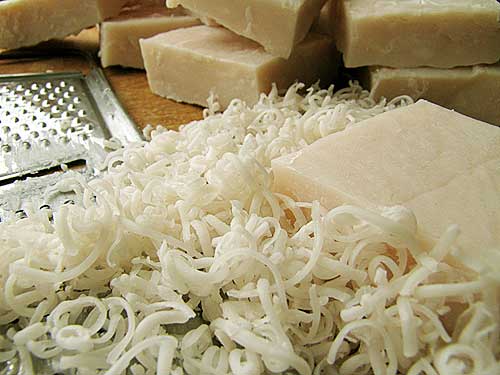
Take homemade laundry detergent to the next level! Make your own homemade laundry soap to grate into your detergent mix!
Do you not make your own laundry detergent? You can find my recipe here: Homemade Laundry Detergent.
Have you been making soap? You can find my step-by-step soapmaking tutorial for hot and cold process soap here: How to Make Soap.
Read more about the different processes of making soap and what goes into soap here: Getting Ready to Make Soap: Part 1.
See all about the scary lye here: Getting Ready to Make Soap: Part 2.
And find out all about the necessary tools and utensils here: Getting Ready to Make Soap: Part 3.
If you want to develop your own recipe or test a recipe you’ve found online, use a soap calculator: SoapCalc. Do not make changes to a soap recipe without checking it through a soap calculator.
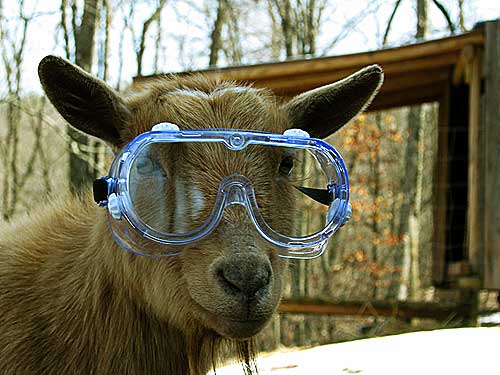
One more note: Wear safety gloves and goggles and always follow safety guidelines when making soap!
I have two recipes to share with you today, one with lard and coconut oil, and one with Crisco shortening and coconut oil. Both of these recipes make a super-sudsing and hard-grating laundry bar. Please do not substitute other brands of shortening. Shortening brands are not interchangeable! Different shortenings have different lye calculations. The shortening recipe below is formulated specifically for the regular (NOT BUTTER) Crisco.
 Printer-Friendly
Homemade Laundry Bar:
Coconut Oil & Lard Recipe
lard — 16 ounces or 453.592 grams
coconut oil (76-degree melt point) — 16 ounces or 453.592 grams
distilled water — 12.16 ounces or 344.73 grams
lye — 5.191 ounces or 147.155 grams
Coconut Oil & Crisco Recipe
Crisco — 16 ounces or 453.592 grams
coconut oil (76-degree melt point) — 16 ounces or 453.592 grams
distilled water — 12.16 ounces or 344.73 grams
lye — 5.134 ounces or 145.538 grams
These are two pound recipes.
Add 1 ounce of scent, if you wish. If making soap by cold process, add scent immediately following trace. If making soap by hot process, add scent after the full cook time, just before placing in molds.
I made this soap using the hot process method, which is my favorite way. You can also make it by the cold process method. See my soap tutorial for all the info on these two methods of soapmaking, and How to Make Hot Process Soap in a Crock Pot for a simplified hot process tutorial. If you haven’t tried making soap yet, why not? It’s so easy, and so much fun.
This recipe traced up very quickly using a stick blender–in about 5-6 minutes. It also cooked up in the crock pot very quickly–in about an hour.
Okay, who’s making a homemade laundry bar for their homemade laundry detergent? You can do it!
Clover says so.


Jill says:
This is like my soap I make for everyday use. I use goats milk instead of the water. Love it and lathers good.
On July 16, 2010 at 7:01 am
CindyP says:
Yay Suzanne! Another batch of soap!
The big difference between this and everyday use is the large amount of coconut oil…50%…which would be VERY drying to your skin. But coconut oil is a great cleansing and hard bar (great for grating).
On July 16, 2010 at 7:33 am
Tara says:
Thanks for the link to soapcalc! What a great resource.
On July 16, 2010 at 8:43 am
Carmen C. says:
:happyfeet: I can NOT wait to try this!!! Thanks for sharing the recipes:)
On July 16, 2010 at 8:47 am
Denise :) says:
LOL! When I opened up this article and saw the top picture, my first thought was, “What does Parmesan cheese have to do with soap??” I love that Clover tolerates the props for the photo ops! 🙂
On July 16, 2010 at 9:33 am
Laurel says:
You say super sudsing — does that mean these bars can’t be used in high efficiency washing machines?
I use Charlie’s Soap and love it, but it would be nice to have a homemade option.
On July 16, 2010 at 9:36 am
Suzanne McMinn says:
Laurel, it is fine in the washing machine. It would be comparable to soap out of the store that you grate up for homemade laundry soap.
On July 16, 2010 at 9:39 am
Jenny says:
Thanks so much for this! My hubby and I made a batch of this up last night. It was our first successful batch of hot process–I love that it will be ready today as soon as it is cut. I’ve been making my own detergent for a while and wanting a simple soap recipe to start using with it, but just hadn’t gotten to it. We’ve just started using our goat’s milk shampoo bars, and I’d love to get a soap recipe for shaving and quite buying shaving cream.
~Jenny~
On July 17, 2010 at 8:08 am
Lisa says:
So you don’t make your own lye? I would like to not be dependent on the store for any part of my soap making. What about making your own lye?
On July 17, 2010 at 12:42 pm
Rosemary says:
I plan to try this soap as soon as I go to the store and buy coconut oil. The other day I helped to demonstrate how to make soap at our local 4-H.
On July 18, 2010 at 11:22 am
highlandview says:
Is the measurement of ounces a liquid measurement or a weight?
On July 19, 2010 at 12:58 pm
CindyP says:
highlandview, all measurements are by weight.
On July 19, 2010 at 7:38 pm
doradufran says:
Nice recipe! Very similar to my laundry recipe, I use tallow instead of lard or crisco though. I used to make laundry gel out of it when I was washing cloth diapers.
Lisa, one cannot exactly make lye in the granular form. What pioneers used to do is save wood ashes and steep them in water in barrels. This gave them a liquid lye, but it varied a lot and sometimes resulted in a soft pasty soap rather than a hard bar. There are sites online that teach this method – it’s very interesting!
On July 22, 2010 at 11:31 am
Anita says:
Suzanne, the link to Chippewa Creek Soaps isn’t working. THere’s a good redirect, though. (just FYI)
On July 23, 2010 at 9:44 am
Suzanne McMinn says:
Thanks, Anita!
On July 23, 2010 at 10:18 am
Donna DuMouchel says:
Your instructions are so good I’m now thinking about making laundry soap for the first time. I hate to show my ignorance, but once I make it, how do I USE it?
On July 26, 2010 at 8:19 am
Suzanne McMinn says:
Donna, you’ll grate the soap and add it to the laundry detergent mixture. Click on the link in this post to the laundry detergent post and you’ll find all the info there!
On July 26, 2010 at 8:21 am
The Chicken Keepers says:
Cute blog! I could spent hours on your sight! We raise chickens, bunnies, and goats. In the past we have also had pheasants and turkeys. Check out our blog at thechickenkeepers.blogspot.com :chicken:
On July 26, 2010 at 11:07 am
RockWhisperer says:
How many bars should this recipe be cut into? I notice you say on your laundry soap-making post to use a small bar, not bath size. So approx. how many ounces in a small bar? Soap newbies want to know. Heh.
On November 21, 2010 at 3:15 pm
Suzanne McMinn says:
RockWhisperer, I don’t buy soap anymore so I can’t remember for sure, but I think those small Ivory bars are 3 ounces. You could check at the store next time you go. You can also adjust the amount of soap in the recipe a little up or down, depending on your preference, so being exact isn’t that important. I sometimes add more soap lately, especially, because I have so much muddy stuff lately!
On November 21, 2010 at 4:15 pm
Mountain Blessings says:
:wave: Hi Suzanne, I tried your recipe, and made the concentrated version mainly because I didn’t have a container big enough. Its awesome and works wonderfully. I added just a tad more bar soap (I used Zote)we have really hard water and use a 1/4c of vinegar in the rinse. I didn’t put any scent in and love how my clothes and especially my towel and rags smell clean. Thanks for sharing!
On February 14, 2011 at 3:58 am
Critter1305 says:
Just a quick question. I am making this soap this weekend and I am wondering if I could put some aside to wet and use as a stain pre-treater. Would it be safe for most clothes?
On September 11, 2015 at 2:16 pm
Suzanne McMinn says:
Yes, it should be safe for most clothes.
On September 14, 2015 at 7:52 am