

Let’s talk about the scary lye. We don’t want to blow up!!!
We do many dangerous things every day, like drive a car. We even do dangerous things in our kitchen on a regular basis, like fry with hot oil or make candy. The difference is, we’re accustomed to those activities. We know the rules and respect the associated safety precautions–but we don’t let the fear of being burned by hot oil or getting in a car accident keep us from getting on with what we want to do. For most of us, making soap isn’t an activity we were familiarized with during our childhoods. We just know it’s dangerous, and it’s actually a good, life-preserving instinct to stay away from dangers we don’t understand. But! We can learn. And then we’ll understand!
Lye is a dry form of sodium hydroxide or caustic soda. Chemically, soap is a salt. Our great-grandmas made lye at home by leaching wood ashes. As I mentioned in Part 1 of our Getting Ready to Make Soap series, this is how old-time country soap got a bad rap for being harsh. Often it was harsh due to the unpredictable, varying strength of homemade lye. Commercial lye has a standard strength, which makes today’s homemade soaps safe and predictable. All soap is made with lye, by the way. Even the glycerin blocks you get at craft stores to make glycerin soaps contain lye. Lye is what makes soap.
I know! It’s shocking if you’ve never thought about it. Lye is kinda like lard. It’s just not a word you hear in most suburban households. We’re completely unfamiliar with it and all we know is that it’s BAD, BAD, STAY AWAY, BAD. Well, we’re on target about one thing–it is a chemical deserving of respect. Lye is a poison. It’s corrosive, fatal if swallowed, and harmful if inhaled. It will burn the skin if it comes into contact with it, and it reacts to water, acids, and other materials (such as aluminum). If your skin does accidentally come into contact with lye, safety instructions recommend immediately flushing the skin with plenty of water for at least 15 minutes while removing contaminated clothing and shoes. Call a doctor or the poison control center, and wash clothing before wearing again.

When working with lye, wear safety goggles and rubber gloves. The goggles should fit snugly, provide complete protection, and fit over glasses. Many people use regular rubber dishwashing gloves, although you can also buy rubber gloves labelled for chemical protection. (I got the ones Morgan is modeling here at Wal-Mart in the refinishing/woodworking aisle.) Wear a long-sleeved shirt, long pants, shoes, etc. Tie your hair back. (You don’t want to be reaching up with your rubber glove and touching your face to push hair out of the way.) Don’t touch your soap directly later, either, even after it’s been poured into molds–not until you’ve tested it with a pH strip.
Don’t use aluminum, tin, or copper in your soapmaking–they react to lye. What can you use? Stainless steel, steel, heat-resistant plastic, glass, or enameled steel. Much of what you need to make soap can be found right in your kitchen already, and much of it can be re-used for food after being neutralized and thoroughly washed. (Don’t re-use plastic utensils/containers or wooden spoons for anything else but soapmaking as they can absorb the chemical. Stainless steel, steel, and glass can be washed pure again.) If you’re not comfortable using the same items for food and soapmaking at all, try thrift stores to pick up extras of things you will need for making soap.
Never add water to lye. ADD LYE TO WATER. Adding water to a chemical can cause a massive heat expansion. I’ve seen a couple of different rhymes in the comments on previous soap posts that you can use. Do what you oughta, add lye to the watta. Or, snow falls on the lake. Whatever you want to use to help you remember that, it’s IMPORTANT. You don’t want to blow up.
Mix the lye and water in a well-ventilated location. Many soapmakers go outside for this part, then bring the mixture back inside afterward. Also, don’t lean over the pitcher as you pour the lye into the water. You want to avoid the fumes. Add the lye slowly, don’t just dump it in.
Other basic precautions in dealing with lye hold true for many other things we do in the kitchen, so use common sense. Keep children out of the way. Send them to grandma’s house or school or the neighbor’s. If they’re in the house, make sure you have another adult available to supervise them. You can’t be running off in the middle of making soap to handle a tantrum. Don’t leave your mixture unattended for any reason. Let the doorbell ring and don’t answer the phone.
Don’t get careless or take safety lightly. At the same time, relax. The lye isn’t going to jump up out of the pot and attack you. It’s a poison, but it’s not like you’re going to drink it. Remember that our great-grandmas did not wear goggles and gloves when they were making soap. They didn’t have access to such things, but they understood the rules and respected what they were handling. We use protection when making soap today for the same reason we wear bike helmets and seat belts–we have the capacity now to make ourselves even safer when engaged in potentially hazardous activities. If they could make soap without it–and survive long enough for us to exist–we can certainly do it with the information and resources that are available to us today. Get some gloves and goggles, dress properly, and handle the lye with respect and knowledge–but without fear.
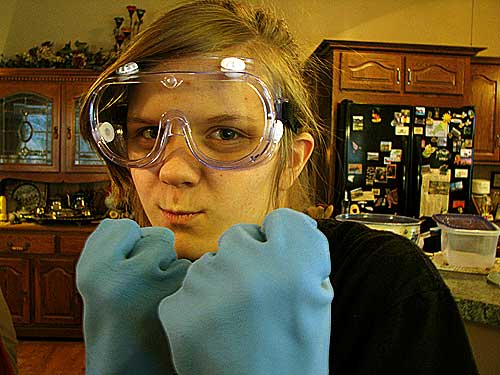
I can do it! So can you!
P.S. Morgan isn’t going to make soap. These photos are the result of too many snow days at our house.


Darlene in North Georgia says:
Even better than flushing with water is to keep an open container of any kind of vinegar right by you. Lye is an alkaline, vinegar an acid. When lye is splashed and then flushed with vinegar, the vinegar neutralizes the lye, instantly upon contact. Then just wash the vinegar off when you get a minute – but don’t let it drip into your pan of soap! lol
When I’ve made soap, I do the mixing of the water and lye on my front porch. I dripped a little on my porch from my stirring spoon and just used a bit of vinegar to neutralize it. Then I didn’t have to worry about rain hitting it and “reactivating” the lye and someone (kid) or something (dog) getting it on them and burning themselves with it. Easy, peasy.
And when I was done mixing the lye, I CAREFULLY carried it inside and put it on top of my washing machine so it was away from curious kids and now the dog (who just cost my daughter $70 in vet bills for swallowing a MAGNET. A rather BIG magnet!). Now that he’s here, he will be gated in the hallway while I make soap. Ain’t baby gates wonderful?!
On February 28, 2010 at 4:41 am
Suzanne McMinn says:
Darlene, I was going to mention about keeping a spray bottle of vinegar but I don’t want to confuse people about cleanup vs personal safety, and wanted to focus this post on personal safety. Vinegar should be used in cleaning up equipment and utensils, but you should actually NOT spray vinegar on yourself if you accidentally splash some lye onto your skin. The vinegar will make the lye burn worse. The best thing to do if you splash lye on yourself is flush the spot thoroughly with cool running water.
On February 28, 2010 at 7:33 am
Suzanne McMinn says:
Here are a couple of expert sources–please research on your own as well. Don’t take any advice on the internet without doing your own research! (Including mine!) Expert sources do NOT recommend spraying vinegar on your skin in the case of a lye burn. Flushing with copious amounts of cool running water is the expert recommendation. (Spraying a lye burn with vinegar is an old wives’ tale.)
https://www.merck.com/mmhe/sec24/ch289/ch289a.html
https://www.certifiedlye.com/safety.html
On February 28, 2010 at 8:09 am
Minna says:
Did you know that some people make -and eat- lutefisk (lye fish)?
https://en.wikipedia.org/wiki/Lutefisk
On February 28, 2010 at 6:36 am
Leah says:
LOL Morgan!!!
On February 28, 2010 at 7:07 am
kerri says:
Morgan is a hoot 😆 Love the photos!
This post makes me think about how vastly different our lives are today from our great grandparents…how “protected” we are from what was everyday doings to them. Education is the magic word. Thanks for educating us, Suzanne. It’s much more fun than school was :sheepjump:
On February 28, 2010 at 7:19 am
Jenny says:
Well, I actually don’t deep fry at home because the big pan of hot oil scares me! But I did manage to make soap. In fact, we just made our first batch of goat milk soap yesterday. It went pretty well and much quicker than the book had led us to believe. I posted about it on my blog with a few pictures. I guess we will try to unmold it today and cut it so it can begin the long curing process. We’re looking at hot processing another batch so we can have some to use sooner.
~Jenny~
On February 28, 2010 at 7:53 am
Diane says:
Morgan you are very expressive. lol. I love the pictures. Love that you did all those silly poses for your mom. Even let her post the pictures of you in the saftey goggles and rubber gloves. Most kids including my own would not do that for their mom’s. 🙂
Suzanne- You are amazing. Cant wait to see how your soap comes out. And how you like useing it vs using store bought soap. My guess is that you are going to love it.
On February 28, 2010 at 8:05 am
Mary says:
I don’t plan on actually making the soap, but I read every word… and loved every picture of Morgan…so cute.
On February 28, 2010 at 9:00 am
CindyP says:
Great pics, Morgan!!!
And a very good post on safety! I have been burned with cooking with oil (still have scars on my hand), but never with lye. I guess I should take as many precautions with oil as I do with lye! Lye was the biggest reason it took as long as it did for me to start making soap, and people do still shake their heads at me when they see me with my glasses and pink rubber gloves on, but I respect what it can do to me or anyone around me, and I don’t let it stop me anymore!
On February 28, 2010 at 9:40 am
Linda says:
A bit overkill, but really cute!!!
On February 28, 2010 at 10:47 am
Miss Becky says:
I LOVE the pics of Morgan! And I LOVE that her hair is back and her BEAUTIFUL BEAUTIFUL face is visible even if she is wearing goofy goggles! Now I want to make soap :happyflower:
On February 28, 2010 at 10:52 am
aint for city gals says:
Morgan is ready for the big time…lol…so cute. You are right…we CAN learn things and the step by step is good…
On February 28, 2010 at 11:20 am
LauraP says:
Love the pics – Morgan really got into it, didn’t she?
Now, the lye & vinegar thing — it’s not precisely an old wive’s tale, but most of the people recommending it aren’t including the correct, safe procedure. Here’s what happens — spray vinegar on lye, and yes, it’ll neutralize the lye, but it creates a lot of heat in the process and can burn worse than the original lye spill. So, small lye spill + vinegar = maybe no burn, but why risk it? More lye + vinegar = nasty burn. Better to just rinse, rinse, rinse, then treat the skin irritation if there is any. And yeah, I treat the skin irritation with vinegar immediately after rinsing and rarely even get a red spot.
I’m saying this with some 20 years of soapmaking experience behind me. 20 years of playing with lye w/o a burn is a pretty good record. Wish I could say the same for my chicken frying experience.
On February 28, 2010 at 11:47 am
Suzanne McMinn says:
Thanks, Laura! I think that’s the important distinction–immediately rinse thoroughly with water. I’ve never handled lye yet myself, so I can’t speak from experience, but that’s what all the expert sources recommend–immediate water rinsing. Good to know from experience that vinegar CAN help later, AFTER rinsing with water.
On February 28, 2010 at 1:07 pm
jean says:
Morgan I think I love you. Not in a scary staler way but you have a great sense of humor way. Most kids wouldn’t pose for a regular single photo but you are willing to pose for several photos. All of them hysterical. Thank you.
On February 28, 2010 at 12:54 pm
lavenderblue says:
Don’t know about lye and soap making but Morgan is freakin’ hilarious. 😆
On February 28, 2010 at 1:20 pm
Cate says:
Love the Morgan photos! Me thinks the apple didn’t fall far from the tree! Soap making is very fun and easy. Will probably make up another batch of goat milk soap next weekend. Need to get some rose essential oils to scent it and then I’m good to go.
On February 28, 2010 at 1:51 pm
Estella says:
Morgan makes a great model for your comments!
On February 28, 2010 at 2:45 pm
Gillian says:
Hello~
I have been making soap for years!!!!
soon you will leave the gloves behind….I found that I got more lye all over the place WITH gloves ON than off- with Gloves on I could not feel the lye- so it ended up on my shirt- and pants- counter…everywhere.
Lye feels similar to bleach when it burns skin- you feel it in plenty of time to wash it off….
I worry more about the “smoke” from the heat of the lye and breathing it than on my skin-
Relax- have fun…
happy soaping!!! :shimmy:
On February 28, 2010 at 3:04 pm
Paula Clark says:
I’ve been making soap for years too and don’t wear gloves or goggles either. All that was just too much and I felt like I didn’t have control of my hands. LOL I do wear my regular glasses, I figure they will stop any splashes! But I am careful. I mix in my kitchen because I would probably fall down with lye water and do more damage. I plan it when nothing else is going on in the kitchen. It’s just my hubby and I so I just warn him not to touch anything. But really I have splattered a bit of lye on me and just rinse it off. Relax and enjoy the process. It is a wonder to watch the soap trace and just know it going to be good!
On February 28, 2010 at 7:58 pm
Loopy says:
I’ve been making soap for about 15 years and have only had two bad experiences with lye – definitely DO NOT get distracted in any way. I usually put the pitcher in the sink and opened the window above the sink so the fumes had somewhere to go. One time I leaned over my pitcher too closely and burned my lungs something awful!
Are you doing cold-process or hot process? I’ve done both but I really enjoy hot process more because there’s no cure time and it can be used in 24 hrs.
Good luck!
On February 28, 2010 at 8:14 pm
Loopy says:
Oh! And line your counters with several layers of newspaper just in case any granules get on them. Then you just toss them. I always kept several layers under the mixing pot as well and on the floor in front of the oven when I cooked it.
On February 28, 2010 at 8:16 pm
Runningtrails says:
Good for you! I’m glad you are doing this. I know you have been planning to do so for awhile now.
Morgan is so cute and funny! She is such a good sport, letting you take and post those pics!
I have been making soap for many years too. I have never had a big problem with the lye. I have gotten a lung full from time to time and coughed uncontrollably. I usually add it to the water outside. I have gotten the odd flake/crystal on my arm or hand etc. I just rinsed it off. It doesn’t burn immediately. I have also handled a lot of raw soap barehanded, but only for a few minutes then washed hands.
My biggest worry is that the odd lye crystal will stay on the counter or table or fall on the floor to be picked up by someone else or end up in food somewhere. I like to measure it in the sink where I can rinse it all down the drain.
You will like having lye handy to unclog drains too. Works great!
On February 28, 2010 at 9:35 pm
Shirley Corwin says:
I don’t think I plan on making soap but you never know! Anyway this was so interesting and was made even more so with the pictures of Morgan and her expressions. She is a really good sport to do this for you! Really cute!!
On February 28, 2010 at 9:36 pm
Nursecookie says:
I’m, as always, right behind you. Haven’t found lye yet. Wondering if, when I do, I could borrow your mad scientist in the goggles and blue rubber gloves. She really looks like she knows what she’s doing.
On February 28, 2010 at 9:47 pm
Mary says:
:purpleflower: Morgan is an excellent spokesmodel for your soap! Too funny!! Good luck!! :sun:
On March 1, 2010 at 9:17 am
carsek says:
I have made lye soap before also and I agree that the protective gear more or less just got in the way. Use your common sense and it will be fine. And do be careful about breathing the fumes. If you make small batches then all your containers will fit in the sink as you work, hardly any chance of spilling then. Have fun. This is some of the best soap out there. Also, I have people who come to me for lye soap every year to kill the poison ivy they have gotten into. If you wash with lye soap after coming in contact you hardly ever break out. Great pics, Morgan!!
On March 2, 2010 at 5:47 am
jojo says:
I received Smart Soapmaking from Amazaon and have nearly all of the supplies except for the stick blender and scale. I’m still searching for those and then it will be time to buy the supplies to actually make the soap. I’m getting excited but it will probably be another week or so before I’m totally ready.
On March 7, 2010 at 8:47 pm
Barbee' says:
This is really interesting to me. I have never made soap and knew nothing about how it is made. I learn something new here almost every day. Amazing! Morgan, I don’t know who’s the cuter: you or that pair of kittens! (I miss my teenage kids – now all grown up and out in the world.)
On March 8, 2010 at 10:51 am
Heathercapocus says:
Just a dumb question from someone living in the suburbs but becoming more self-sufficient! Where exactly would someone find lye and lard to do this project? Also, does anyone have any scented oil suppliers that you could recommend?
Cheers!
On February 25, 2011 at 11:09 am
Suzanne McMinn says:
Heather, you can buy lye at some hardware stores, so check around. You can also order it online at soapmaking suppliers such as brambleberry.com. Another good soapmaking supplier is wellingtonfragrance.com.
On February 25, 2011 at 11:17 am