
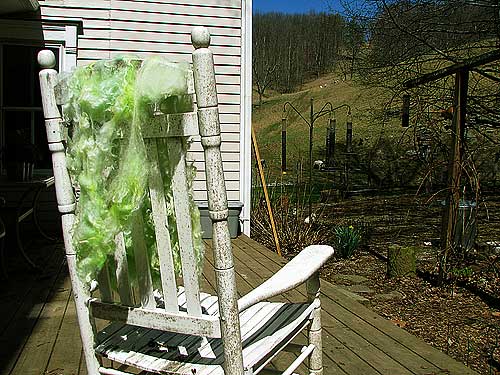
Freshly-washed and dyed Border Leicester wool drying in the breeze on the back porch of the 1860s-era farmhouse at Kilmarnock Farm.
Saturday, I was lucky enough to take a class in fiber arts with three friends at this beautiful 300-acre farm tucked in the hills of Orlando, West Virginia, about an hour and half north of here. Ann Craven operates the Hares to Ewe Fiber Studio in a small building behind her farmhouse where she offers classes for small groups as well as private lessons in knitting, spinning, weaving, dyeing, felting, and more.
I love old farmhouses.
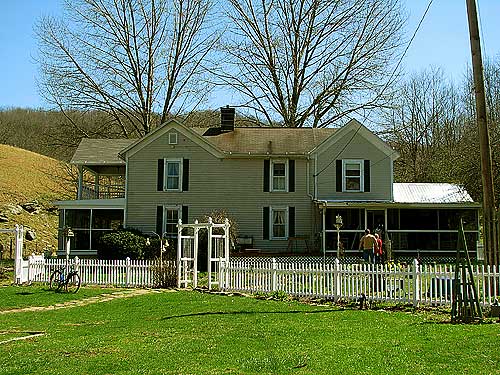
You just walk into an old farmhouse and it’s like your soul sighs or something. They are so comforting.
Ann took us into the farmhouse then out to the studio in the back.
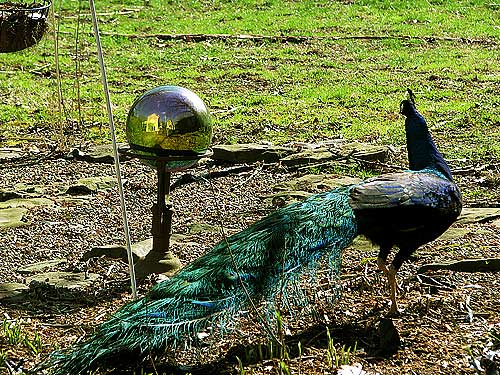
She headed into the studio while we were still standing around, admiring the house and the landscape and the peacocks. Taking the class with me were Missy from the goat farm, Kathy from the sheep farm, and Mim, who has an alpaca farm.
Ann, charging onward: “Come on, girls. What are you doing? We’re here to spin!”
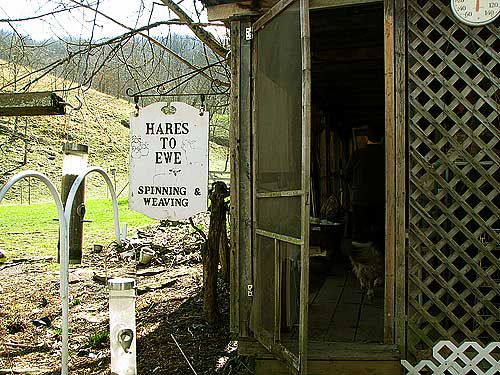
This was a precursor to the rest of the day in which we were torn between awe and utter bafflement.
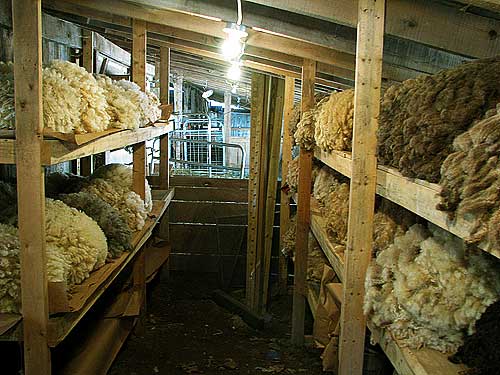
Inside the studio, anyone at all interested in fiber arts would be tempted to drool. The walls were lined with shelves of wool in various stages of processing.
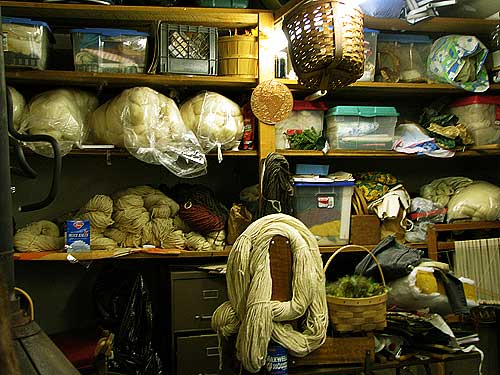
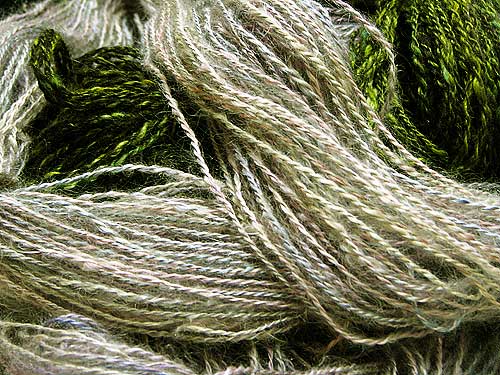
There were baskets and baskets packed with gorgeous handspun yarns.
This basket holds washed, dyed wool, ready for carding.
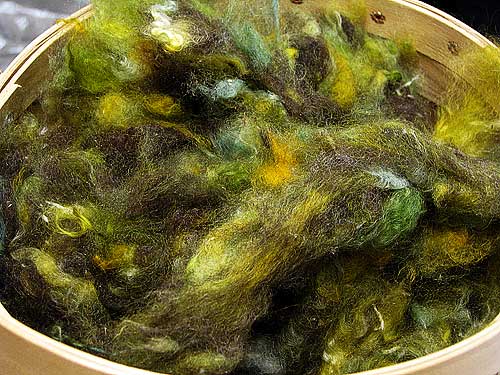
We were still standing around saying, Wow, while Ann was already picking up a pair of handcarders. She didn’t waste a minute–the day was packed with information, demonstrations, and hands-on practice.
Carding wool is how you create soft, lofty yarns. Using washed, dried wool, the wool is combed between carders faced with short wire teeth. This opens and straightens the fibers to prepare them for spinning (or felting).
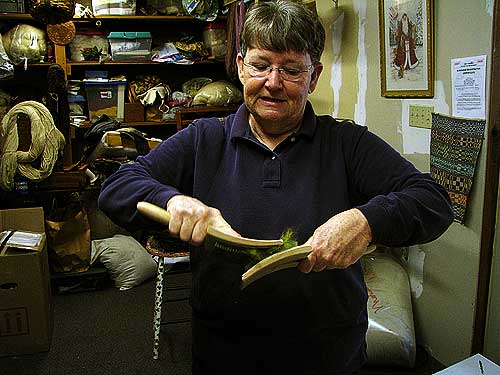
Wool processed this way with handcarders is called rolag. (Mill-carded wool done on machines is called roving.)
Ann, showing us the carded wool.
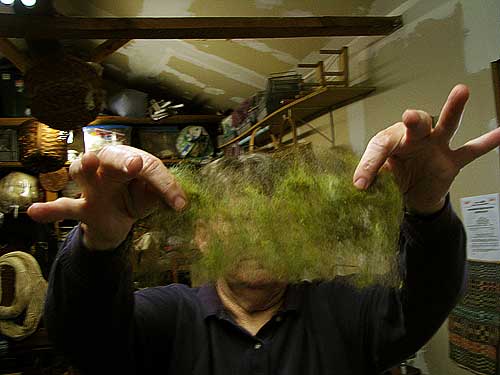
Now, after a bit of gentle drafting (teasing the wool open by holding the wool between your hands and lightly separating the fibers without pulling them out of the fiber mass completely), it’s ready to spin!
Ann, demonstrating handspinning.
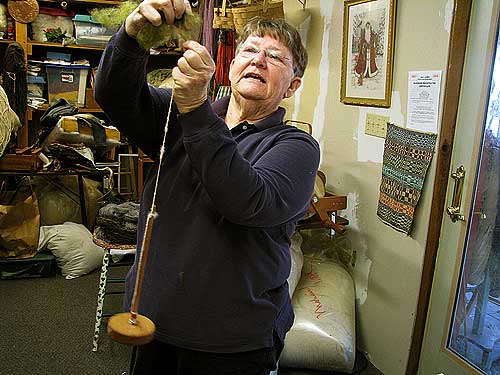
Spinning is the simple act of twisting drafted fiber. That’s it! (Ha! Just try it.)
You can spin using nothing more than a hooked stick. There are various types of handspindles, most of which are comprised of a wooden shaft with some sort of weight at the bottom and either a notch or hook at the top to attach the yarn. (You can even make your own handspindle using a dowel and compact discs.) Then there are spinning wheels, for the serious home spinning enthusiasts who want to produce more yarn more quickly.
Ann can spin like nobody’s business.
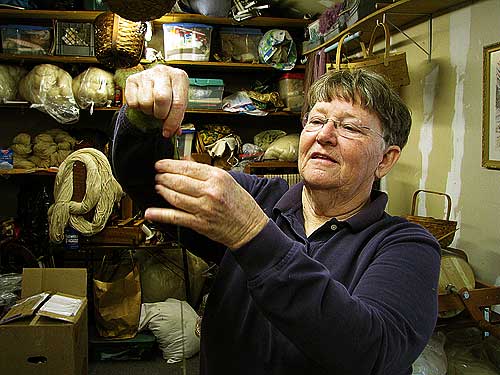
She demonstrated the use of a spinning wheel for us. We all decided we would sooner shoot our eyes out than attempt that contraption.
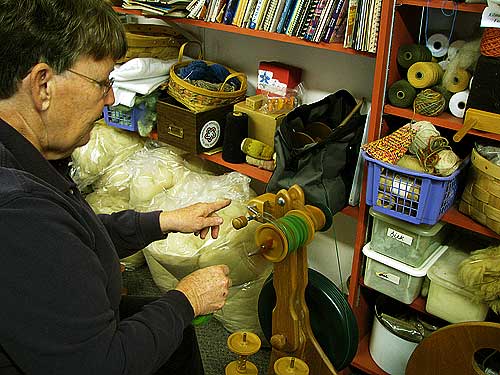
Our brains and fingers were already on overload practicing our handspinning.
I wished I’d known making a slip knot was so critical to starting your handspindle because I totally would have practiced that the day before.
Ann, perplexed: “Do you not know how to knit?”
Me: “Uhhhhh……….”
I’m learning!!!
There was a lot of spindle dropping and crying of, “Help! Help!” We decided we knew why she limited small-group class size to four, or maybe we were just needier than her usual students, but I think even Ann was glad when it was time to head back to the farmhouse for lunch. (Actually, she was very patient with us, though I do think she was secretly wondering how I navigate everyday life with only half a brain.)
After lunch, while everyone else was chatting and relaxing, I had to sneak outside to see the farm animals, of course.
They raise Komondor livestock guardian dogs at Kilmarnock Farm.
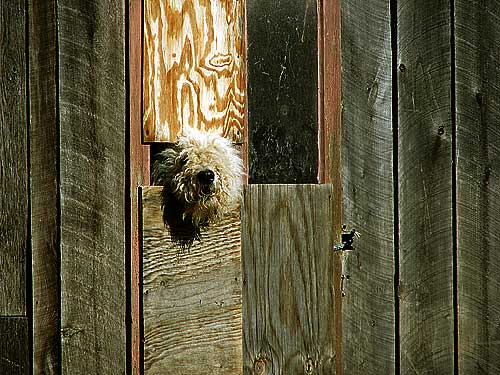
This one had his head stuck out of a hole in the barn like Oscar the Grouch the whole day. He about scared the doo-dah out of me when I tried getting close. I think he wanted to eat me for his lunch. He was fierce.
They also raise Border Leicester sheep, a longwool breed that makes for strong, lustrous yarn.
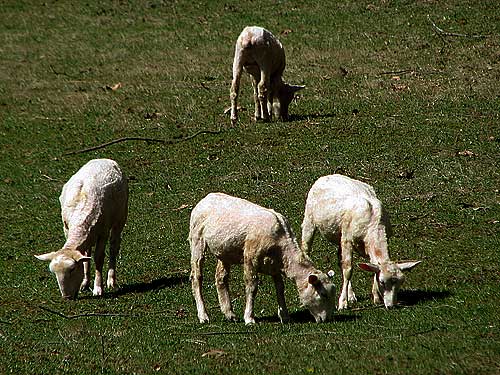
(They’d just been sheared the day before.)
Then I found the Angora goats.
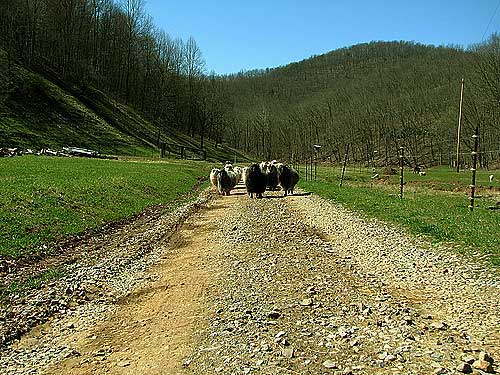
We spied each other from afar.
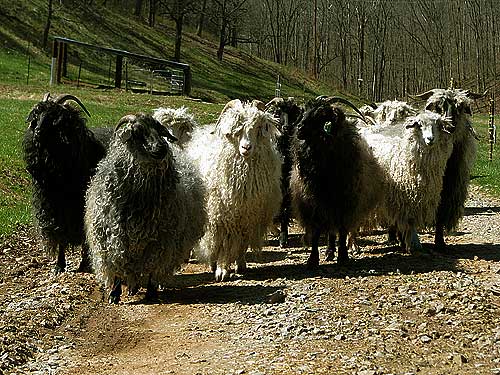
They marched up the long drive to the farmhouse as if they had some serious intent and were determined to arrive at their destination.
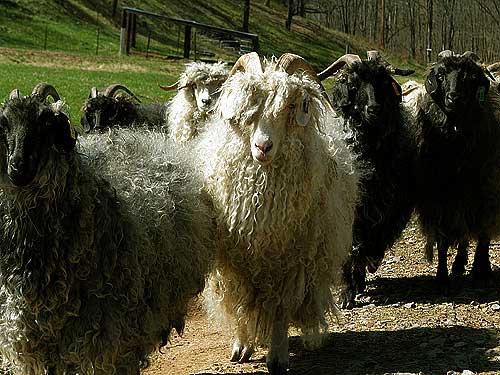
I was their destination. How cool! My new best friends!
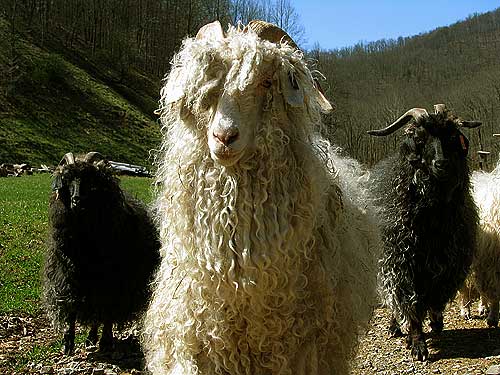
This one got right up close to me, right up in my face, leaned into me and…..
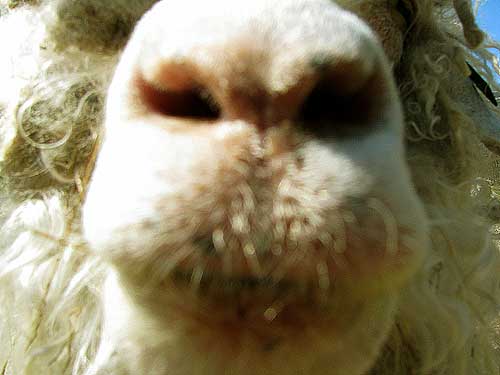
….sniffed me.
Then they all turned and RAN.
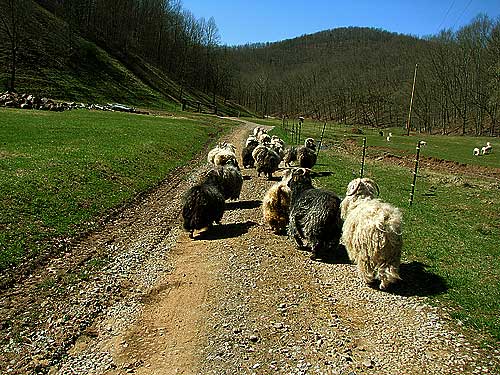
How rude! How disturbing! I yelled after them, “DID CLOVER TELL YOU TO DO THAT?”
By then, the lunch break was over and Ann brought everyone outside for a tour of the barn. She has shelves and shelves of fleeces from the recent shearing.
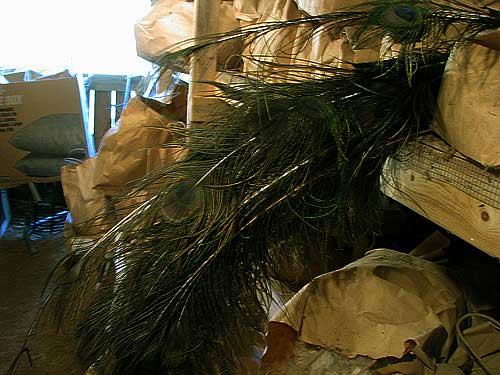
Not to mention, peacock feathers!
There was little time to ooh and ahh, though. The afternoon round of information, demonstrations, and hands-on practice started back in the farmhouse with a how-to on washing a skirted fleece.
Ann showed us how to wash wool with some of her Border Leicester fleece along with a pound from one of my Cotswold fleeces I’d brought with me. She washed the wool by soaking the portions of fleeces in hot water with Era liquid detergent. (Soak a fleece only. Never run hot water over it or agitate it while washing–that will cause the wool to felt.) Then you can spin it briefly in a washer or drain it in a large colander.
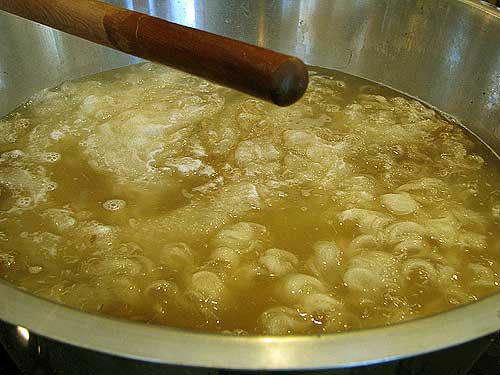
Look at that dirty soaking water! But…..
See my pretty Cotswold wool after she was done?
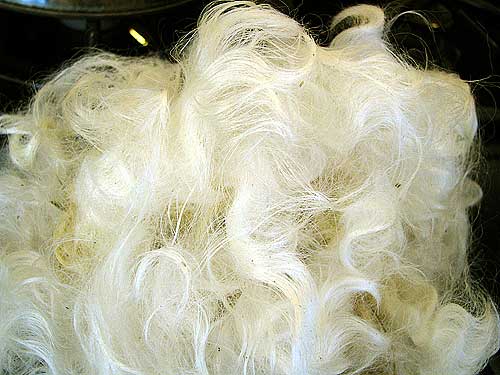
I asked Ann to critique my wool. She said it felt strong, had a good hand, and that the sheep were healthy. (Great news to hear from an expert!) I asked her if it seemed skirted all right, since I’m inexperienced. She said, “They’re sheep! They’re dirty!” Whew. I was afraid everybody else had clean sheep. Her skirted fleeces looked about like mine, which made me feel better. And hey, the wool cleaned up good!
With the washed wool back in a pot of clean water on the stove, Ann showed us how to dye it–with Kool-Aid! She used three packets of Kool-Aid (no sugar, plain Kool-Aid) in complementary colors for a subtle blend of greens.
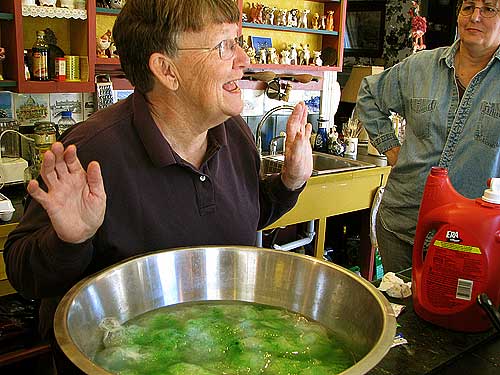
She’s saying: “It’s so much fun, girls, and it’s so easy!”
Back in the studio, Ann showed us how to ply yarn and we practiced our handspinning and carding skills again. I was a quick study. Or not.
Ann, showing me for the 200th time how to load the wool onto the handcarders.
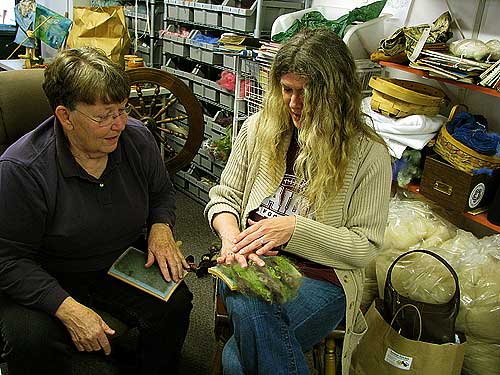
Ann, showing me for the 200th time how to card the wool with the handcarders.
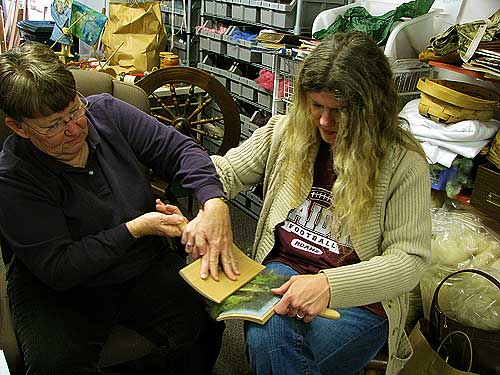
Ann, saying: “There’s something wrong with her, isn’t there?”
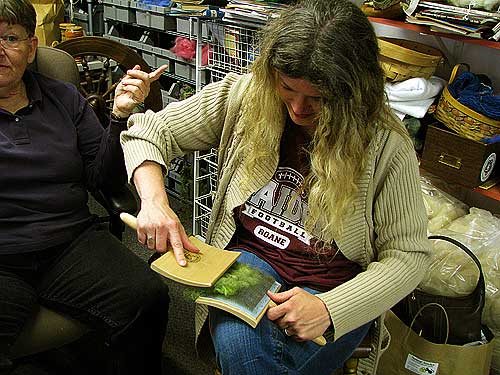
(I made that up. Ann would never say that. SHE WAS JUST THINKING IT.)
Me, saying: “Look!!! I carded wool!”
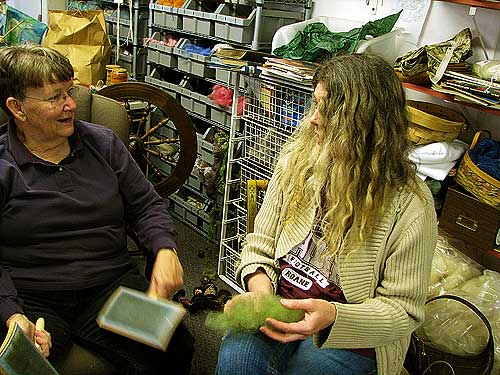
Like nobody’s ever performed such a magic trick before! Later, Ann showed me how to spin some of my Cotswold wool without carding it. Cotswold wool is another longwool, luster breed that produces a fleece with a lot of natural crimp. (Crimp is the waviness or curls. Luster is the gloss or sheen.) Spinning it without carding (to retain the crimp) can be done to create novelty yarns for special projects.
It was an awesome day. We had so much fun and we learned so much. Watching the transformation unfold from dirty fleece to washing, dyeing, carding, and spinning really demystified it all for me. Gaining skill at handspinning is much like knitting–it takes practice and persistence. I’ve got plenty of wool to work with, so I intend to learn–I really enjoyed the whole process from sheep to yarn. (As soon as I have it ready, I’ll be selling Cotswold and Jacob rolag–ready for spinning, felting, or other craft purposes–from my two remaining fleeces here.)
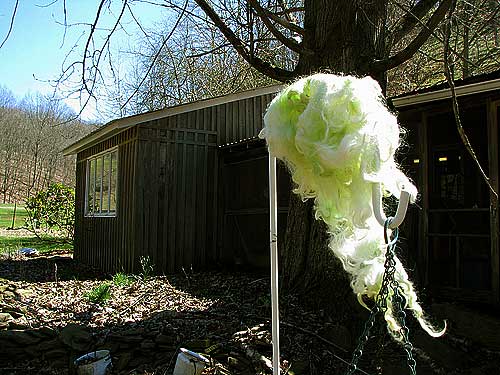
Some of my Cotswold wool, washed and dyed, hanging on a tall plant stand to dry in front of the fiber arts studio at Kilmarnock Farm.
Note: I couldn’t include details and directions here for everything we learned, but watch for upcoming individual posts on washing, dyeing, carding, and handspinning wool with step-by-step instructions and photos.
*See How to Wash and Dye Wool.
Read the feature story I wrote about Kilmarnock Farm in the Charleston Daily Mail.


Cama says:
Wow! Amazing! Thanks for the tour. Can’t wait to see more :sheep: .
On April 8, 2009 at 2:59 am
Jan @ Greensboro Daily Photo says:
Wow Ms. McMinn: You are going to be into everything. How will you find time for it all? Carding wool does look like fun, though, especially when it is that GREEN color!!!
On April 8, 2009 at 4:26 am
CindyP says:
What an excursion you ladies had! Kilmarnock Farm looks so peaceful and old, ahhhh. What an amazing process, from sheep to yarn! And Suzanne, that is crafting…now you are endless in what you can make, all from those sheep that needed a home…God only knew what was going to happen when you found out about those sheep! Can’t wait for the detailed posts! :sheep:
On April 8, 2009 at 4:57 am
Linda says:
You must have had such fun and frustration. Thanks for the tour. I can’t wait for the up coming posts. I really love those angora goats.
On April 8, 2009 at 5:52 am
Kathryn says:
That goat has the cutest nose I have ever seen! What a neat day you had. Thank you for taking us along.
On April 8, 2009 at 5:55 am
amber says:
:sun: Oh my gawsh…I was laughing sooo hard at the goats sniffing you…then running away! That was too funny! And it is so neat that she used koolaid to dye the wool…Wonder if the koolaid company knows about that use for their product lol. Thanks for showing us how much work goes into this stuff.
On April 8, 2009 at 5:56 am
Mental P Mama says:
Wow. What an amazing woman Ann is…and she looks so serene. Such a treat for you to get to go there!
On April 8, 2009 at 6:06 am
monica says:
So cool!
1.the sheep came up to you because they thought they saw the glint of shiny scissors.
2. The hole in the side of the barn could be a model for a dairy goat stand–at least the head end.
3. So cool that she has a house built when EVERYONE did this–even to make socks!!!!!
4. so cool: beyond words!!
Hey–watching Good morning America. 98 year old Grandma, found buried in the earthquake rubble, under her bed. She was knitting. There it goes to show you that knitting is going to hold up the world when everything is falling down around us.
On April 8, 2009 at 6:07 am
Kris7 says:
The best way to learn is at someone’s elbow, and this post makes me feel like we’re all together (yes, all of us readers)learning the process with you.
So much good information presented in a down-to-earth, fun way. Thanks for another awesome post, Suzanne!
Kris7
Working hard at http://www.sccworlds.com
On April 8, 2009 at 6:08 am
M says:
Sounds like you had a great day :snoopy: beautiful weather and a fun time learning a lot of new stuff! Definitely wish I could have been there, I have always been fascinated by spinning but have never had the opportunity to learn.
No go home and practise!
M
On April 8, 2009 at 6:21 am
MARY says:
:sheep: How cool is that?? How interesting!! It looks like you gals had a fabulous day at the farm. What a beautiful place, and it looks like you guys went straight to the expert! I know you will be using Georgia’s spinning wheel in no time!! :sun:
On April 8, 2009 at 6:23 am
shirley says:
The goats were expecting you to pull cookies out of your pockets and when you didn’t, they got all huffy.See, Clover called the sniffer on her cell phone to tell them you were coming and bringing cookies.
Oh, the demands Clover will make now to punish you for making her look bsd. :no:
On April 8, 2009 at 6:26 am
shirley says:
can’t type this morning. Meant to say BAD.
On April 8, 2009 at 6:27 am
Fencepost says:
Very interesting post, Suzanne. Thanks for sharing it with us. I am looking forward to the follow-up posts.
Love that Angora critter nose shot!!
On April 8, 2009 at 6:45 am
Nancy in Atlanta says:
Still laughing at the angora goats’ antics! Yep, they came closer to see who you were, then realized you were the crazy lady Clover had warned them about.
A lot of work went into that teeny tiny house on the post – it’s lovely. Do you suppose there’s a teeny, tiny Annabelle playing inside?
Thank you for sharing with us. :sheep:
On April 8, 2009 at 6:57 am
Gini says:
Thank you for this incredible post! I do love fiber arts but haven’t made the time to really devote my hand to any of them. Like you, I’m kind of bumbling in the knitting department. But my goal this year is to get much better this year! Your day sounds like it was fascinating and I’m totally envious. Someday, someday…
On April 8, 2009 at 8:32 am
The Retired One says:
The whole tour and your post of the instructions was AMAZING!! Thanks so much for sharing it all. The dog and the sheep were gorgeous too…and it was so neat of you to have pictures of her and you too (also gorgeous!)
The Retirement Chronicles
On April 8, 2009 at 8:42 am
trish says:
Morgan, Your teeth are beautiful.
Suzanne, Can you send me your email address at [email protected]? The link to send you my address for the free book isn’t working for me. I don’t have that program apparantly.
Thanks Morgan!!!!
On April 8, 2009 at 8:51 am
Kelleh says:
Oh how exciting! I’ll definitely have to check this out; it’s been forever since I’ve had my hand on a spinning wheel or a loom!
Where is this place located in relation to Charleston?
On April 8, 2009 at 9:15 am
DebK says:
Thank you for this wonderful post! I have just recently found your blog, and love it!
On April 8, 2009 at 9:24 am
Kacey says:
That looks like you had so much fun! Jealous here. A whole day spinning. Sigh.
On April 8, 2009 at 9:28 am
margiesbooboo says:
Oh Suzanne! You naughty little tease! I’m so jealous of your trip. I miss WV so much and then you post this blog today of sheep and peacocks and goats and wool and farmhouses. I would love to spend the weekend there. I’ve got a wool batt that a friend sent me from Oregon from his sheep to use in a quilt but I think it needs to be felted or else it will pull through during the quilting. I wonder if she could help me figure it out? I really think Ace sent me the wrong thing but I’d like to make it work for a really warm quilt, you know what I mean?
huggs,
margiesbooboo
On April 8, 2009 at 10:02 am
Leah says:
That is an awesome post Suzanne. Glad you enjoyed your day and were able to bring home a new skill with you. :fairy:
On April 8, 2009 at 10:29 am
Joanna Wilcox says:
As always, you tell a great story with your writn=ing a photo’s. Thanks, I feel like I tagged along.
On April 8, 2009 at 11:37 am
Estella says:
Love the pictures and story.
You are so ambitious.
On April 8, 2009 at 1:42 pm
Christine says:
Cool! I can’t wait to see what you’ll post along the way. I’m going to a fiber arts festival this weekend where I’m hoping to meet a knowledgeable spinner of my own. It seems like it would be very relaxing once you get the hang of it. I think using all natural dyes would be cool too. I can’t wait to get my sheep!
On April 8, 2009 at 1:45 pm
catslady says:
It’s all very interesting and fascinating.
On April 8, 2009 at 1:53 pm
Debi says:
:sheep:
What an awesome time ya’ll must have had! Great post!!!
Clover really holds a grudge doesn’t she?
On April 8, 2009 at 1:56 pm
Robin Akin says:
:snoopy: Having heard your interview on WV Public Radio, I’m a new fan and have spent many hours catching up, and telling everyone I work with about the fun I’ve had and now you add carding to the list of fun. So when does the spinning begin?
Robin Akin – also in WV!
On April 8, 2009 at 3:39 pm
Christy O says:
What an amazing day! I’d love to find a class like that. I’ll soon have fleeces of my own to play with.
On April 8, 2009 at 3:49 pm
heidiannie says:
You dyed the wool with Kool-Aid! I love it! Back when I was in my hippie stage- I was dying stuff with herbs and onion skins! I never thought of Kool-Aid!
On April 8, 2009 at 4:38 pm
Cranberry says:
Amazing trip you had Suzanne! I would love to grab one of those billy goats gruff Angora’s and hug them! talk about santa’s beard on that white one, just gorgeous! thanks for the field trip!
:sheep:
On April 8, 2009 at 6:13 pm
Lola-Dawn says:
:hissyfit: You’re having fibre fun and I’m stuck indoors at work … NO FAIR!!! I’m seriously jealous here, especially ‘cuz I’m READING ABOUT you having fibre fun while I’m stuck indoors at work! Looks like you had a great day, and learned lots of neat things. I love koolaid dyeing. My fave hand knit socks are dyed with 3 flavours of koolaid. Makes me wonder what all that koolaid I drank as a little kid did to my innards …
On April 8, 2009 at 8:18 pm
SuzieQ says:
:snoopy: Almost felt as if I were there with you..such great photos and explanations. But most importantly, WHEN ARE YOU GETTING YOUR ANGORA GOATS??? :snoopy:
On April 8, 2009 at 8:52 pm
anni says:
Ladies we are done for………….she is never going to part with those fleeces now she knows what to do with them.
Good for you Suzanne. As usual, you rock.
anni
On April 8, 2009 at 9:18 pm
Christy says:
Is the old farmhouse uninsulated and drafty like yours was?
I love old buildings and have always wanted to live in one. Reading about your experience has made me think about that in a whole new way, though. Now I have different questions.
So is it? I really want to know.
On April 8, 2009 at 9:38 pm
Cheryl says:
What an interesting day, you had!
I love the pictures of the Angoras. They are beautiful animals….sorry Clover.
On April 9, 2009 at 12:39 am
lola falana says:
Is that a wedding band you’re wearing???? :snuggle:
On April 9, 2009 at 2:49 am
Suzanne McMinn says:
No, LOL. It’s NOT a wedding ring!
Christy, it was warm the day we were there so I don’t know. It didn’t feel drafty, but it was a nice day, so I don’t think I’d notice if it was.
On April 9, 2009 at 4:43 am
sc says:
Oh my goodness….luscious is what comes to mind. A person could get completely ‘lost’ in this studio; go for the day, come out a week or two later. What great fun! I am glad you enjoyed it.
Cheers
On April 9, 2009 at 6:24 am
Becky says:
JEALOUSY!!!!!
Looking forward to the step-by-step. Just finished my first alpaca fleece.
On April 9, 2009 at 9:41 am
Donna says:
Okay, I guess I would have had to take the kitting or crocheting, because I would not have enjoyed the rest, however, I did find it interesting to read. LOL
On April 9, 2009 at 2:03 pm
Flora Thompson says:
I have some wool that I “cleaned” all by myself and I was pretty proud but I think it needs to be cleaner, so I’m looking forward to your how to’s of doing a better/good cleaning of mohair,How soon do you think it will be?
Blessings, Flora
On April 15, 2009 at 12:07 pm
Debi Rodriguez says:
What a wonderful piece, I just loved reading it and seeing all the photos. As a fellow spinner, I look forward to reading more about the whole process of preparing wool for spinning……and yes…I was drooling over the photos of that studio:)
On June 4, 2009 at 6:25 pm
FarmDreams says:
I thoroughly enjoyed reading about your trip to the fiber farm. It was sent to me by a link from my brother. I just have to share that he sent it because he knows Ann and has hunted at her farm. When I opened the link I couldn’t believe it was on your blog. I just finished reading your book. You have not idea how much I loved your book! I had been meaning to look up your blog and then here it was in front of me. Your book actually helped me make a big decision in my life…. and rekindled my belief that I can get to my dream farm in the country just, as you did. I’ll be sure to check on her often and hope to come to visit for a retreat too. Lorrie :chicken:
On March 30, 2014 at 12:44 am