

Our mostly mild winter here this year kicked in with a cold snap recently, and another one is predicted for this weekend, but in the meantime, we’re having a warm snap. I took the opportunity to go out into the fields to do my soil sampling.
According to the USDA, the best time of year to do soil sampling is late summer or early fall, but you can do it anytime, and if you’ve just taken over a property, it’s a good idea to do it as soon as possible if you want to start improving it your first year. It’s never a bad time to improve your soil. The testing is free through the USDA. The only cost is to mail the samples. Tip: The USDA guy here told me to pack up all the little sample envelopes in one box. If you’re taking a number of samples, it’s cheaper to pack the samples together for mailing than to send them individually.
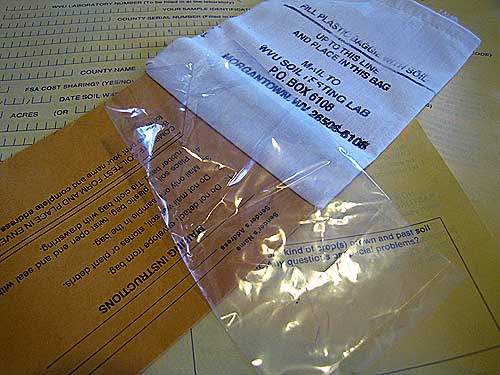
To get the kits and testing lab address for your area, contact your local USDA office. There should be an office in your county. If you have trouble finding it, your local extension agent should be able to point you in the right direction.
Here, the samples go to the West Virginia University College of Agriculture and Forestry Soil Testing Laboratory. They test for pH, lime, and other elements, and let you know what your soil needs. In most cases, I think this means lime, and the USDA offers a cost-sharing program to provide lime and low-cost rental equipment for spreading the lime.
You can sample all sorts of fields (including regular lawns! so go ahead, get your lawn tested), but most of what I’m testing are “tall grass and hay” pastures. They recommend you take as many as 30 samples from a 10-acre field. They did not, however, send a supply of tanned, bare-chested romance novel cover heroes with shovels in hand to help me do that, so I took something less than 30 per field.
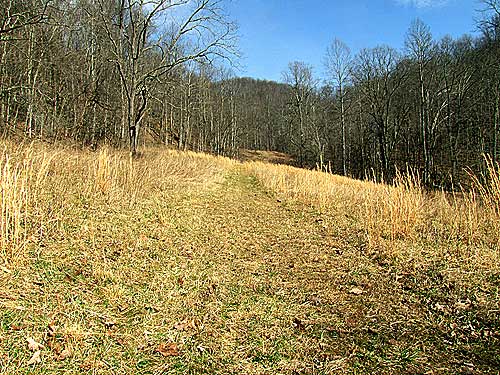
I needed to get on with my day and I was afraid I was going to miss Judge Judy.
I’m such a bad farmer!
Do you know how many holes that would be? I sampled two 10-acre fields, and two fields something less than 10 acres, then I took a few samplings to represent the barnyard fields. (These fields are smaller and close together, so I treated them as a whole, taking a few samples from each area.) But still, seriously, if I followed the instructions on the number of samples, I would have been digging something like 150 holes. Or whatever. Like I can do math. And like I’m going to dig 150 holes! They can’t be serious. I bet when they get a box of 30 samples from one field, the guys at the soil testing laboratory say, “Got another one!” and laugh so hard, they fall on their microscopes. Soil testing lab humor. They can’t fool me! I won’t be taken in!
Okay, anyway, the holes aren’t big, though that doesn’t make me want to dig 150 of them. Here’s what you do to take a sample (for a pasture area–there are different instructions for sampling other areas, such as crop fields, etc).
Remove surface organic material. (This means scrape aside grassy growing stuff and the poop.)
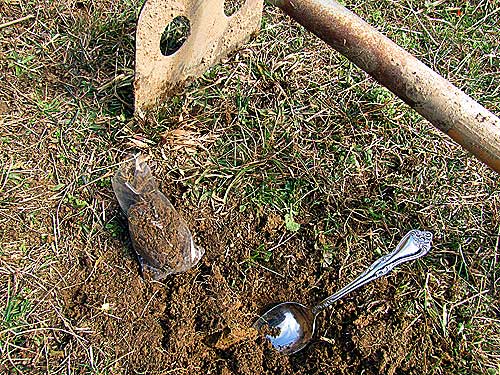
For a pasture area, you want to take your sample within the top couple of inches of the soil, discarding any roots or rocks.
They provide a cloth baggie, with a plastic baggie inside. You fill the plastic baggie and place it inside the cloth baggie. About four big tablespoons fills the plastic baggie.
The soil should be dry. Unless you sample in the summer, your samples are likely to be damp (at least around here where it rains a lot). You can spread out the soil to dry before shipping it off, being careful to keep your samples straight. You should not apply heat to the soil to dry it faster (unless it’s natural heat, the sun).
I labeled all my samples, entertaining myself with a pretense of organization. It makes me feel like a good farmer and makes up for my unwillingness to take 30 samples per field. At least in my own mind.
When your samples are dry, you just pack them up and mail them off and wait for the results. During this time, you don’t have to dig any more holes, which is the best part, and you can just ponder imponderables, like….would I rather dig 150 holes, or help Jack? What if those were your only two choices in life? What if YOU HAD TO CHOOSE ONE? That’s a toughie.

Answers? Be honest! If you were previously opposed to helping Jack, but have now changed your mind in light of all the holes, I will understand!


quinn says:
Where/how did you get the kits? I just googled and could only find kits for sale. I really need to do this. Thanks!
On February 24, 2012 at 5:01 am
Suzanne McMinn says:
quinn, oops, I will go edit that into the post. Contact your local USDA office.
On February 24, 2012 at 5:03 am
Mandys says:
I would rather dig the 150 holes..
On February 24, 2012 at 5:15 am
Old Geezer says:
I think I know which one Jack would choose.
On February 24, 2012 at 5:46 am
caprilis says:
I would help poor Jack… the benefit would be a BABY for Pokey!
On February 24, 2012 at 5:59 am
mammaleigh says:
Help Jack, I have been laying hardwood flooring in my house so I dont think my back could handle digging…haha.
I think Jack would appreciate it too!
On February 24, 2012 at 6:38 am
Janis says:
That is great information about soil sampling. By the way, random comment, I love the way you can see a reflection of the sky and clouds in the spoon!
On February 24, 2012 at 7:03 am
quinn says:
Suzanne, I don’t think all states provide free testing.
On February 24, 2012 at 7:05 am
Suzanne McMinn says:
quinn, oh no, I hope that’s not so! Have you checked with your local extension agent?
On February 24, 2012 at 7:25 am
rurification says:
Holes. Definitely the holes.
On February 24, 2012 at 7:27 am
emit says:
any time you get help from the Feds you will pay in the end. The moneys they give you will be counted as a income at the end of the year so better be careful We used them one year an yes it was nice but in the end we wished that we did it ourself.
On February 24, 2012 at 8:24 am
Cbfisher says:
Ha! What fun reading first thing in the morning. I’m waiting for a third option 🙂
On February 24, 2012 at 8:27 am
wormlady says:
Oh, Suzanne, did you send them a gazillion samples?! No wonder it takes them so long to return results.
Back when I took the Master Gardener class, how they told us to do it was to, yes, get many samples, but then to mix them all together, LET THEM DRY OUT (Extension guys said the hard balls of dried mud were left for last to be tested), and send one sample of the averaged soil.
I’d rather dig the holes. In fact, that’s on my to do list for the near future, but not so many, since I don’t have an actual farm.
P.S. There’s a new Master Gardener class starting in a couple weeks. You can probably still get in. I really enjoyed the class, and the group here is interesting.
On February 24, 2012 at 8:34 am
brookdale says:
Free? Lucky you! Here in ME we have to:
Take soil from 15 different spots in each 8 acre sample area
Place all soil in a clean plastic bucket and mix thoroughly
Fill a pint container (provided)from the bucket
Label containers
Pay…standard test costs $15 for each sample with extra costs for extra tests
Fill in form, send top sheet only with samples and payment to the Soil Testing Service at the University of Maine
Allow at least 2 weeks for results
I admit I have yet to do this, but I have the container and directions.
On February 24, 2012 at 9:18 am
June says:
Here in Mississippi, we have the same instructions for gathering the sample as Brookdale in Maine. They stress using a clean, plastic bucket (no metal). The sample cost is $7 and goes to our county extension office who sends it to MSU for testing.
Our state’s Master Gardening program began classes this week. The 40+ hour course, held over 6 weeks or so, is taught by the Agriculture/Horitculture professors at MSU and each county participates via live feed in their county extension office. Yesterday’s class was on soil and soil samples!
On February 24, 2012 at 10:02 am
TeaCup says:
I don’t really know? With my bad back, I suppose the answer would be to help Jack. On the other hand, what kept running thru my mind was that line of the Beatles, “10,000 holes in Bradford Lancashire, and he had to count them all…” 😀
teacup
On February 24, 2012 at 10:24 am
Sue, a Florida Farm Girl says:
Ours is done like June and Brookdale. We send ours to the University of Florida and it costs $7 for the test. In fact, we need to do that very soon. They normally email the results back within a week.
On February 24, 2012 at 10:42 am
FujiQ says:
Say, that’s a really nice spoon for digging holes!!
On February 24, 2012 at 10:42 am
Sheryl says:
Suzanne, there are some really great test kits available at many garden sites. Also, I vote for asking one of your sons, to do this for Jack-can’t wait to hear their answers lol!
On February 24, 2012 at 11:15 am
boulderneigh says:
Oh, I would definitely rather DIG holes than help Jack FIND a hole!
On February 24, 2012 at 11:35 am
doodlebugroad says:
I would HELP JACK.
I have had to give corralled cattle shots (in the neck) following the task of BANDING YOUNG BULLS. A few years ago, my dad wanted to save money, so instead of calling the vet in, he asked me to do the banding. He held the 250-300 pound calves and I was charged with the task of slipping on a rubber ring that is literally the size of a Cheerio cereal – slip that onto a “plier-like” contraption – get down behind the wrangled calf, grab hold of its testicles and fit them through this stretched out rubber ring and the slide it off … making sure it is as high up as possible. After a few weeks the testicles fall off … that’s how you get a steer.
After that first time, it became a regular spring event. Definitely better than cutting, but still wasn’t my favorite task. So, helping Jack would likely be okay with me.
On February 24, 2012 at 12:30 pm
Camille says:
Boy, I dunno (hesitating)…but just look at that sweet face… Would I get to wear gloves? Would cocktails be served after?
On February 24, 2012 at 1:18 pm
mermonster says:
Digging holes, sorry Jack.
On February 24, 2012 at 2:07 pm
Auntie Linda says:
I don’t know, Camille, I think I might need the cocktail first!
Soil sampling in CT is similar to Florida, Mississippi & Maine. We have a choice between sending it to UMass or UConn for results, for varying fees. They both send back the results within 2 weeks. The results from UMass are a bit more detailed.
On February 24, 2012 at 2:46 pm
CarrieJ says:
I’d help Jack. It would be much less physical effort and take less time. I’m sure of that. That’s what they make gloves for. I tried to dig a hole once. It was hard!
On February 24, 2012 at 3:23 pm
rileysmom says:
There’s the 3rd option! I’ll be in charge of cocktails….
or else I’d dig holes!
On February 24, 2012 at 3:26 pm
wanda1950 says:
What a dilemma! I do want Pokey & Jack to have a baby. Have a bad back & digging is painful. Jack might not care for having his parts manipulated. I vote for the person who examined Beulah Petunia helping Jack & getting the farm helpers to dig the holes–oh, wait, the farm helpers might be able to help Jack, too.
On February 24, 2012 at 3:40 pm
LisaAJB says:
Ummm, jack or 150 holes? I choose Jack. He’s a man so I know it will be over quickly, where as the holes could go on and on.
On February 24, 2012 at 3:47 pm
shirley T says:
Hummm!!! if I had to pick~it would have to be Jack. I’m hoping you don’t have to pay taxes on the kickstarter program.I’m so happy you got that funded.
On February 24, 2012 at 4:10 pm
Merino Mama says:
Roane County dirt. I could recognize it anywhere. Funny story — my husband and I were at CAMC Memorial visiting my dad and we parked beside an SUV that had this reddish mud splashed on the side of it. My husband being from Roane County originally said, “That’s Roane County mud.” Later on that day, as we were leaving, the people in the SUV next to us were leaving also and we heard them saying something about going through Walton! My husband just looked at me, smiled and said, “Do I know my mud or what?” 😉
On February 24, 2012 at 4:11 pm
Sheila Z says:
Bad back here… I’ll beg off both. Doctor’s orders! LOL
On February 24, 2012 at 5:13 pm
MissyinWV says:
I’m still laughing from the whole Missing Judge Judy thing and the “Gotta another one” Hillarious! 😀
On February 24, 2012 at 10:58 pm
JerseyMom says:
I’m gonna choose the holes….only because I know there are dozens -no, that’s too small a number- of donkeys all over the country in search of homes. So many end up at the slaughter house and although I know Suzanne would never send any of her furry kids to slaughter, I’d rather see a rescue donkey come to Sassafras than go to extra lengths to have Jack assisted….. So it’s the holes for me!
On February 26, 2012 at 8:23 pm