
First, go downstairs to the freezer and get out a big bag of fat. If you don’t have a big bag of fat, you’ll have to go to a butcher shop. Trust me, it’s worth it. Making your own lard is easy! It’s fresh, natural, and not hydrogenated like store-bought lard, and if you grew your own pig, you know exactly what it was fed. I hear tell it makes the best pie crusts in the world and I can hardly wait to make some. I made my first homemade lard this week and was instantly hooked. No more lard from the store for me.
Lard has a bad rap, but don’t let the Crisco people fool you. You should see what’s in shortening! Lard, home-rendered, is actually good for you. Generations before us thrived on traditional fats, which are much healthier for you than man-made. Lard is a real, natural food–don’t be afraid of it!
 Printer-Friendly
How to Make Your Own Lard:
pork fat
water
(Short ingredient list.)
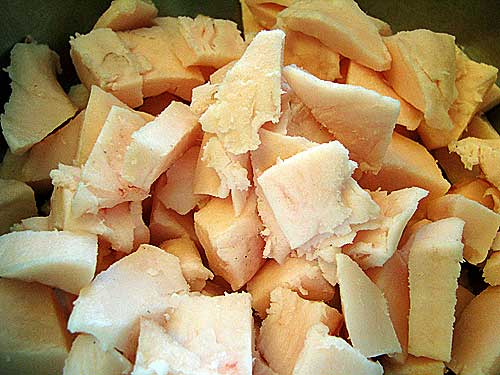
To render lard for baking, the best pork fat is kidney, back, or belly fat. Freeze the fat first to make it easier to handle–cutting up the fat is a messy job. Chop it into about 1-inch pieces. (Some people even grind the frozen fat. The smaller the pieces of fat you start with, the quicker it will render.) How much fat you render at once doesn’t matter–however much you want to work with at a time.
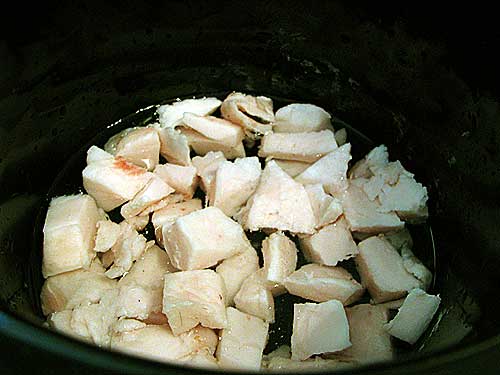
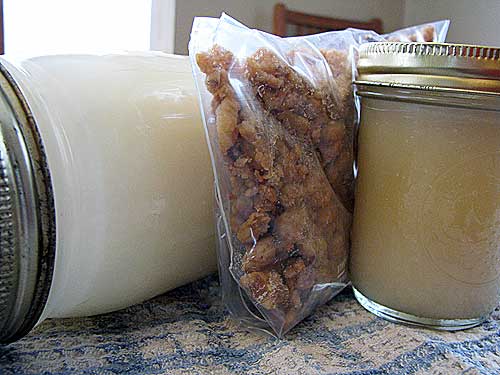
Use a large cast iron kettle or dutch oven to cook it on the stovetop or cook it in a crock pot or the oven. Cook the fat any way you choose–the method is similar no matter which way you do it. I used a crock pot, and for my first batch, used a small quantity of fat, enough that about filled up my small 3 1/2-quart crock pot. This rendered down to a quart of regular, creamy-white baking lard plus a half-pint of what is called savory lard and the cracklins. (You actually get three products out of one job! The mild baking lard, the savory lard, and the guilty pleasure of the cracklins.)
First add water to cover the bottom of the pot or pan you’re using to cook the lard then add a layer of fat pieces. The water will eventually cook out–it’s just there at the start while you get the first pieces of fat melting so the fat doesn’t stick to the bottom.
Cook the lard slowly. I set my crock pot on low and kept the pot uncovered throughout the process. When you see the first pieces of fat floating and turning white, the rendering has begun.
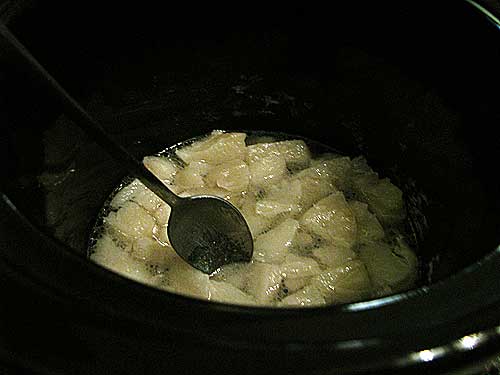
Go ahead and put in the rest of the fat.
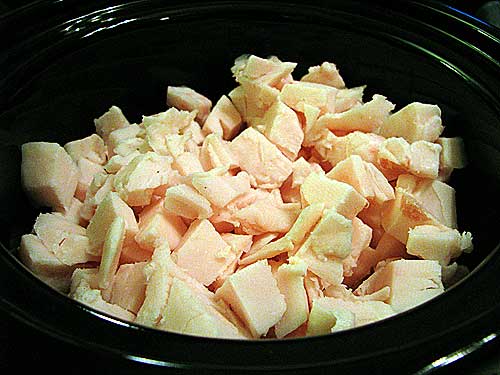
You can stir it occasionally, but it doesn’t need a whole lot of attention. It knows what it’s doing. It doesn’t need your help. The pieces will float as the amount of melted fat increases.

Eventually, the pieces of fat will sink to the bottom–those are your cracklins-to-be. Stick a spoon in there and you’ll see your nice, clear liquid fat. The cracklins will still have a puffy fatness to them. (Not crispy yet.)
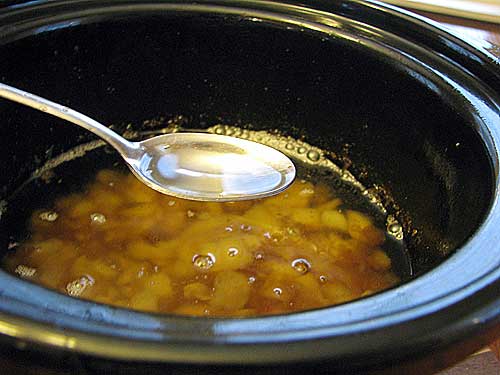
You want to render your good, mild baking lard before you finish the cracklins. When you see the pieces sinking, it’s time to get the good stuff. In my crock pot on low, this took about 12 hours.
Line a colander with cheesecloth.
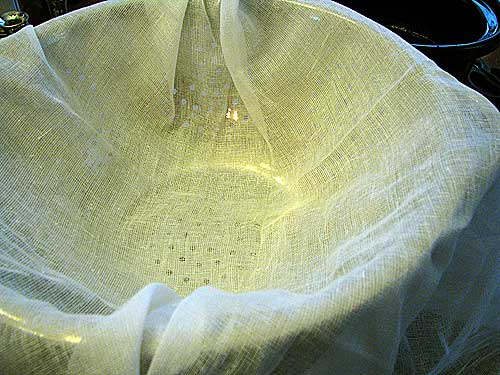
Strain the lard into the colander. I used a bowl underneath to catch it that has a pour spout, the easier to then pour my lard into a canning jar for storage.
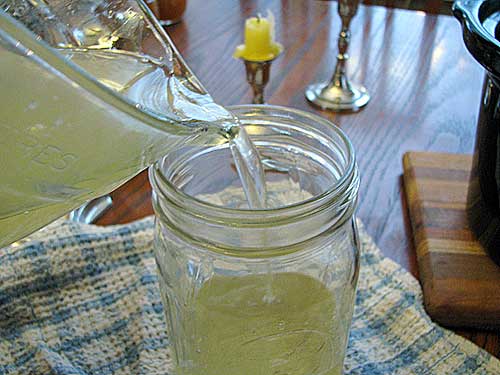
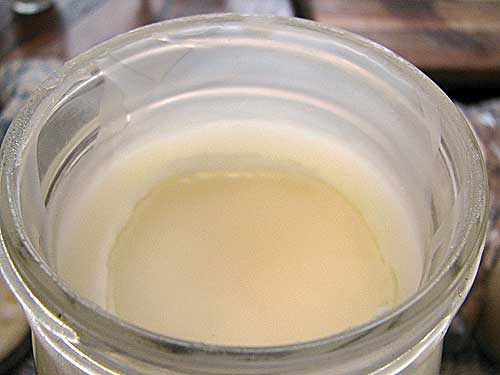
Be careful, pour slowly–you’ll make a mess if you pour it out too quickly. This first rendering of clarified lard is perfect for pie crusts and other baking uses (and also for soapmaking). It will be mild and turn a gorgeous white once it sets. Chill it quickly for best texture. I put mine in the freezer for about an hour then once it started to set, transferred it to the fridge.
Here are the cracklins, left after the straining. See how you can still see a lot of puffy fat to them.

I dumped the cracklins back in the crock pot and returned the heat to low. I cooked the cracklins for about another hour and a half, until they were crispy and golden.
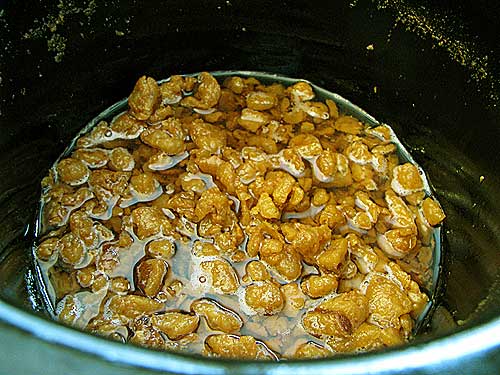
Cracklins are delicious sprinkled over salads or on top of casseroles. (Think Durkee fried onions and green bean casserole. Anything where you’d use fried onions, you could use cracklins.)
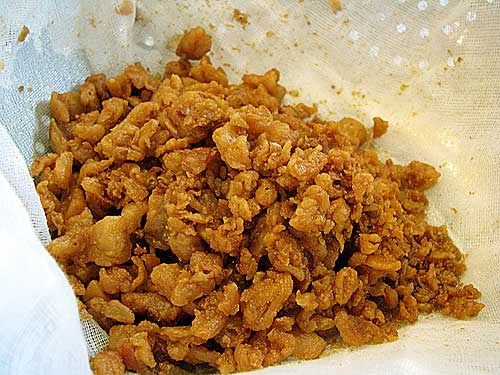
Again, I strained the lard into a cheesecloth-lined colander, clarifying this second rendering, then set aside the cracklins to cool. After the cracklins were cool, I put them in a labelled storage baggie and stuck them in the freezer for next time I’m making a casserole. I poured the strained second rendering into a half-pint jar. This is what is referred to as “savory” lard. Because it was made from cooking down the cracklins, it has a much stronger flavor. You can use it for various savory cooking purposes–it’s just probably not something you’d want for apple pie. It will set to a light amber color.
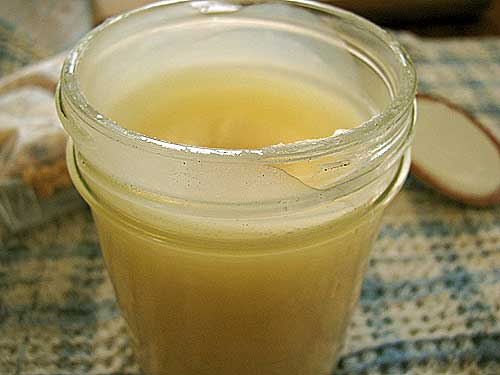
To store your home-rendered lard, choose whatever method you prefer. You can keep it in the fridge (or freezer, if you’ve made a large quantity at once). You can store it right on the pantry shelf–many people say they do that. You can even can it. I’m keeping mine in the fridge.
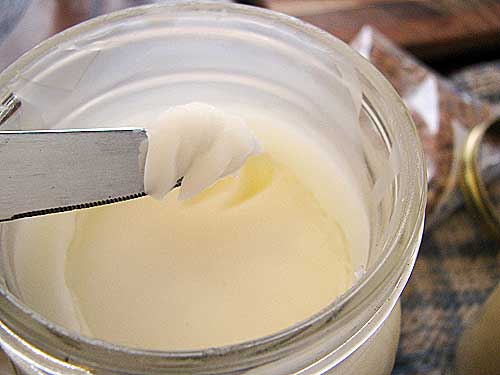
Beautiful, creamy homemade lard. The mild first rendering is a wonder to behold. I see biscuits.
Making your own lard is incredibly easy and takes you another step closer to your food and its origins (and even more natural homemade soap). Any recipe that calls for shortening–pie crust, cookies, biscuits, frying french fries, and so on–can be made with lard instead of shortening. The rendering process does take a good amount of time, so be sure to take that into account in making your plans. Now that I’ve familiarized myself with the process, next time I’ll cut the fat up the night before, stick it in the fridge to keep, then start it in the crock pot first thing in the morning. I think I’ll try it in my cast iron kettle next time, too. (Think of the seasoning that’ll be for my cast iron!) How long it takes for you will vary depending on the amount of fat and the starting size of your fat pieces. Remember, however, that the rendering needs little tending while it’s taking place. I made the mistake of starting mine in the evening and I actually turned it off when I went to bed then got up in the middle of the night and turned it back on. The first rendering was ready when I got up in the morning. I was sleeping during several hours of the cook-time after I turned it back on. (The 12 hours for my cook time is the total minus the time I had the pot turned off.)
I’ve got plenty more fat in the freezer and I’ll be making my own lard from now on.
I want to thank Cathy, who inspired me with her lard-making experience. You can read a whole discussion on the Chickens in the Road forum here about making lard. The discussion also includes links to other resources on methods of rendering and also on canning lard. You can render fat from any animal, by the way. It’s an amazingly simple process that is old-fashioned, natural, and traditional–and as good today as it was for the generations that came before us.
See this recipe at Farm Bell Recipes and save it to your recipe box.
See All My Recipes
Printer-Friendly


Memoria says:
This is great! I didn’t know you could render lard in a crockpot. That sounds so much easier. Thanks for posting this. I’m looking forward to seeing your pie crusts.
On February 27, 2010 at 1:40 am
Jo says:
That is so awesome, Suzanne!
I get so mad when I think of all the ways we’ve been deceived into thinking that things like “Crisco” is better for us than lard. They really turned lard into a “four-letter word” but hopefully we are getting wiser.
I have read quite a bit about lard too but I’m not sure where I can find fat like that around here. I’m not sure if my local grocery store’s meat dept would have some? Or if a meat locker not far from here would?
So sad how far away from real food we’ve gotten, but thanks to you and many others on the ‘net for educating us! :happyfeet: :shimmy:
On February 27, 2010 at 2:23 am
Charlotte says:
So does lard from other animals taste any different? I have a few steers which we homekill for our own beef and I’d love to render all the fat we get from them, but would it be suitable for baking?
On February 27, 2010 at 2:49 am
Charlotte says:
So I just went and read the forum on lard. Maybe I could just use the beef lard for soapmaking…and then convince my husband we need to get a pig 😉
On February 27, 2010 at 3:23 am
Karen Anne says:
Vegetarian, goes off to lay down with cool facecloth over face 🙂
Are you going to show us Easter eggs? The latest box of eggs I got from the local organic place came with directions for natural dyes. I think I will try some fo those.
On February 27, 2010 at 6:33 am
carsek says:
I want some lard, Real lard. Well, I’ll have to check around and see what I can find for fat. And it is a shame what they have done to our food. It is prossessed so much anymore that there isn’t any “goodness” left to it. Why else would they add so many vitamins? If you knew what was in your carton of milk you wouldn’t drink that any more either. Can anyone say “bleach”? Yuk!!
On February 27, 2010 at 6:35 am
Hlhohnholz says:
If any of you have a Carniceria (a Mexican butcher shop) nearby, that would be a good place to get your fat. 🙂
On February 27, 2010 at 6:48 am
CindyP says:
I’ve been waiting patiently to get out of bed to see these pictures! After all the discussion on the forum, I wanted to see pics!
I’ve got to get on this!
Does it feel creamier than store bought? It looks creamier!
On February 27, 2010 at 6:58 am
Penny says:
Suzanne – Once you make your pie crust using lard, you will never make them using any other type of fat/oil. Wonderful!
On February 27, 2010 at 7:10 am
Suzanne McMinn says:
Penny, I do make my pie crust with lard, I’m just looking forward to making it with homemade lard now!
On February 27, 2010 at 7:16 am
Johanna says:
I’m with Karen Anne. Wake me when it’s over.
On February 27, 2010 at 7:15 am
Diane says:
That looked so easy. I am not sure I will try this one. But I am will check into the discussion about Lard If I can find it I would use it more than shorting. Thanks!!!
On February 27, 2010 at 7:43 am
glenda says:
Would you believe I made lard yesterday! I was glad to hear about the re-rendering method for cracklins and savory lard. First time I have heard that technique. I saved the fat globules and will do that today. I have another bag of fat to render today.
I have also rendered beef fat using the same technique.
I use the tallow for soap making and cook with the lard. I hate to waste it on soap!
I remember when the grandparents had hog-killing time in the fall and butchered the pigs. They rendered the lard
outside in a large iron kettle over an open fire and stirred with a long paddle.
I have another package of fat to render today. I think I will post about it on my blog for others to see my process.
On February 27, 2010 at 7:48 am
Susan at Charm of the Carolines says:
It’s hard to believe, but it’s true. Lard is not bad for you in moderation. Just like bacon isn’t bad for you. Our grandparents ate it every day on the farm and lived to be a ripe old age. Amazing what propaganda we get over the years from special interest groups. Thanks for sharing this post today!
Susan
On February 27, 2010 at 8:00 am
Jenny says:
You made that look simple and doable. I had the butcher shop save the fat from our pigs, and it’s in the freezer. I planned to make some up for using in soap, but I’ll have to use some in the kitchen also.
~Jenny~
On February 27, 2010 at 8:06 am
ElizaRed says:
I can remember neighbors helping with hog butchering, the big ole iron kettle over the outside fire and stirring with the long handled paddle. Wonder if it was the same kettle as the apple butter was made in??
These days, however, I will stick with olive oil for my salads…no longer make/rarely eat pies and biscuits. Reminds me a bit of the “heart healthy” sticker in the vending machine at work being placed on the fried pork rinds…feel my arteries clogging just thinking about pig fat.
On February 27, 2010 at 8:13 am
Phyllis Ryan says:
I remember my mother’s pie crust, made from lard. Jo is so right. Margerine is one step down from plastic, but they tell us butter is the enemy. The lard looks beautiful and will make great pies.
On February 27, 2010 at 8:17 am
Marymac says:
I made a small amount of lard not long ago, it was so good. It brings back memories of my child hood. When I was little my brothers and sister would put lard on bread as a snack instead of butter, sprinkled with a little salt. This was so good. times were tough and butter had to last our family of 7. We had more lard than butter. Guess what? It still is good, but only the homemade kind.
On February 27, 2010 at 8:32 am
KentuckyFarmGirl says:
We just picked our hog up last week and I have a freezer full of pork! I made sure to ask for the fat. I have 3 bags of the little strips of fat and one big bag of scrap fat. I never thought about rendering it in the crockpot!!! Have I told you lately that I LOVE your blog and the wealth of info that you share with us?
I rendered just enough last week to make suet cakes and the birds were crazy about it!
On February 27, 2010 at 8:44 am
CntryLadi says:
I love to put cracklins in my cornbread when I make it. My dad raised our own meat when I was a child and mom would always render the pork fat. We could not wait for her to make cornbread with the cracklins!!
On February 27, 2010 at 8:45 am
Linda says:
Does this mean Sausage and Patty went to freezer camp? I can’t wait to find some pig fat and try this. Thanks Susanne for the post.
On February 27, 2010 at 9:27 am
Tammy says:
I read this post just in time this morning. I just trimmed alot of fat off of a picnic shoulder and put the shoulder in the crock pot. I was gonna throw the fat away. I quickly rethought that after seeing this post and put the fat into a plastic container and put it in the freezer. I should have known better but I have forgotten some things from my childhood. Thanks for reminding me. Blessings to you.
On February 27, 2010 at 9:28 am
Debnfla3 says:
I’ve helped Mama do this a hundred times or more and the lard IS wonderful. But the cracklin’s……oh my goodness! We always used ours to make cracklin corn bread!! Now that is what cracklins were made for down here in the south!
Nothing better than a pan full of cracklin corn bread and a pot of collard greens!!! Well, perhaps a sweet tater full of home made butter and a pig foot to go with it all…hahahahahahaha
On February 27, 2010 at 10:21 am
Robin G. says:
This is interesting! I’ve been rendering chicken fat for awhile now — I put the fat in a pot with water and just let it boil on high until the water is gone. I don’t get very high quantities (after all, it takes a lot of chickens to get enough fat), but I’ll usually get a cup or two. I use it in place of butter or olive oil sometimes, when I want a chicken-y flavor to something I’m cooking (like lentils) without going through the trouble of actually adding chicken. (I do the same with duck fat, though I rarely have duck, so that’s a real special occasion.) This would get me a much higher quantity, though — I will have to stop by the butcher’s and give it a shot!
On February 27, 2010 at 10:48 am
Richelle says:
We’ve been butchering our Iberian pigs for a couple of years now and I make lard exactly the same way. In both varieties as well. The only difference is that here in Andalucia they don’t believe in the slow crockpot method. Just put the pan full of fat with a cup or so of water on high and stir frequently. Only lower the temperature once you have rendered the clean lard because then the cracklings burn all too easily and that is not a smell you will enjoy lingering in the house :smilerabbit: Try the savory lard next time you make your recipe for fat tortillas, it’s lovely! And the cracklings will be even tastier if you leave some meat to the fat when you butcher the pig.
Greetings from Andalucia, Spain
On February 27, 2010 at 11:01 am
Sharon Gosney says:
When I would buy a 1/4 cow,I asked the butcher for everything. I would render down the fat into blocks and use it for deepfrying. It sure gave whatever I’d depfry such a delicious flavor…nothing store bought could ever stand up to home made.
And you are so right there’s nothing like making pie crust using lard…it so flakily and taste so much better than using shortening.
On February 27, 2010 at 11:09 am
Aedrielle says:
Thank you, Suzanne, for waking people up to the fact that animal fats are not bad for you. They are the most natural of fats and people have been eating them for thousands upon thousands of years – well before cisco and margarine. AND those people didn’t have obesity, diabetes, cancer, etc.
I was a devout vegan for many years because I thought I was being ‘healthy’. However, I gained 70 pounds in those several years and developed pre-diabetes. About five months ago I read Nourishing Traditions by Sally Fallon and my whole world changed! I continued reading on the subject of traditional diets and read Real Food by Nina Planck, Good Calories Bad Calories by Gary Taubes and Full Moon Feast by Jessica Prentice. They all tell of traditional cultures and how they ate – and how backwards modern society is with regards to nutrition.
Since I started eating more animal fats and proteins, I’ve dropped weight, I have so much more energy, I haven’t been sick, my cholesterol is back within normal ranges (after having been very elevated while vegan), and my blood glucose is down significantly. Sadly, our modern culture has the facts all wrong and continues to feed this backwards thinking to the public. Fats ARE good for you – animal fats. Rancid, hydrogenated, unnatural vegetable fats (soy oil, corn oil, margarine, etc) are the worst fats and wreak havoc on your body.
To everyone: If you’re at all interested in nutrition (or losing weight, or getting rid of diabetes, high cholesterol, etc) I encourage you to read the books I listed about and watch the documentary ‘Fat Head’ (which you can find on NetFlix). These things changed my life and now I feel I need to help spread the word so that others can feel as healthy and wonderful as I do!! 🙂
On February 27, 2010 at 11:28 am
Leah says:
Never had the makings for lard,but I always have a cup of bacon grease in the fridge to season things like gr beans! Learn something new every day,it’s so easy it’s pathetic! Enjoyed the post.
On February 27, 2010 at 11:44 am
Debnfla3 says:
I keep a jar of bacon grease too for seasoning.
On February 27, 2010 at 1:06 pm
Flatlander says:
When we bought our farm, we found a big cast iron “tub” in the bush.
No idea what it was..until the old owner told us it was made for lard making in the past.
Of course that tub is rusted and old..and NO I’m not going to make lard in that one..although it would be a nice picture me stirring the lard in a kettle above the fire.
Our pig is just a weanling…but in a few months..I think I have both my slowcookers going… :hungry:
On February 27, 2010 at 1:18 pm
Estella says:
We used to raise our own pigs, so have done this before, but not with a crock pot. It is wonderful.
On February 27, 2010 at 3:53 pm
JoJo says:
Oh for peats sake Suzanne — now what have you got me into! :hungry: I just called the butcher and had him put me some to the side. I’ll post an update when I finish my first batch of lard! And I’m still waiting for the soap book to arrive that I ordered so I can follow you on your next adventure! :happyflower:
On February 27, 2010 at 4:37 pm
LeAnn says:
I have some beef fat in the freezer, maybe I’ll try making some lard. When I was a kid we rendered out pig fat, but never beef. I don’t know why, we raised all the meat we ate. My dad rendered out some bear fat once. It smelled terrible and the meat wasn’t too good either. No one wanted to use the lard, so he used it to grease his work boots. It worked well for that, except his boots smelled like that nasty bear grease!
I just printed out two more of your recipes. I’m going to have a whole cook book of them if I keep it up! I am allergic to soybean oil and they seem to put it everything (along w/a bunch of other junk). I’ve printed a few of your “mix” recipes so I can control what type of oil, if any, goes in. They are handy when time is short and DELICIOUS! Thanks again!
On February 27, 2010 at 8:35 pm
Runningtrails says:
Beautiful job! I render my own fat too, all kinds of fat, not just pork. I save it all in the freezer for fall soap making.
On February 27, 2010 at 10:42 pm
Becky says:
Wow! You have opened my eyes! I googled the health of lard and I was astounded at how much better it is for you then I thought it was! This post was perfect timing because I was getting ready to go pick up some pork and beef from a local farmer and I asked him if he had any pork fat. He did!! What luck! I’m planning on trying my hand at rendering very soon. 🙂 Thanks!
On February 28, 2010 at 7:16 am
Crystal says:
haha – great minds! I made lard for the first time this week, and just posted on it too! yay for lard! 😀
On February 28, 2010 at 1:26 pm
Crystal says:
also – your instructions are really good! I’m going to have to try the crockpot next time. I did mine stove top and I had a feeling I wasn’t quite getting everything I should out of it.
On February 28, 2010 at 1:30 pm
Tobey says:
Oh, yes, cracklin’ cornbread. I can hardly wait until you try some with your cousin’s fresh ground meal and your own cracklins! NOW I am hungry…
On February 28, 2010 at 4:44 pm
Phyllis says:
We just butchered a hog a couple of months ago. I rendered all the fat we could get from it (very lean hog). My parents did this every winter at butchering time. I love using homemade lard and yes I believe it’s much better than store bought healthwise. I use it in practically everything I cook. I also save all the bacon grease for seasoning food. Homegrown lard, homegrown chickens, homegrown eggs, homegrown vegetables,etc.—–that’s what I’m talking about. :snoopy:
On February 28, 2010 at 5:36 pm
Chic says:
Another project for the future…YEAY!! This reminds me of my Grandmother who used to save all her ‘drippings’ in a jar. She never made her own lard though and that’s just waht I’m going to try out one day down the road. Thanks Suzanne and Cathy for the great idea! :hungry2:
On March 2, 2010 at 12:45 pm
Kris says:
Thanks for passing this on. I am going to give it a try simply because this is what my grandmother had to do (sans crock pot of course). Other than flour and sugar, nothing else was purchased at the store.
Not only is this about good food, it’s a little bit of history.
On March 2, 2010 at 3:02 pm
Heidi says:
LeAnn – dont use beef fat. Its not the same thing. 🙂 There is NO compairing boughten lard to home renedered. Once in a while though, you might get a pig that was butchered that has a ‘piggy’ taste to it. Usually, its an older male pig that has been butchered so the fat is ‘tainted’with that smell. BUT, if you have a good butcher and tell him you want fat for lard, he will get you young hog fat!! NOTHING BETTER!!!!
I have missed you SUE! hope you are well!
On March 5, 2010 at 8:34 am
Barbee' says:
I think I will try this. But, I’m wondering: what do we use the savory lard for? I understand using the white lard for baking, and I know about crackling bread; it’s the darker savory lard I don’t know what to use it for. I will go over to the forum to see if that is mentioned. But, I will check back here for a few days to see if I get replies. Thank you.
On March 7, 2010 at 11:02 pm
Suzanne McMinn says:
Barbee, I haven’t used the savory lard yet, but I would/will use it for anything where I’m not making a dessert out of it! I’d use it for pie crusts for meat pies. Tortillas! Biscuits where I’m making a savory biscuit. Etc. Anything like that!
On March 8, 2010 at 6:22 am
Helen says:
I have been wanting to make home-rendered lard for so long, and I had found a local source of pig fat, but was still hesitant because I wasn’t sure of how to proceed, when lo and behold, your post on home-rendering lard appeared! Well, today I went and bought 30lbs of pig fat that I am going to render into lard over the next few days, using my 6 quart crockpot. Thank you so much, Suzanne, for the clear and concise instructions that you give to so many old-time, country skills that so many of us want to learn. And since I now know of a good, reliable, consistant source of pig fat that is only about an hour away from my home, I can render lard whenever I need it!
On March 9, 2010 at 7:22 pm
darlene says:
Can you also make lard from bacon fat?
On March 18, 2010 at 1:47 pm
Suzanne McMinn says:
Darlene, you can save bacon grease and use it, of course, but it’s not quite the same thing as lard.
On March 18, 2010 at 4:10 pm
Prudence Kinley-Ruth says:
I have a large 23 gallon Butcher’s rendering kettle stove that is embossed with steer heads if anyone is interested. We sold the farm and have no use for it now. It’s really neat. I used to make huge batches of chicken corn soup in it and sold the soup at Craft Shows I promoted on our farm. People loved it. They’d stand around it and smell the smoke, enjoying their homemade soup. I’m asking $500.00 for it and we are in Pa.
On June 2, 2010 at 4:31 pm
Tammy @ Not Just Paper and Glue says:
Wow! Thank you so much for this! The next time we butcher pigs I am going to ask for the fat. Wish I had read this article a few weeks ago because we just got pigs back from the butcher so it will be awhile for the next batch.
On September 9, 2010 at 6:29 pm
CATRAY44 says:
I finally tried lard in my crock pot again… I loved doing it this way. Not sure why I didn’t like the results the first time, other than my crock pot was very old and I now have a new huge one. It came out perfect!
On September 19, 2010 at 7:23 pm
Sheila says:
Bought some fat today and I’m gonna try and do this either later tonight and let it cook all night or just start it in the morning when I get up 🙂 (hubby is gonna make fun of me for this I know , but I don’t care , I want to start making my own stuff LOL).
On November 13, 2010 at 5:22 pm
Sheila says:
Ok I got most of my fat cut up but some pieces still had little bits of meat left on them that I couldn’t get off , is it ok to leave that on there?
On November 13, 2010 at 9:48 pm
Suzanne McMinn says:
Sheila, yes, that is okay!
On November 14, 2010 at 7:24 am
Sheila says:
I made cookies last night using my homemade lard and not only did they turn out delicious but nice soft and chewy as well :).
On December 6, 2010 at 10:46 pm
Sheila says:
I made some more lard yesterday , but both renderings came out dark like savory lard , did I do something wrong? I let the first rendering go for 12 hours and the second for an hour and a half , did I not let it go long enough or too long? The first time I did this , my lard came out beautifully (though I still haven’t used the savory lard yet), any idea what I might have done wrong?
On December 13, 2010 at 8:50 pm
Suzanne McMinn says:
Sheila, the first one sounds long enough but an hour and a half on the second one???
On December 13, 2010 at 9:29 pm
Sheila says:
I must have misread that , I thought thats how long you were supposed to let the second rendering go for , should I shorten or lengthen the time on it next time?
On December 13, 2010 at 11:51 pm
Suzanne McMinn says:
ohhhh, no, Sheila, I misunderstood. I thought you meant a completely separate rendering. It sounds like you did it right, so I don’t know why you didn’t get any clear lard. It could be an issue with the specific fat. You might want to post on the forum about it as there are several people there who render lard regularly who might have more insight/ideas than me!
On December 14, 2010 at 6:33 am
Jess says:
Pork is rather limited and expensive where I live. I managed to get a huge pack of pork rind today, it has a very thick layer of fat or skin (I am not sure which is which). I would like to try making lard out of it – do you think it is going to work?
On January 14, 2011 at 4:32 am
Suzanne McMinn says:
Jess, you can render any kind of fat. Certain fats are more desirable than others, but you can always try whatever you have and find out if you like it.
On January 14, 2011 at 7:26 am
mycookinghut says:
Beautiful! I love the crispy bits, in my noodles espcially! :woof:
On January 28, 2011 at 7:43 am
maria says:
Tamales came to my mind yum!!!
On March 31, 2011 at 6:26 am
KieferOgburn says:
Thanks for this post! We rendered about six pounds of fat from a Boston Butt in two processes. The first process was run at too high of a temperature, the second was not. We ground the fat using the smallest aperture disk on our electric food grinder and processed using a three station slow cooker (“Crock Pot”). We located “pork fat” at our local HEB market, however the meat department manager was unable to tell us where the fat was removed from the pork (the product was not cut at the store). The fat looks quite white and has very few blood spots, it is priced at 98 Cents (USD) per pound. Your thoughts and suggestions are appreciated!
Robert and Lynn in West Texas
On November 20, 2012 at 10:38 am
Suzanne McMinn says:
You can render any of the fat–it’s just some parts of the pig is considered more premium fat. I would render any fat I could get my hands on, LOL.
On November 20, 2012 at 10:49 am
aquaria says:
You are my hero. And you made it look a lot easier than how my grandmother did it. Of course, she was working from whole hogs, so that sorta changes things a bit.
On April 16, 2013 at 5:46 am