
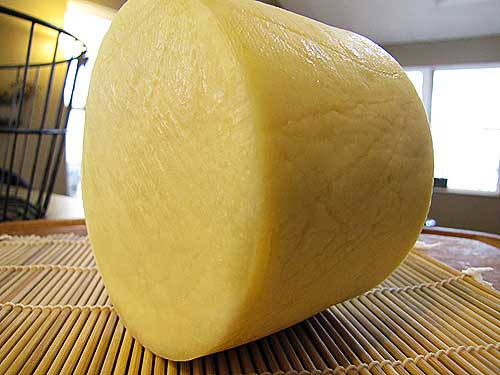
Romano is one of the world’s oldest–and most popular–cheeses. It’s great on top of pasta and garlic toast, and is a key ingredient in many Italian recipes. Named after the city of Rome, it was a favorite of the emperors. It’s a hard, salty, sharp cheese that can be made with sheep’s, goat’s, or cow’s milk (or a combination). If you make it with cow’s milk, add lipase powder. (If you haven’t tried lipase in your Italian cheeses yet, try it! I used to make mozzarella without lipase. Once I started adding lipase, I was hooked on the flavor it adds.) Lipase is an enzyme that adds the particular flavor you find in Italian cheeses, many of which were originally made with goat’s or sheep’s milk.
The only Italian cheese I had tried for a long time was mozzarella, and I had a hard enough time conquering that one. I would look over the Romano recipe periodically and turn the page. I was afraid to try it. But, I’m not allowed to be scared now! I have my cheese challenge for New England Cheesemaking to tackle, and with my goal to make all my own cheese, I couldn’t wait too long to start making Romano. I love Italian food, and unless I want to give up lasagna forever, I’d better get some Romano or Parmesan going because it takes a long time to age. I haven’t tried Parmesan yet, but it’s a similar process to Romano, so I’m eager to try it soon now that I’ve conquered Romano. And yes, I mean conquered! This cheese is so much easier than I expected.
Romano requires thermophilic starter, which is a bacteria that thrives on higher temperatures. Mesophilic starter, which is the starter I’ve used in previous cheese challenge recipes such as Monterey Jack, is actually killed by heat higher than 104 degrees while thermophilic, on the other hand, is inactive at lower temperatures. The process of creating Romano requires heating the milk up to 116 degrees.
The following recipe is from Ricki Carroll’s Home Cheese Making.
 Printer-Friendly
How to make Romano cheese:
2 gallons low-fat milk (2 percent)
6 ounces heavy cream
1 packet direct-set thermophilic starter
1/4 teaspoon lipase powder, dissolved in 1/4 cup cool water
1/2 teaspoon rennet, dissolved in 1/4 cup cool water
cheese salt and water for brine
1-2 tablespoons olive oil for the rind (later)
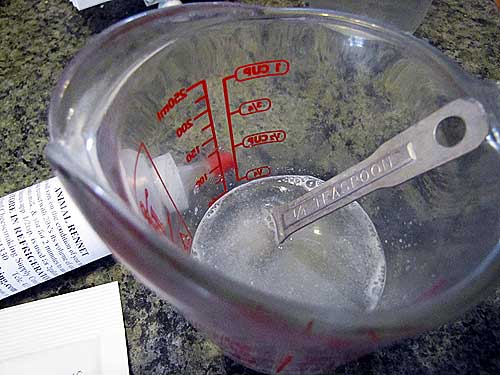
Start by placing the lipase powder in the water to dissolve.
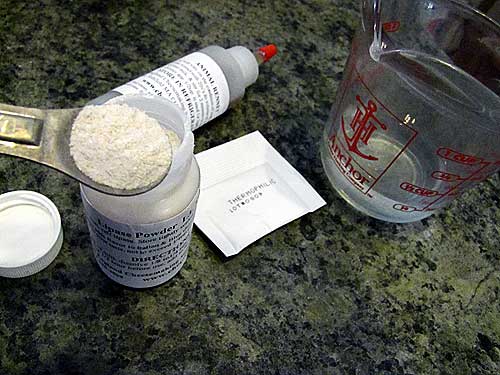
For best flavor, you want the lipase powder to sit, dissolved, for 20 minutes before adding to the milk, so get this going before you start heating your pot of milk.
The lipase powder seems kind of clumpy when it goes in.
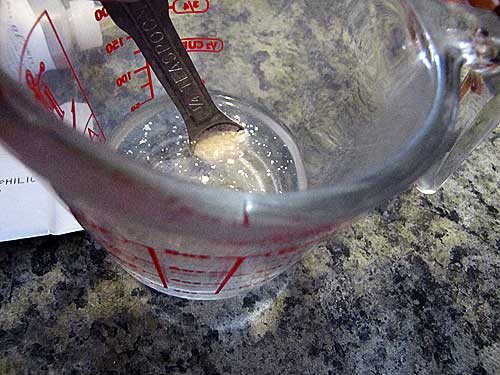
But don’t worry–it dissolves perfectly as it sits. Once it dissolves, stir well and wait 20 minutes.
To make the cheese:
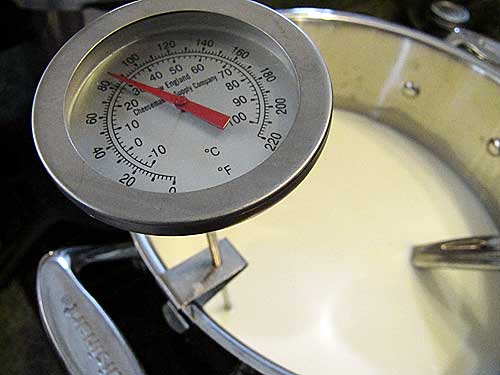
1. Heat the milk to 88 degrees F.
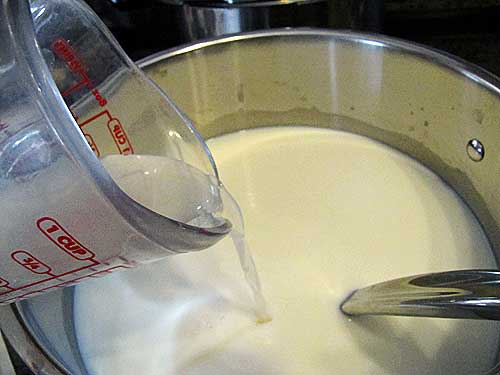
Add the cream. Add the starter and mix well. Add the lipase, if using.
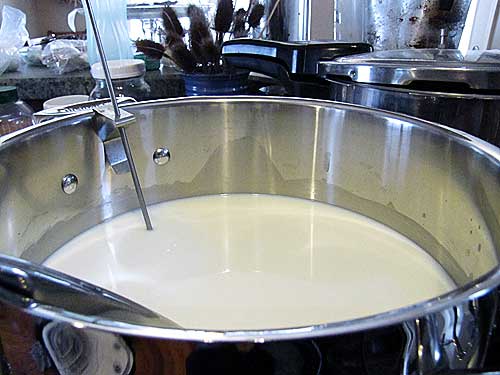
Cover and allow the milk to ripen for 10 minutes.
By the way, I got a new 12-quart stainless steel pot to use for two gallon cheese recipes and I am loving it. It’s just the right size for two gallons of milk.
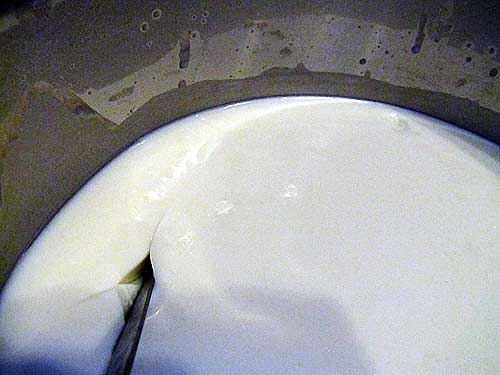
2. Add the diluted rennet, stirring gently with an up-and-down motion for several minutes. Cover and allow to set at 88 degrees until the curd gives a clean break. (For me, this takes about an hour.)
This is what a “clean break” means. If you put a knife in there, you could separate the curd without it falling back all over itself. It will firmly separate.
3. Using a curd knife and/or stainless steel whisk, cut the curd into 1/4-inch cubes.
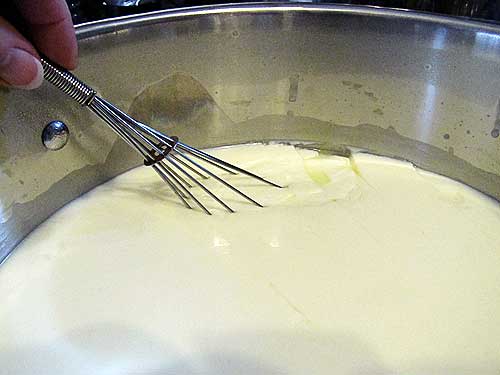
You need nice small curd cubes for Romano. It’s okay if all the pieces aren’t exactly the same size.
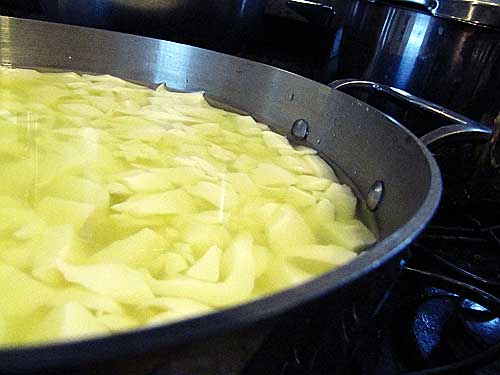
4. Heat the curds to 116 degrees over the course of 45 minutes, raising the temperature by 2 degrees every 5 minutes at first, then gradually increasing to one degree per minute. (I do this by turning on and off the heat every few minutes. Watch the temperature constantly. This is The Hour of Paying Attention to the Romano. Don’t go doing something else.)
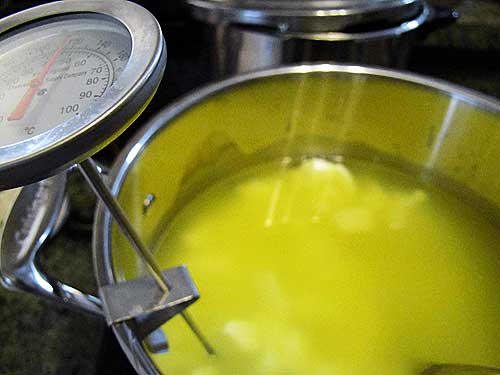
Maintain the curds at 116 degrees for 30 minutes or until they become firm enough that they retain their shape when squeezed.
The curds will have become much smaller now as much of the whey has been expelled.
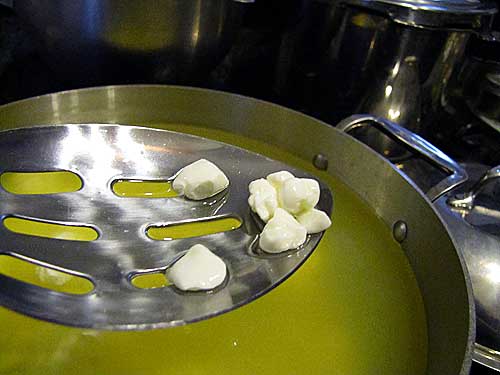
Take a few curds into your hand and squeeze them to test.
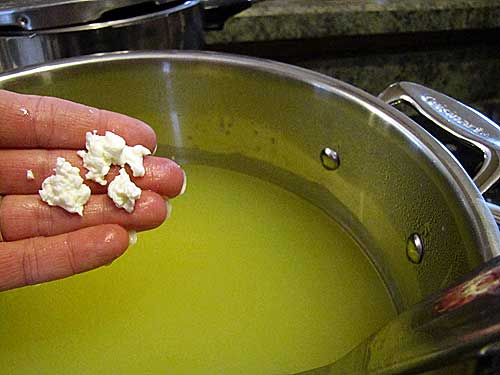
5. Drain off the whey.
6. Line a 2-pound cheese mold with cheesecloth. (You should be getting your mold lined while you’re heating the curds. Have it ready. Don’t dawdle!) Place the curds in the mold.
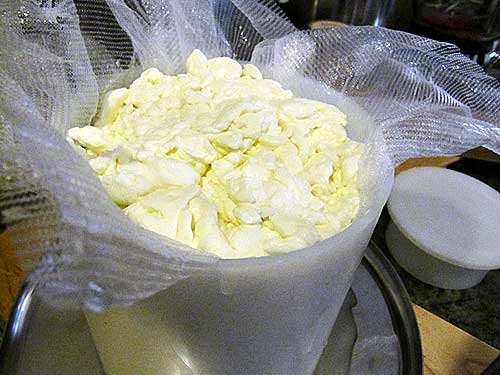
Press at 5 pounds pressure for 15 minutes.
7. Remove the cheese from the mold and gently peel away the cheesecloth. Turn over the cheese, re-dress it, and press at 10 pounds pressure for 30 minutes.
8. Repeat the process but press at 20 pounds pressure for 2 hours.
9. Repeat the process again but press at 40 pounds pressure for 12 hours.
10. Remove the cheese from the mold. Peel away the cheesecloth. Make a brine using 2 pounds of cheese salt and a gallon of water. (I actually use smaller bowls and smaller brines now to save on salt, just be sure that you keep the ratio of salt to water in your brine the same and that it is enough to immerse the cheese.) Soak the cheese in the brine for 12 hours in the refrigerator.
11. Remove the cheese from the brine and pat dry. Age the cheese at 55 degrees and 85 percent humidity. Turn it over frequently and check for mold. If there is any, you can remove it with a cloth dampened in vinegar or salt water. (I haven’t had trouble with mold on my Romanos–possibly because it’s a more dry cheese.)
12. After 2 months, lightly rub the cheese with olive oil to keep the rind from drying out. (Note that you only need to use one or two tablespoons of oil.) Age for another 3 to 10 months.
Yield: 2 pounds.
Romano is sharper and dryer the longer you age it. It can be used as a “table cheese” after only 5 months, but if you want that wonderful, hard, flavorful Romano that you can grate on top of your pasta and garlic toast, you really want to wait a year.
A YEAR.
This could be the longest year of my life.
My experience: I love making Romano! Here’s why: IT’S EASY. And fast. It’s one of the quicker hard cheese recipes I’ve tried. From the time you put the milk in the pot to the moment you put it in the press is only 2 hours. And half of that time is when the milk is setting up and you don’t even have to do anything. Where has this cheese been all my life?
A two-pound Romano worthy of the emperors.
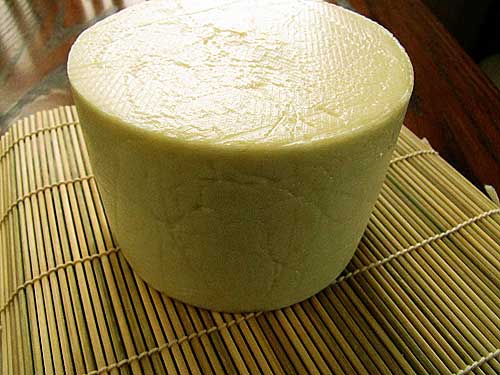
I spent so much time admiring this two-pound romano that 52 finally said, “What’s its name?” I said, “Bobby…..” And then I decided it was a girl. “Sue. Bobby Sue!” I have no explanation for this other than that I think I am a little bit in love with it.
The rind on that cheese is well-knit, by the way. The impressions on the sides of the cheese are from the cheesecloth. I’m still working on refining my method for keeping the cheesecloth from making imprints. I am, quite possibly, obsessed with cheesecloth imprints and my inability to completely eradicate them. I should probably give up on that.
The only real difficulty I had with the recipe was figuring out how to make low-fat milk out of my fresh whole cow’s milk. I researched low-fat milk. What I could find said that low-fat milk is made by taking milk fat out and adding powdered milk solids back (for the consistency of the fluid). Non-fat milk also has powdered milk for the same reason. Only whole milk (from the store) doesn’t include powdered milk. (Who knew?!) I’m milking a cow to make cheese with fresh milk and I’m going to put POWDERED milk into it? Nooooo……. I took my question to the Chickens in the Road forum and after some discussion, came to the conclusion that the best way to make low-fat milk at home from fresh milk was to let the milk sit longer before skimming the cream. When you bring in fresh milk, after filtering, it goes into a big bowl in the fridge to sit for, usually, a day before skimming. If you let the milk sit longer, two days, more cream rises to the top and, after skimming, a lower-fat milk is left behind. (Note that the milk is refrigerated the entire time.) If you have the time and patience for it, you could even let your milk sit three days before skimming. (Or skim daily for three days.)
I’ve made a couple of Romanos now and will be making more because I have a feeling it’s going to be my go-to hard cheese when I’m “pressed” (haha) for time. None of mine have aged two months yet, though, so I haven’t gotten to the point of rubbing them with olive oil. If you have any Romano experience, I’d love to hear about it!
See how to make a homemade cheese press here. The spring-loaded press I use now can be found here. See how I made my cheese cave here.
See all my posts in Cheesemaking here.
I get my supplies here.
This is my cow.
To help you get started making cheese, New England Cheesemaking is providing a package including (value of each item in parentheses): a hard cheese mold ($15.95), thermophilic culture ($5.95), veal rennet ($6.50), lipase powder ($6.95), cheesecloth ($5.95), cheese salt ($2.95), and calcium chloride ($4.95). The total value of the package is $49.20. Note: This giveaway is open to U.S. residents only.
For a chance to win: Leave a comment on this post and let me know you want it. ONE winner will be drawn by random comment number to receive the package. Eligible entry cut-off is midnight Eastern (U.S.) time tomorrow night (February 16). This post will be updated with the winner by 9 a.m. Eastern (U.S.) time on Thursday (February 17). Return to this post to claim your prize!
UPDATE 02/17/11: The winning comment number, drawn by random.org, is #172, Rebecca B. Email me at CITRgiveaways(at)yahoo.com with your full name and address for shipping!
THIS GIVEAWAY IS CLOSED TO ENTRY.


Joyce B says:
Oooooh, I would dearly love to win this package. Thanks for sharing your process for making cheese, cheesepresses etc. So glad I checked in with your site I almost missed this great opportunity.
Blessings,
On February 15, 2011 at 1:25 am
Vicki says:
It would be so fun to make my own cheese, even though I don’t have a cow.
On February 15, 2011 at 2:11 am
Julia says:
I would love to win the package. It would be so much fun to be able to make cheese.
On February 15, 2011 at 2:22 am
Tobey says:
Thanks for the giveaway, and I would love to win this!
On February 15, 2011 at 2:25 am
Michelle says:
I want one, please oh please! I have two mini lamanchas who’ve just delivered their kids (6 in total) in the past 4 days, and I’m about to be swimming in goat’s milk! :happyflower:
Thank you for all of the cheesemaking tutorials and tips, by the way. With any luck, I’ll be putting them to use very soon! 🙂
On February 15, 2011 at 2:27 am
GrammieEarth says:
MMMM That Romano looks divine!
Too bad that the draw is only available to US residents. I can still enter though since my son and other family members live in the US and would re-deliver….right??? I’m still a born n raised New Englander! LOL
Good luck to all!
Pam
On February 15, 2011 at 2:47 am
Suzanne McMinn says:
GrammieEarth, as long as you have a U.S. address for the initial delivery, you can live anywhere!
On February 15, 2011 at 8:06 am
Janet says:
What a lovely give away! Thanks for making it available. I have Kinder goats in my yard, so will be looking for cheese making supplies. Spring is on the way! Your Ramano is beautiful. thank you for being such an inspiration!
On February 15, 2011 at 3:01 am
lauren says:
Ohh Id love win this 🙂 Great giveaway!!
On February 15, 2011 at 6:10 am
judydee says:
A YEAR??? I better get started now, so please enter me for the drawing. Looks like fun. Thanks.
On February 15, 2011 at 6:16 am
Roz says:
I would love to win this giveaway and try to make Romano cheese! But how in the world do you wait a year for the cheese, wow!
On February 15, 2011 at 6:17 am
Jeanne says:
I would love to win this! A year is a long time to wait to try the final result though – must make some instant gratification mozzarella in the meantime! : )
On February 15, 2011 at 6:24 am
Christine says:
I would ♥ to win this give-away!!! That is some gorgeous looking Romano…good luck waiting a year, I dont think that I could 😉
On February 15, 2011 at 6:37 am
Maureen says:
It looks great and I would love to win the giveaway!
On February 15, 2011 at 6:41 am
Renee says:
Please enter me to win. The Romano looks beautiful!
On February 15, 2011 at 6:57 am
wvhomecanner says:
Oh mouth is watering. I think I could do this :yes:
dede
On February 15, 2011 at 6:58 am
Carmen at Old House Kitchen says:
Please enter me! Our goat momma is due in April and I can’t wait to start making cheeses!
On February 15, 2011 at 7:02 am
Anke says:
Oh yes please… I’d love to be the lucky winner…
On February 15, 2011 at 7:06 am
Deb says:
Oh I’ve been thinking it would be nice to make some of this, but I didn’t have the right culture! So yes, enter me to win!! 🙂
On February 15, 2011 at 7:21 am
CasieD says:
Great job! I’d love to learn how to make my own cheeses too.
On February 15, 2011 at 7:27 am
Debbie says:
I want to make cheese!!!
On February 15, 2011 at 7:40 am
Teresa says:
I would love to win this! My husband and I just bought a farm in Mason County and he says I can have baby goats once we get the house finished. I am so in love with Dr. Pepper! Keep up the good work. Yours is the only blog I read every day. – Teresa
On February 15, 2011 at 7:42 am
susan says:
I think that I’ll try romano next. you make it look so easy. I agree with you on the lipase powder it really make a better tasting mozz.
Now I have a question, how do you keep the different cheeses, with different humidity needs together in the cheese cave/ I am using a small frige. and have some of my cheeses in the veggie bin with jars of water to keep it the right humidity, but keeping the whole frige that way seems way beyond me.
On February 15, 2011 at 7:54 am
Laurie Hamar says:
Thank you for another opportunity to start making cheese. Please include me in the drawing.
On February 15, 2011 at 7:57 am
Deb says:
I want to make cheeeeeese…. ok, I’m wineing. sorry 😆
On February 15, 2011 at 8:04 am
Sundownr says:
Oooh, how I would love that cheese-making kit!! I think I must’ve been a lil cheesemaker dude in a previous life. I’ve made a few soft cheeses (yo-cheese, farmer’s, mozzarella, riccota, etc.) over the years and recently made a whey cheese (mysost) that was absolutely incredible! Now I know what to do with all that leftover whey!
Please DO add my name and number to the drawing!
:sun:
On February 15, 2011 at 8:05 am
DebrafromMD says:
I love Italian food too so learning to make the hard cheeses would be wonderful.
On February 15, 2011 at 8:12 am
annabel52 says:
Oh yes I would love, love to make cheese. I have tried mozzarella and would love to move up to hard cheese.
On February 15, 2011 at 8:23 am
Country Carol says:
OH, I’d love to try to make romano. I haven’t tried making a hard cheese like romano. It would be great to receive this kit!
On February 15, 2011 at 8:24 am
Kristen says:
Awesome giveaway – please enter me? I just took a cheesemaking class last weekend, and all I need are the materials. This package would be perfect! Thank you!
On February 15, 2011 at 8:24 am
mygirls01 says:
enter me please!
On February 15, 2011 at 8:24 am
Joey says:
I would love a cheese kit – I am working on learning soft cheese now!
On February 15, 2011 at 8:25 am
Beth Brown says:
I would LOVE this cheesemaking kit!
On February 15, 2011 at 8:25 am
Lanette says:
I would love to win this because my New Year’s resolution is to try one new ‘homesteading craft’ a month. So far, I’ve sewed a pillow-case dress and made several batches of soap. March will be making lip balms and I’d love to make April ‘cheese-making’! 🙂
On February 15, 2011 at 8:26 am
TotallyCooked says:
oh please can you open this competition to us ‘outsiders’? I am in South Africa. We are busy closing on a 22 hectare smallholding and I am OBSESSED with the idea of making my own cheese. So much so, that when I go to bed at night I dream about the bread dough that could be rising and the cheese I am going to make to enjoy with it – all I need now is my farm, goats, cow … I dream about a cheese cave and how it would feel to turn my cheeses every day. I linger at the cheese counter in the supermarket just looking at all the little precious’s that I could make one day soon
I am frantically busy packing boxes but I do have room in my boxes for this little piece of heaven. I would even be willing to swap hierloom seeds for this opportunity – would bribery help?
On February 15, 2011 at 8:27 am
Suzanne McMinn says:
TotallyCooked, this one is not entirely up to me to decide about the shipping, I’m sorry!
On February 15, 2011 at 8:29 am
Bridget says:
Please enter me in the contest. We have been transitioning to DIY everything over the past two years (with much help and inspiration from your blog), and cheese is the final frontier!
On February 15, 2011 at 8:27 am
Linda Goble says:
I would love to make cheese. please put me in for the drawing. :snoopy: :snoopy:
On February 15, 2011 at 8:27 am
Julia says:
Hi Suzanne, I’m curious….Why do you use low fat milk plus cream? Why not use whole milk plus less cream?
Don’t enter me in this contest please–I know I’ll never make cheese. Now if it was calendars or cookies, I ‘d be in!
Thank you
On February 15, 2011 at 8:31 am
Connie says:
I’d love to win it!
On February 15, 2011 at 8:33 am
Lynda Blackmon says:
I have always wanted to try making cheese but was scared to try,with your directions I think I can and would love the tools to do it
Lynda
On February 15, 2011 at 8:34 am
Caroline in NH says:
OK, after reading this, I’m going to have to subscribe to your blog. I’ll be going back to read archives today. I have a small farm (chickens & goats) and will be trying to learn to make more than just chevre this year (once my baby goat kids get here and my girls are milking again!) In my quest to broaden my cheese horizons, I would *love* to be entered into your drawing!
On February 15, 2011 at 8:36 am
Cheryl says:
Id love to try making some hard cheeses! I make farmers cheese and mozerella cheese from my goats milk but ive not tried any hard cheese yet. Im a little chicken but you make me feel like i can do it! My first goat is due to kid March 9th and im soo ready to have fresh milk again!
On February 15, 2011 at 8:37 am
Kristina Apodaca says:
Oh please enter me! I want to win this more than any other prize you have given away. Your Romano looks divine!
On February 15, 2011 at 8:38 am
Heather N. says:
Would love to win this and give cheesemaking a try!
On February 15, 2011 at 8:40 am
Carrie in Utah says:
I have just started making cheese, thanks to your blog for inspiring me! I use your cheese write ups as a reference (I am very visual, and all the excellent pictures help me feel like I am doing it right). Please enter me in the drawing!
Thanks!
On February 15, 2011 at 8:40 am
Imperious Fig says:
I’d love a cheese kit! Your posts are inspiring me to try to make cheese this year.
On February 15, 2011 at 8:41 am
TotallyCooked says:
so much sadness 🙂
On February 15, 2011 at 8:45 am
Faith says:
I reeeaaaaalllllyyyy would loooooove a cheesemaking kit!
On February 15, 2011 at 8:47 am
Pete says:
Sounds lovely!
Of course – we NEED this cheesemaking kit!
THANKS!
On February 15, 2011 at 8:47 am
texwisgirl says:
Don’t enter me in the giveaway, but I had to comment. When I first saw your title, I thought it said “Making Romeo” and I thought it was something related to Valentine’s Day. Then when I read how you’re in love, I thought it rather apropos. 🙂
On February 15, 2011 at 8:54 am
Kari says:
I’d love to try making Romano cheese – what an awesome giveaway! 🙂
Please enter me in the drawing.
I have absolutely no experience with making lower-fat milk from whole milk, but skimming every day for 3 days or waiting until the 3rd day to skim sounds like a good plan. Adding powdered milk to fresh milk from BP seems so wrong. Good luck!
On February 15, 2011 at 8:54 am
Ramona says:
YES, enter me in. I would luv to try my hand at cheese making.
On February 15, 2011 at 8:58 am
Naomi says:
i think cheese making would be fun , please enter me in the drawing
On February 15, 2011 at 9:02 am
Lisa says:
Please enter me in the giveaway. I love reading about your cheese adventures!
On February 15, 2011 at 9:02 am
Courtney says:
I would love to entered to win.
On February 15, 2011 at 9:03 am
Deanna says:
Oh, yes! Cheese Please!
On February 15, 2011 at 9:03 am
lavenderblue says:
I thought Romano was a goat cheese. Am I reading something wrong? I’d love to win the kit. I’d love to have a cow and a goat and chickens and… Of course, we all know this. How about a cow raffle or a farm raffle, there must be unused farms somewhere in the U.S.?
Wouldn’t the same rule apply to “Totally Cooked” as “Grammie Earth”, if there is a U.S. address that the kit could be shipped to (friends, relatives) people who would be willing to ship it to them from the U.S., could outsiders enter then? Or does it have to do with the contents of the kit and what can be sent through the mail system?
On February 15, 2011 at 9:05 am
Suzanne McMinn says:
lavenderblue, it was traditionally made with goat milk, I believe, but can be made with cow’s milk, too, and the flavor comes from the lipase. (If you use goat milk, you may not need to add the lipase.) And yes, that applies to anyone, if you have a U.S. address of someone (friend, relative) who will forward the kit on to you, then you can enter!
On February 15, 2011 at 9:08 am
Amy H says:
How fun, I’d love a cheese starter! Romano is one of my favorites.
On February 15, 2011 at 9:06 am
Connie from Ohio says:
I would love to win this. My husband loves my homemade cottage cheese. Even when it does turn out that well.
On February 15, 2011 at 9:13 am
pattyb says:
Please enter me in the cheese give-away. I would love to learn how to make cheese.
Thank you,
pattyb
On February 15, 2011 at 9:14 am
Erica in VA says:
Hey Suzanne… have you ever randomly drawn your own comment to win? LOL
Your romano looks amazing! I too am now wondering how to make sure there are no little impressions from the cheesecloth, as I am rather obsessed with such things myself! If I come up with anything I’ll be sure to let you know!
And I’d love to be entered for the cheese kit, please! Goaties are due soon so it’s only a short time now before I will be milking twice a day again!
On February 15, 2011 at 9:19 am
Suzanne McMinn says:
Erica, no, I’ve never yet drawn my own comment (I would redraw, of course, LOL) and I always hate to comment on a giveaway, but I hate to ignore questions, too.
Re the question about different temps etc in aging caves, you can do this with a smaller mini fridge for some cheeses. Most cheeses I make can age in similar conditions.
On February 15, 2011 at 9:24 am
jim says:
cheese kit please
On February 15, 2011 at 9:20 am
Kristen A says:
Please enter me. I am slowly gathering supplies to get started making cheese. This would really help. Thank you!
On February 15, 2011 at 9:23 am
Sherri says:
Making cheese sounds so scary, yet you make it sound so easy. I’d like to enter the giveaway as well.
On February 15, 2011 at 9:25 am
yotetrapper says:
Thanks for the great article on this. I am new to cheesemaking. Two weeks ago I made my first cheese, ricotta. Yesterday my husband finished up a cheese press for me! Today, the plan is to try a farmhouse cheddar. I would love to be entered for the giveaway.
On February 15, 2011 at 9:29 am
Jennifer S says:
I would love to win this! Please enter me!
On February 15, 2011 at 9:31 am
windspiritwhimsies says:
Your cheeses always look absolutely wonderful! Would love to give it a go! Please enter me,thanks! :moo:
On February 15, 2011 at 9:36 am
Heidi says:
Would love to win this! I really want to try my hand at making cheese and this would be perfect to get me started!
On February 15, 2011 at 9:38 am
TONYA says:
PLEASE PICK ME-I WANT TO MAKE CHEESE!!! THANK YOU-TONYA
On February 15, 2011 at 9:39 am
Sally says:
Oh, definitely enter me in this one! What a beautiful Romano you’ve made, cheesecloth imprints and all.
On February 15, 2011 at 9:46 am
Kathleen says:
I have made a few simple cheeses, but want to branch out–I’d love to win this! Thanks so much for the great posts on making cheese. I can’t wait to pour a cup of tea and browse through your blog this afternoon.
Kathleen
On February 15, 2011 at 9:46 am
Hlhohnholz says:
Cheese please!
On February 15, 2011 at 9:47 am
Constance says:
Making cheese is something I really want to learn to do. So glad I found your blog and this giveaway!
On February 15, 2011 at 9:47 am
Sarah K says:
I want to win the cheese making package!!!
On February 15, 2011 at 9:48 am
Jeanne says:
I’m fascinated by the idea of making my own hard cheese! Please enter me.
On February 15, 2011 at 9:48 am
sam says:
I have made yogurt cheese by straining the yogurt. Now I am ready to go big time. Please enter my name.
sam
On February 15, 2011 at 9:51 am
Mary says:
Pl :heart: ease enter me, I would love to start making cheese. Thanks!
On February 15, 2011 at 9:53 am
Kelly A says:
I am trying to become more and more self sufficient, on my to do list this year are cheeses and soaps!
On February 15, 2011 at 9:56 am
Nic, SD says:
Would love to win one!
On February 15, 2011 at 9:57 am
Em says:
We love cheese around here!! I just started making maozarella and now I am ready for another challenge…Romano sounds perfect!
On February 15, 2011 at 9:57 am
Patricialynn says:
Would love to win the cheese kit – and that Romano looks so delicious, I could almost smell it through the computer monitor!
:snoopy:
On February 15, 2011 at 9:59 am
Leah's Mom says:
Please enter me in the drawing! Enjoying reading all your cheese adventures.
On February 15, 2011 at 10:01 am
Chuck says:
My wife likes reading the blog! Please enter us for a chance to win. Thank you-
On February 15, 2011 at 10:02 am
joanne says:
I want the cheese package!
On February 15, 2011 at 10:03 am
Elizabeth says:
I’d like a chance to win. Please enter me too :shimmy:
On February 15, 2011 at 10:03 am
sharonh says:
OOOOOH! Enter me in the contest, please! I have wanted to make cheese for the longest time, but wold like to find a store locally to buy the rennet etc. from. Anyone know a Nevada store where they might sell cheesemaking products?
On February 15, 2011 at 10:04 am
Teresa says:
Looks delicious – I’d like to give it a try! thanks
On February 15, 2011 at 10:13 am
prayingpup says:
I am so ready to try my hand at making cheese! Please enter me!
On February 15, 2011 at 10:18 am
drucillajoy says:
Please enter my name for your drawing, I’d love to win it!
Also, just want to mention…I see no reason why I couldn’t ship to someone from other than the U.S. if they won, as long as they pay me the shipping price, I’ll send it on anywhere…good luck to us all 🙂
On February 15, 2011 at 10:20 am
carla says:
Oh boy! I want to win this!
On February 15, 2011 at 10:25 am
Rose says:
I would love the cheese making kit!
On February 15, 2011 at 10:27 am
Kristina says:
How fun! I would love to try making cheese. The kids are old enough they would really enjoy it and I can count on them for workhorses. I am not much of a cheese fan but do love the cheese on Italian foods. The rest of the family sends me to the poor house by the amount of cheese they consume. Thanks for the entry!
On February 15, 2011 at 10:29 am
QuietStorm says:
I would LOVE to make my own romano and parm!!!!
Please enter my name in the virtual hat
On February 15, 2011 at 10:33 am
Debi says:
I’d love to win!
My Hubster made me a cheese press already from your directions, it’s just waiting for me to get started!
On February 15, 2011 at 10:35 am
Sarah Rutledge says:
I would Love to win the cheese making package! I’ve just started making my own cheese, and it is the most fun and exciting hobby I’ve had in a while. Just found your site, am bookmarking for the great recipes and available knowledge!
On February 15, 2011 at 10:38 am
Teri says:
Would love to win this giveaway!
On February 15, 2011 at 10:40 am
jan~n~tn says:
I think 52 was justified in asking ‘it’s’ name. Think about it…you are going to have to take care of :airkiss: , and watch over :hug: , that precious ‘two-pound romano'(and all those like it) for an entire year before you can present it as food :sun: .
And, Yes, i’d love win the kit.
On February 15, 2011 at 10:40 am
Betsy says:
I would love to try making my own cheese! The thought never would have occurred to me before I saw this post and your photos showing the process. 🙂
On February 15, 2011 at 10:46 am
Abby's Mamma says:
You are such an Inspiration to us :happyflower: We are slowly learning to live a less hectic, more sustainable life and you have been such a help in doing that. I would love to be netered in this give away so my little one & I could learn a new skill. :fairy:
On February 15, 2011 at 10:47 am
Abby's Mamma says:
Guess that should say “entered” 😉
On February 15, 2011 at 10:47 am
Shannon Olson says:
I would love to win!!! I have just started making cheese and haven’t progressed to hard cheeses yet. what a great opportunity and what a lovely blog you have! :cowsleep:
On February 15, 2011 at 10:51 am
mary ellen says:
I would love to win this cheesemaking kit. My girls are due in mid April, so I think I,ll have enough milk to start making cheese. Suzanne, I really need an animal post from you. My day isn’t complete without hearing what is going on in the barn.
On February 15, 2011 at 10:53 am
mary ellen says:
I would love to win this cheesemaking kit. My girls are due in mid April, so I think I,ll have enough milk to start making cheese. Suzanne, I really need an animal post from you. My day isn’t complete without hearing what is going on in the barn.
On February 15, 2011 at 10:53 am
hershiesgirl says:
I want it! I want it! EVERY time you post about making cheese (no matter what kind) I think, I really, really need to give this a try. I always chicken out! Winning a kit would definitely get me started!
On February 15, 2011 at 10:57 am
Jillian M. says:
I would love to be able to make my own cheese!
On February 15, 2011 at 11:00 am
Carrie Johnston says:
I’ve done your mozerella cheese recipe. How much lipase do you put in that recipe? I just placed my order with New England Cheese. And, I would like the cheese starter kit!
On February 15, 2011 at 11:03 am
Robin Edmundson says:
I love making fresh cheeses, but I’ve been too scared to try aged ones. You’ve inspired me!
On February 15, 2011 at 11:10 am
Sean Lally says:
Awesome cheese. Count me in as an entrant. Thanks!
Sean
On February 15, 2011 at 11:14 am
marymac says:
I want to make cheese. Pick Me!!
On February 15, 2011 at 11:14 am
Nadeanne says:
Oooo…i want it, i want it! 😀
On February 15, 2011 at 11:16 am
Debbie R says:
Cheese please!
On February 15, 2011 at 11:18 am
Mandy says:
Please enter me into the drawing. That romano looks awesome!
On February 15, 2011 at 11:29 am
Tracy in SCL says:
Pick me, please. Pretty please?
On February 15, 2011 at 11:30 am
Sheila Z says:
me too
On February 15, 2011 at 11:30 am
Sue Ann Nelson says:
I would love to have the cheesemaking package.
On February 15, 2011 at 11:32 am
Ramona Slocum says:
Hi Suzanne, What do you do with all the food you are making every day? I know you have one daughter at home, one son in the service and one in college. How do you keep it from spoiling with just the 2 of you. Maybe your hubby is there every day too?? I also enjoy seeing the farm animals eating the cookies. I ejoy your website along with my coffee every morning. Keep up the good work. I applaude your endurance.
Hugs,
Mona from MN
On February 15, 2011 at 11:37 am
Louise says:
Thank you for all of your wonderful posts. I look forward to them every day. Please enter me in the cheese giveaway.
On February 15, 2011 at 11:40 am
Angelina says:
I would love to win this! I shall keep my fingers crossed 🙂
On February 15, 2011 at 11:41 am
Tammy from MI says:
Mmm, makes me hungry thinking about it. I’ve been dabbling a bit with farmers cheese and mozzarella but would really like to try some hard cheeses.
On February 15, 2011 at 11:46 am
Heather E. says:
You are inspiring me to make some more cheese! I’d love to get the cheesemaking kit – thank you!
On February 15, 2011 at 11:51 am
Christina S. says:
Add me! 🙂
Also, you should never drink or use milk with a lower fat content – your body needs that fat to digest the milk. That is why so many people have lactose issues – because they drink processed milk with the natural fats removed and powdered milk added back in.
Raw milk is very easy on the gut because of the natural bacteria. My husband and I have been drinking raw milk for about two years now with only good results.
For more info, check out realmilk.com. :heart:
On February 15, 2011 at 11:53 am
Luann says:
Please enter me… I dont own my own milk cow yet but I would love to start learning how to make cheese…
On February 15, 2011 at 11:54 am
Cindy Jones says:
Awesome…please enter me…thanks
On February 15, 2011 at 11:55 am
Gen-IL Homesteader says:
Your romano looks beautiful! You’re becoming quite the pro at cheese-making!! :snoopy: Please enter me, with thanks to you and New England Cheese Making.
On February 15, 2011 at 12:08 pm
Charley says:
Count me in! I need to make cheese! 🙂 lol
On February 15, 2011 at 12:09 pm
Kat J says:
Oh, I’m so jealous. You make hard cheeses seem so approachable, your cheese looks amazing. Please enter me in the cheese package giveaway. May if I win I will branch out from crock pot yogurt. Thank you for that recipe by the way.
On February 15, 2011 at 12:17 pm
Lynda says:
Another great giveaway…and this time I hope I’m the winner! I use your tutorials all the time…thank you.
On February 15, 2011 at 12:21 pm
Debbie says:
Cheese, please! Enjoying watching your cheese making experiences.Love to win-thanks!
debbie
On February 15, 2011 at 12:23 pm
Blyss O'Cael says:
I would love to win the cheese kit! I can’t wait for the CITR Workshops to learn more, either!
Blyss
On February 15, 2011 at 12:24 pm
Jan says:
I would love to have this kit. I want to make my own cheese so bad!
On February 15, 2011 at 12:27 pm
Aaron Thomas says:
hmmmmm! Would love to win the kit to start making my own cheeses!
On February 15, 2011 at 12:28 pm
Kris says:
I want… 🙂
On February 15, 2011 at 12:51 pm
Renee says:
I would really love to have a cheese making kit.
Please, please..
It would be so much fun learning how to make cheese.
On February 15, 2011 at 1:15 pm
Tammy/psmflowerlady says:
Mama Mia! Sign me up! :moo:
On February 15, 2011 at 1:34 pm
Kathy says:
I would love the cheese kit – I’ve made ricotta, but didn’t want to spend the $ on a cheese mold, etc. unless I knew I could really do it!
Also, I would love to see a picture of how you are storing these. Where will I find room to keep these for a whole year??
On February 15, 2011 at 1:40 pm
Casey says:
Oh I want it! I have been wanting to make cheese for quite some time now and just have never gotten around to it.
On February 15, 2011 at 1:41 pm
Shelly says:
:snoopy: I would dance like snoopy if I won a cheese making kit.
On February 15, 2011 at 2:05 pm
John says:
Please put my name in for the cheese making kit.
On February 15, 2011 at 2:06 pm
Glenie says:
I would love to win, pick me.
On February 15, 2011 at 2:22 pm
patsy says:
I want cheese making stuff!!
On February 15, 2011 at 2:28 pm
Kathi N. says:
I want one!
And thank you for the lesson.
On February 15, 2011 at 2:33 pm
ElizaRed says:
Put me down for wanting the Cheesemaking items.. would love to try this.
On February 15, 2011 at 2:56 pm
Cindy says:
I would love to win the cheesemaking supplies. My husband has promised to make me a cheese press and I cannot wait to get started!
On February 15, 2011 at 2:59 pm
Jani Jeane says:
I would love to win them! I am working my way toward hard cheese.
On February 15, 2011 at 3:02 pm
DaAnn says:
I would love to win this kit and make Romano cheese!
On February 15, 2011 at 3:07 pm
Ashlee says:
I would love to win the kit! I’ve been dying to try making cheese ever since I found your blog. Before that, I didn’t think it was something a person could actually do at home! Your Romano looks amazing :hungry:
On February 15, 2011 at 3:31 pm
Becky M says:
I would love a cheese making kit. I do have to say that your cheese looks wonderful. Great job!
On February 15, 2011 at 3:33 pm
meagan elliot says:
Love your blog! Love cheese! Please enter me. 🙂
On February 15, 2011 at 3:34 pm
John Jezl says:
Very nice! Working my way up in the cheesemaking. I figure it can’t be too much harder than salumi. Found a source for raw milk and everything! 🙂 Romano would be a good place to go next.
On February 15, 2011 at 3:34 pm
MFryoux says:
Please enter me in the drawing! The only cheese I’ve ever made was Farmer’s cheese lol.
On February 15, 2011 at 3:40 pm
farmershae says:
I think the cheesecloth marks just make it look more “artisnal” 😉 LOL. Please enter me in the drawing, I need to get on the cheese road!
On February 15, 2011 at 3:45 pm
Anna says:
I have wanted to give cheese making a try for a while now, I would love to win this!
On February 15, 2011 at 3:59 pm
Ulrike says:
“I always hate to comment on a giveaway, but I hate to ignore questions, too.”
Now I’m tempted to ask a question just to goad you into commenting on a giveaway post. :devil: But I won’t.
I’d love to win, however.
On February 15, 2011 at 4:15 pm
Elizabeth Miller says:
Oooooh, to make my own cheeeeese!!! Yes please! I would LOVE to win this!
On February 15, 2011 at 4:29 pm
Danielle says:
I want that cheese kit. Oh man, do I want it.
-Wild Goat Woman
On February 15, 2011 at 4:30 pm
Clifford says:
So into cheese, Am trying soft cheeses now. Would love to start with this.
On February 15, 2011 at 4:42 pm
Amy says:
That would be great. I’d like to enter the giveaway.
On February 15, 2011 at 4:42 pm
Barbie says:
I’m ready to try cheesemaking, would love to start by winning! Your romano cheese looks so delicious, when will you be cutting it? :eating:
On February 15, 2011 at 4:47 pm
proudmary says:
I would like a chance to win the cheese making kit. Thanks :snoopy:
On February 15, 2011 at 4:47 pm
Bruce Zelazoski says:
I would love to have your cheese making kit.
I am a relatively new home cheesemaker and have used Rikki’s recipe for Parmesan. It did come out OK although because of a less than ideal cheese cave it dried out a little too much as it aged. On a second attempt I applied a light coat of cheese wax and it came out pretty good.
Thanks for the post and especially the great photos. They really help.
On February 15, 2011 at 4:48 pm
Bobbie Giarratana says:
I make cheese and love your videos (especially the bouncing sheep and dog friends) and would love to win the package! Yay! What a fun idea.
Bobbie
On February 15, 2011 at 4:49 pm
TwistedStitcher says:
I’ve already tried making mozzarella, and well, the results weren’t great. Then I saw your post about how difficult it really is and it has given me new hope to try making some other cheeses. I would really love to have this kit. It is just what I need.
On February 15, 2011 at 4:50 pm
Whaledancer says:
Questions, Suzanne:
In step 2, how do you hold the temperature at 88 degrees for an hour?
Are you using a different kind of cheesecloth? It looks shimmery.
How do you control the humidity in your refrigerator “cheese cave”?
On February 15, 2011 at 4:50 pm
Suzanne McMinn says:
whaledancer, just put the lid on the pot and it will hold the temp. I’m using disposable cheesecloth now. I don’t have a hygrometer yet (to regulate humidity). If a cheese needs higher humidity, I add a bowl of water.
On February 15, 2011 at 5:44 pm
Melissa Pilcher says:
I would love to try making cheese. We already make our own beer and our own bread so this would complete the meal!
On February 15, 2011 at 4:50 pm
JustAnotherJenny says:
I would be quite happy to win this! 🙂
On February 15, 2011 at 4:51 pm
Gretchen Metzler says:
I most definitely want this! Love your blog and especially the cheese and soap posts (I came to it by way of Ricki Carroll’s Moosletter — also great!)
Feeling like spring in Wisconsin,
Gretchen
On February 15, 2011 at 4:51 pm
Katie says:
what a wonderful giveaway! thank you!! I have been nervous to try making a hard cheese, but you make this one sound simple. I think it’s time I gave it a try!
On February 15, 2011 at 4:51 pm
Annie P. says:
I want to win!
On February 15, 2011 at 4:53 pm
Rebecca B says:
I have finally mastered mozzarella- but haven’t had the courage to try hard cheeses just yet. Winning this would definitely get me to do it!
On February 15, 2011 at 4:53 pm
rkm413 says:
I would love to win the package and make Romano cheese. I grew up on Locatelli brand Romano cheese and have a lot to live up to! Must be hard to wait a whole year to see if it came out good:(
On February 15, 2011 at 4:55 pm
Kelly says:
I would love the cheesemaking kit. Your photos of the process are great! Thanks!
On February 15, 2011 at 4:58 pm
tsmith says:
Please enter me!
On February 15, 2011 at 4:59 pm
Lisa says:
I want it!! I would love to make cheese for my family (7 of them are my kids). Cheese is something I have yet to master, but am willing to
On February 15, 2011 at 5:00 pm
MaryMooCow says:
Please enter me! :sheepjump:
On February 15, 2011 at 5:03 pm
Lois Lupica says:
Beautiful Romano!!
On February 15, 2011 at 5:04 pm
Steve Kamp says:
Wow! I am going to make Romano as soon as I can. Thanks for the recipe. I miss my own chicken in the road. Sadly i have a killer fox that I just can’t seem to catch so my poor chickens spend all their time locked up.
On February 15, 2011 at 5:07 pm
Melissa says:
Thanks for the excellent tutorial on Romano. I would love to try my hand at this; I’m still a novice, and have only made paneer so far.
On February 15, 2011 at 5:07 pm
Jacqueline says:
For valentine’s day my husband got me a dairy goat. Just did our first milking last night and already this morning (second milking) I realize I need to get a move on making cheese pronto. What fun this will be. We sold our old dairy cow and kept her daughter but no milk yet. She’s busy dancing with the bull and won’t be in milk till next fall so this lovely goat with the sweet goofy smile will tide us over in the meantime.
On February 15, 2011 at 5:10 pm
jennifer says:
Oh pick my number!!! As soon as my precious jersey Camilla freshens again(and that should be within the next 3 wks) I will definitely try this…and I love New England cheesemaking!!!
On February 15, 2011 at 5:10 pm
Richard says:
I would love to try this. I have made soft cheese, but this would be my first Hard cheese.
On February 15, 2011 at 5:10 pm
Melissa M says:
Please enter me…….I would really like to try cheesemaking!
On February 15, 2011 at 5:18 pm
Matt Fitz says:
I’ve been looking to get back into cheese making after a little hiatus, and this would be PERFECT! a couple nice new tools and ingredients to go along with a great recipe!!! please pick me:)
On February 15, 2011 at 5:21 pm
William Mark says:
Lucy123: I would like a kit…please enter me
On February 15, 2011 at 5:24 pm
Becky W says:
I want a Romano Cheese making kit!!!!
and a fresh goat………..hehehehe seriously…have one goat fresh, but always have been told don’t even try to make cheese for the first 6 weeks with that milk.
On February 15, 2011 at 5:33 pm
Bob Emro says:
Please enter me in the drawing. Thanks!
On February 15, 2011 at 5:42 pm
Lynda says:
I would love to win this kit. I was just telling my daughter that it’d be so much fun to start making cheese! 🙂
On February 15, 2011 at 5:50 pm
Janice Beall says:
I’d love to try this cheese. Please enter me. thanks
On February 15, 2011 at 5:52 pm
Linda Atkins says:
Having a giveaway is great; count me in. I am most interested in making molds as I am a potter. My first try at cheese was a week ago. Looking forward to trying more recipes.
On February 15, 2011 at 5:53 pm
Kat says:
Oh please, oh please, oh please let me win!! I want to move on from my mozzarella-only status, and in just a few months I’m going to have all the goat’s milk I can possibly use! I can’t wait to start cheese making for real!
On February 15, 2011 at 5:55 pm
Melissa says:
I had no idea Romano was so easy to make! I would love to win the cheese-making kit.
On February 15, 2011 at 5:59 pm
Jessica Rice says:
Great photos. I would really like this prize – just finally created my first mozzarella – took 4 tries before I got it right. And, I received a man-made from scratch cheese press for Christmas that I am itching to try out.
On February 15, 2011 at 6:00 pm
Carmella (Pangallo) Hoffman says:
Please enter me in the drawing to win the Cheese kit! I am Italian and would love to make Romano! :wave:
On February 15, 2011 at 6:07 pm
Jenna says:
I would really like to win such a kit! I hope I may!
And thanks for all your cheese-ly advice. It’s inspiring.
On February 15, 2011 at 6:07 pm
liz says:
Hey Suzanne-
Thank you so much for posting the photos of what the curd should look like and giving your helpful tips along with the process. I tried Romano and it turned out like cheese, but defiantly not Romano. haha, it was mystery cheese…
I have a feeling after reading your post that my curds didn’t turn out like yours, so maybe they didn’t get to the right temp. anyways I am excited for you that you mastered this one in a month. Can you do Gouda next month? I seem to have issues with that one too (maybe it’s my press)??
also would love to win your super awesome prize package, but if not I will keep reading!
On February 15, 2011 at 6:15 pm
Suzanne McMinn says:
liz, I did the recipe/tutorial on gouda last month. You can find it in my Cheesemaking archives:
https://chickensintheroad.com/cooking/archives/cheesemaking/
On February 15, 2011 at 6:33 pm
Denise says:
Finally mastered Ricotta & Mozzarella, time to move on to hard cheese. Espcially since I eat Romano chesse on almost everything. Tip: Once the cheese is finally ready, save the rinds….I toss them in soup, stews, etc. I keep them a bag of them in the freezer
On February 15, 2011 at 6:16 pm
George Fitzgerald says:
I have one round of Parma style cheese in the “cave” since July. Half skim milk and Half Goat milk I can’t wait til this summer to open it up and try it out. You are so right about it being and easy cheese to make.
On February 15, 2011 at 6:29 pm
EightPondFarm says:
Please enter me in the contest. Although I would have had a hard time not naming my Romano, Ray.
On February 15, 2011 at 6:32 pm
Alison Martin says:
Suzanne, you made that look and sound extremely simple! I love it. I too am fearful of harder cheeses, I will have to try it now. Please put me in the drawing for the supplies please, I would love to have a set up like that.
Ps, I like your new 12 qt pot, great size. Thanks for all of the great pictures also, it makes it easy to understand.
On February 15, 2011 at 6:32 pm
Rosemeri says:
Oh, please. Sine me up for the cheese kit. I would love to make some cheese. Thanks for the post.
On February 15, 2011 at 6:33 pm
Brian says:
So far I’ve only made mozzarella. I’ve wanted to make a hard cheese but I was afraid it was too difficult. After reading your blog I’m definately going to try this recipe. I LOVE romano cheese. Here’s hoping that I’m fortunate enought to win the contest. Thanks for sharing!
On February 15, 2011 at 6:33 pm
Alison C. says:
I’m a young, beginner cheese maker living in Lawrence, KS. Loved the post.
On February 15, 2011 at 6:35 pm
Ticia Gingras says:
Pick me! Pick me! Seriously . . . pick me! Now that all of that is out of my system, I’ve been making mozzarella and ricotta. My first Ricotta Salata is now three weeks old in the fridge. Not sure I can wait the length of time I need to before eating it. I suppose I will be the same with my next project – Romano cheese. Thanks for the great descriptions and photos. I am psyched and ready to jump into my next cheese-making venture.
On February 15, 2011 at 6:38 pm
Jean Castle says:
Romano has to be the next cheese I try (and I would LOVE to win the kit). I have to buy my milk as I don’t have any animals I can milk any more but I still love making cheese. However I stayed away from hard cheeses. Thanks for showing me how easy it can be to make.
On February 15, 2011 at 6:38 pm
Jessica Arnold says:
Sounds like tons of fun. I would love to win this set up to try and make it on my own. Thanks for all of the good tips!
On February 15, 2011 at 6:41 pm
Carol H. says:
Your site has really helped me to see how things should look along the way. It’s always nice to have pictures along with the steps of a process. Thank you for the great information and giveaways! Please enter me in the drawing for the cheese kit.
On February 15, 2011 at 6:42 pm
Donna says:
Nice. I’ve been making cheese for about a year and a half, but have yet to make Romano. Believe it or not, I’d actually planned to make it tomorrow – and THEN I saw your post! Do you suppose it’s a sign that I’ll win? Hope so! 🙂
On February 15, 2011 at 6:46 pm
Amy says:
Would love to try cheese making
On February 15, 2011 at 6:52 pm
Chris Bredenkamp says:
I want the NE Cheesemaking kit! Yes indeedie!
On February 15, 2011 at 7:00 pm
Lindsay says:
Oooh Romano is my favorite! I would love to win this! :sun:
On February 15, 2011 at 7:01 pm
gardengal says:
I haven’t had the nerve to try my hand at a hard cheese, but this gives me hope. (And the cheese looks great!)
On February 15, 2011 at 7:08 pm
Bootsy says:
Your step by step instructions and picutres are great. I can’t wait to try for myself…so far I’ve done a lot of reading and now you’ve given me the courage to try for the real cheese….maybe I’ll even win the prize and make a delicious romano. Thank you again.
On February 15, 2011 at 7:09 pm
janice brockett says:
I am just getting into cheese making and would love to win. You gave me the courage to try after you accepted the challenge. If you could try then so could I.
On February 15, 2011 at 7:10 pm
BethAnn says:
I am experimenting with a few hard cheeses… we have a raw milk dairy and so have plenty of milk. My first Parmesan cheese flopped, but after reading your detailed instructions I think I am ready to try again! Please enter me in drawing… I would love to have the supplies to try more hard cheeses. Thank you!
On February 15, 2011 at 7:11 pm
Mo says:
Very inspiring. I would love to win and try this myself.
You make it seem very doable :purpleflower:
On February 15, 2011 at 7:13 pm
jkellner says:
Thank you for the wonderful pictures and directions. So far I’ve done a lot of reading and you’ve given me the courage to try my hand at cheesemaking. Maybe I’ll even win the kit and make some romano. Thanks again
On February 15, 2011 at 7:14 pm
Samantha says:
despite being lactose intolerant, i love cheese! awesome giveaway
On February 15, 2011 at 7:15 pm
Evelyna Saxon says:
Oh, please enter me for the prize drawing! Thanks so much!
On February 15, 2011 at 7:19 pm
Aunty Depressed says:
I have a need for Cheese.. Please enter me in the drawing. :moo:
On February 15, 2011 at 7:29 pm
Donna Stoufer says:
Suzanne, The cheese is beautiful! My husband and I just started making cheese a few month’s ago but this is one we will have to try! Would love to win your give away! Buy the way – we have enjoyed your blogs and your site! It brings smiles to the long cold winter!
On February 15, 2011 at 7:34 pm
Sally says:
Love the detailed instructions with photos and the confidence they exude! I’ve recently begun cheesemaking. A few wins, a few losses. Each one is fun and exciting. As you mentioned, I’m intimidated by the hard cheeses. After reading this, believe I’m ready to take the plunge. Your giveaway would be a great boost to the process.
On February 15, 2011 at 7:53 pm
Lucy says:
I’d love to give making my own cheese a try. Please enter me in the drawing.
On February 15, 2011 at 7:53 pm
Sarah Thionville says:
Love the content in this post! The pictures are delicious! Count me in… Hard cheeses are such a delight. My first one ended up having a crack of blue in; who know why? But it was delicious.
On February 15, 2011 at 7:56 pm
Susan says:
Oh yes, I would love to win the cheesemaking package. My two cows will both be having calves in the next two months and I will have milk galore!
On February 15, 2011 at 8:03 pm
Jeanne says:
I want it! Tried to register here but never received the email. You have great pictures that make this look so easy! I think Romano should be my first attempt at hard cheeses, don’t you? Love your web site! If I lived closer, I’d come for a visit!
On February 15, 2011 at 8:03 pm
LisaAJB says:
Ohh, I want to win a cheese kit! Thanks again!
On February 15, 2011 at 8:09 pm
Wanda H. says:
I’ve been making cheese mayself and would love to be entered in your drawing
On February 15, 2011 at 8:12 pm
athomemamatwo3 says:
Oh memememeee!! I just ordered a small beginners kit from NewEngland Cheese Making Company!! I would really love this!!
On February 15, 2011 at 8:35 pm
nova W says:
Thanks for the clear instructions, Please do enter me in the drawing too.
What fun
On February 15, 2011 at 8:41 pm
Kim Carson Ray says:
You are so right about the lipase powder. I made Parm using it and the flavor is spot on! Please enter me in your drawing so I can try Parm’s cousin, Romano…thank you!
On February 15, 2011 at 8:44 pm
cooker says:
Sue
Would love a kit as my love affair with Romano has been going on for nearly 50 years. After reading the recipe and experience I beleive the tears of joy I shed would only add to the recipe:). Going to take your advice with the lipase powder for mozzerella as I am looking for that flavor boost. Great job
Peter
On February 15, 2011 at 8:46 pm
Ancilla Winters says:
Would LOVE to win this romano cheese making kit. What a perfect way to celebrate my daughter’s birthday (Feb 16.) I’m ready to make other things besides mozzarella, queso blanco, yoghurt, mascarpone, and creme fraiche.
On February 15, 2011 at 8:59 pm
Chris Bredenkamp says:
Oh, regarding getting a low fat milk, instead of ladling out the cream from the top of your pan, try what I do. Get a 2 gallon water jug. The kind that has the spigot at the bottom. Pour your fresh milk into it (from the top), put the lid on and then after the time period your interested in, open the bottom tap. The cream remains above undisturbed the entire time you drain off the milk from below. After experience you will learn about how much milk you get before the cream begins coming out. Change out collection pans before that happens so you can keep the milk completely cream free. Works great!
On February 15, 2011 at 9:01 pm
Ginny says:
Made romano once and and turned out beautiful like yours. I can’t wait a year either, what are we going to do?
On February 15, 2011 at 9:02 pm
Turtle Mom says:
I REALLY want to make my own cheese! Yummy!
On February 15, 2011 at 9:03 pm
Merry says:
Oooh, Suzanne & Bobby Sue, breakin’ up is hard to do – so pleeeze let me be the winner. Thanks for this project. It gives me courage to move beyond soft paste cheeses. And my SO can get me a cheese press for my birthy.
On February 15, 2011 at 9:07 pm
janicecauley says:
Please enter me in your latest cheesmaking giveaway.
On February 15, 2011 at 9:07 pm
Howard says:
I want in on this. I am very interested in making cheese.
On February 15, 2011 at 9:11 pm
Kate says:
You’re an inspiration! :happybutterfly:
On February 15, 2011 at 9:18 pm
margaret says:
love my goats, coined the white mafia (they rule the barn yard). really enjoy your cheese adventures, have inspired me to make more than farmers cheese, all I have done so far. would love to win the cheese adventure, keep on making cheese, you make it sound easy. my chickens can tell you, mistakes are not all bad.
On February 15, 2011 at 9:35 pm
Melissa says:
I would love to will the cheese package. I can see myself making cheese on a Sunday morning. Over come the fear and conquer
On February 15, 2011 at 9:37 pm
Debbie says:
I just started making cheese. I purchased the mozzarella kit from Ricki, and my daughter and I made our first batch. It was fulfilling and rewarding. I want to start making different kinds of cheese and winning this would be great.
On February 15, 2011 at 9:37 pm
Jenny says:
I would love to win this!!
On February 15, 2011 at 9:43 pm
emily says:
I’d like that.
On February 15, 2011 at 9:50 pm
jojo says:
Oh please oh please random generator, pick my number! 🙂
On February 15, 2011 at 10:02 pm
lori says:
I sure would love to win the package. I am very new to cheese making, just since August. So far, my goat cheeses have been wonderful. Most of my equipment is homemade and rather rustic, so having some “real” equipment would be great.
My question is: how do you make low fat milk from goat’s milk? Kids will be hitting the ground next month for my first real season of milking. I know the goat milk is higher in butterfat that doesn’t really separate into cream and milk. But I am really interested in knowing how to get it to do that my cheeses will have a little less cholesteral.
I am continuing to practice this winter with cow milk from the store. I have been reluctant to make any that have to age so long as Romano – Husband is a cheese freak and can’t wait that long.
On February 15, 2011 at 10:11 pm
maryann says:
I would love to win the cheese-making package as I haven’t found the courage to order a set yet lol.
On February 15, 2011 at 10:17 pm
Vickie Paxton says:
Hi Suzanne!
Looks like an awesome recipe and I can hardly wait to try it. Please enter me in the giveaway! Thank you!
On February 15, 2011 at 10:17 pm
Veronica V. says:
Neat! Can’t wait to try making my own cheese!
On February 15, 2011 at 10:23 pm
Sharon Dziekonski says:
I Would LOVE this kit!!! I have been making goat cheese for 10 years now and am just starting to try hard cheeses (they seem so scary!)
On February 15, 2011 at 10:26 pm
John Spears says:
I am new to cheese making and the package would sure help me on my way to making great cheese.
On February 15, 2011 at 10:29 pm
Melody says:
Please enter me in the drawing!
Also, your romano looks BEAUTIFUL! I’m sure we’re all looking forward to the end result after it ages. Of course, after a year, we’ll surely have forgotten all about it – will be a nice “surprise” of sorts by then! 😉
On February 15, 2011 at 10:34 pm
Marie says:
I’ve been in a cheesemaking craze for the last month, ever since I discovered a local source for both raw cow and goat milk. Have tried mozzarella (the junket rennet version), ricotta, with Ricki’s recipe, an odd looking cheddar which resulted from my using a tofu press and bags of beans for a weight, and a failed provolone…another mystery cheese. You’re describing this recipe for romano as EASY, gives me the courage to try. Could certainly use some pro supplies. Glad NE cheesemaking introduced me to your blog- lots to learn here- Thanks
On February 15, 2011 at 10:35 pm
Mark says:
I love your year of cheese posts!
Please enter me in the giveaway.
On February 15, 2011 at 10:39 pm
Shar says:
It looks moooovalous!!! CONGRATS!
Thank you and NECC for the drawing!
Please include me in the drawing!
On February 15, 2011 at 11:08 pm
Ralph Gilbert says:
So many cheeses, so little time. Don’t worry about the marks from the cheese cloth it gives it character. The Romano looks great just so hard to wait until you can try it.
On February 15, 2011 at 11:23 pm
Karen Edelstein says:
Your blog is so compelling….now I, TOO, must make some Romano!! Please add me to your contest, too. Thanks for the inspiration.
On February 15, 2011 at 11:47 pm
Hugh says:
Help me make cheese! I’d love to try this. Thanks for the write up.
On February 16, 2011 at 12:04 am
Susan Glynn says:
I would love to make a Romano like the one you have so nicely outlined here. It looks soooooo yummy! Pick my number for the drawing and I’ll give it my best shot.
Sue
On February 16, 2011 at 12:17 am
Laney says:
Wow! That is a beautiful cheese!!!
I would love to make my own Romano cheese… I could eat the whole wheel just by slicing little bit by little bit off and nibbling on it. YUM!
I wouldn’t mind taking a stab at making it especially if I was to win the drawing 🙂 Put my name in the hat please 🙂
On February 16, 2011 at 12:19 am
Ellen Chanterelle says:
I have made Romano several times using this recipe and my own, raw goat milk and have always been happy with the results. I enjoyed reading about your Romano-making experience. I am hoping to be the lucky winner in the cheese package drawing too!
On February 16, 2011 at 1:20 am
Joan Galbi says:
Suzanne,
I too was afraid of making romano, too hard I thought. Now I’m ready to plow ahead.If Suzanne can do it maybe I can too.
Romano may just break my cheese boundary!!!
Thanks
On February 16, 2011 at 1:34 am
Liz Clements says:
This looks like a great cheese recipe to try. I was unemployed for 16 months and in that time I did a lot of research on cheese making. I started out with Camembert. I am getting ready to make some blue. This would be a great prize to win to add to my love of cheese making that has kepted me going through the hard times when I was unemployed.
On February 16, 2011 at 1:47 am
Karen says:
I could be really cheesy. Pick me!
On February 16, 2011 at 1:51 am
Cheryl says:
My hope springs eternal that I will one day win the cheese! (Or at least the means to make it.) Please, count me in 🙂
On February 16, 2011 at 2:03 am
MMT says:
Would love to try making cheese. Count me in please!
On February 16, 2011 at 2:16 am
Rob B. says:
Hmmm….maybe Roman isn’t as hard as it looks, I would love to try it w/ that free kit! Thanks for entering me!
On February 16, 2011 at 2:26 am
ElaineWilson says:
I would like to submit my name for a romano cheese kit. Cheese making is fairly new to me and I would love to make an aged Italian cheese. I am a 69 year old who learned to cook in her Italian grandmother’s kitchen. She used Romano cheese (she was from outside of Rome so Parmesan cheese was out of the question).
I now have grandchildren of my own and delight having them in the kitchen…what a treat it would be to make Romano chees with them and teach patience along with the process.
Thanks for the website.
Elaine D. Wilson
On February 16, 2011 at 3:41 am
Karen Ford says:
Milk Nigerians and make fresh cheese. Would love to make the hard cheeses!
On February 16, 2011 at 5:40 am
Jenny says:
I’ve only made soft cheese with my goat’s milk ’til now…but I’d love to apply for your ROMANO give-away! Next, I’ll need a cheese cave and cheese press!
On February 16, 2011 at 5:53 am
Jo Owens says:
Yes, Bobby Sue is a work of art!
On February 16, 2011 at 5:53 am
Annette Simonds says:
It is the middle of a long NY winter and what better thing to do than make cheese. All that is missing….your prize giveaway. I cannot wait to give it a whirl.
On February 16, 2011 at 6:55 am
Kris S says:
I have just started on my cheesemaking adventure and I would love to win this. Romano is one of my favorites. It would be fun to have some aging in my basement.
On February 16, 2011 at 7:36 am
Marilyn Weber says:
I was so excited – the only drawback to my cheesemaking has been the cave- and you answered that too!!! Please, enter me in the drawing – I too need the ingredients – especially now that my fridge will get a new thermostat and become my cheese cake so no more wasted cheeses!!! Thank you for doing this!!! Marilyn Weber
On February 16, 2011 at 8:03 am
kim smith says:
Would love to win!!
On February 16, 2011 at 8:05 am
BethieofVA says:
Would LOVE it! I tried to make mozerella once and failed miserably. I have not given up, yet!
On February 16, 2011 at 8:08 am
Cat M says:
Oh pick me!!! I would love the cheesemaking kit. I have dairy goats, but I’ve never been brave enough to try the hard cheeses. I’m going to try them either way though. You’ve shown us the way!! Thanks so much for sharing.
On February 16, 2011 at 8:10 am
Jeff T says:
I would love to win this as well, however even if I dont I am still gonna try this one 🙂
On February 16, 2011 at 8:15 am
Renee Leveque says:
I would love to be entered in to win!Renee
On February 16, 2011 at 8:17 am
dilli says:
Would love to make hard cheeses for a change and the kit would be lovely!. Although I do not know if anything would ever get past curd stage here.. :happyflower:
On February 16, 2011 at 8:20 am
Marinel Kelley says:
It would be lovely to win!
On February 16, 2011 at 8:28 am
Vera McPike says:
Ooooh, yes, please enter me in the giveaway drawing!
On February 16, 2011 at 8:28 am
Java Mama says:
I would love to have a hard cheese kit! enter me please!
On February 16, 2011 at 9:16 am
Suzanne Behrmann says:
We love your cheese challenge and are following eagerly each month. We are a small goat dairy in the Eastern Panhandle of West Virginia hoping to become certified to make and sell goat cheese later this year. Your posts are so encouraging and I have been saving them for future reference! We will be freshening early March and can’t wait to have fresh milk again to try this cheese.
Please enter us in the give-a-way.
Suzanne Behrmann
Suave Groundhog Farm
On February 16, 2011 at 9:20 am
Abiga/Karen says:
I want to make cheese too!!!! Enter me to win…..
On February 16, 2011 at 9:29 am
Kelly in TX says:
This looks SO fun and I love cheese…maybe if I win I can take the plunge and make some myself!
On February 16, 2011 at 9:51 am
Mary from Baton Rouge says:
I would love the kit. Count me in! You give me inspiration to give my cheese making dream a try!
On February 16, 2011 at 9:53 am
Janet Parisi says:
Suzanne
I would love to win the cheese making supplies. I have just started in this hobby and love it. By the way, Bobby Sue is beautiful!
Janet-North Carolina
On February 16, 2011 at 10:21 am
Deb says:
:cowsleep: I read about putting lipase in mozzarella, I just loved it! Also tried the Bulgarian Yogurt….it should be labeled HIGHLY ADDICTIVE…YUM. I would love to try to make Romano, would you please put my name in the drawing as well..Thank you
On February 16, 2011 at 10:22 am
Katie says:
Wow that is a lovely cheese! I have only made mozzarella, you are inspiring me to try new cheeses.
On February 16, 2011 at 10:25 am
Karl says:
You have inspired me. Now I better finish that order for cheese making supplies.
On February 16, 2011 at 10:36 am
Michael J says:
This heres a story about Billy Joe and Bobby Sue
Two young cheeses with nothin better to do…
If I win I’ll make a Billy Joe! I promise!
On February 16, 2011 at 10:51 am
Laura Pintor says:
Please add my name to the drawing. I’ve wanted to make cheese @ home for about 10 years now:) Thanks, Maggie
On February 16, 2011 at 11:02 am
Nena Rybarczyk says:
Trying again for the brass ring.
On February 16, 2011 at 11:18 am
Alicia Nakamura says:
Ohhh!! What a lovely cheese Bobby Sue is! My husband wants to start making cheeses. I’m showing him different cheese caves, I’ll have to show him yours. This kit would be perfect!! Pick me! 😀 We’re buying a Dexter heifer for a milk cow this spring…So it won’t be until next year to have fresh milk, but we can practice until then. Fun!! I’ve tried my hand at homemade yougurt too…came out ok. Practice practice! Great post! :sun:
On February 16, 2011 at 11:21 am
Tonya says:
Hmmmm…holiday weekend coming up….maybe it’s time to finally try a hard cheese! Would love to have the kit, of course 😆
On February 16, 2011 at 11:29 am
Andrea says:
I would love to win the Romano set. Your tutorial was great. If you can do it, so can I, right?
On February 16, 2011 at 11:31 am
mom2jalunomi says:
Oh, do I really want to enter this contest? Do I have the time to try something new? Sure I do…the laundry can wait!
On February 16, 2011 at 11:34 am
christina says:
OK, I’m convinced I can make Romano after reading this. I would love to win some cheesy supplies – please enter me!
On February 16, 2011 at 11:47 am
Lynne says:
This cheese sounds amazing! Can’t wait to try it. Thank you for sharing — the pictures are so helpful!
On February 16, 2011 at 11:55 am
Heather C says:
I have made Romano several times, and found that I needed to let the outside dry out a bit before I started aging it or I was battling the mold like crazy! If I let it dry a couple days the mold wasn’t too bad. I have not cut into any yet as it is still aging, but I do love making it and prama too! Both are easy and I can’t wait until they are ready to eat.
On February 16, 2011 at 12:36 pm
Lisa says:
Hi Suzanne,
I love that you are so brave with all of these cheeses, and that you didn’t add powdered milk to get low-fat milk!
I would love to make Romano as I need to try some cheese that doesn’t take all day.
Keep it up!
On February 16, 2011 at 12:47 pm
Nicole says:
This sounds like an “easy” cheese to make…my last foray into mozzarella was not so good. Would love to win the giveaway
On February 16, 2011 at 12:49 pm
Enjay says:
Please enter me in the contest. All of your cheese making posts are really make me want to try it so badly! 🙂
On February 16, 2011 at 12:49 pm
Nancy Chase says:
Cheese making has been on my list of skills to learn for the longest time now. I would love to win the kit, to get me started!
On February 16, 2011 at 1:01 pm
Pam Staples says:
Hello,
Thank you for the contest. I would love to win a cheese making kit!
Pam in AZ
On February 16, 2011 at 1:09 pm
Ja'mir Graham says:
excellent give away, I am a beginner and this would be awesome . Thanks for the great site, loved the archives 🙂
On February 16, 2011 at 1:10 pm
Petra says:
I love the process of cheese making. When I was little we vacationed out in the dairy country and were able to watch the process of cheese making on a much much bigger scale. I am intrigued with the process and love me some cheese!!!!
On February 16, 2011 at 1:11 pm
Jennifer B says:
Thanks for the great contest. I have tried to make cheese using Rikki’s mozzarella recipes, but I need more practice. I would LOVE to win this kit so I could try a new kind of cheese!
On February 16, 2011 at 1:11 pm
Marlene says:
We have a dairy goat. Right after kidding we are flush with milk and I go crazy making cheese. I have never tried to do Romano. I would love to try it. The kit would sure be a help. After reading your story, it sounds like I could actually make it.
On February 16, 2011 at 1:17 pm
Justine says:
I would love to win this kit and try my hand at making cheese!
On February 16, 2011 at 1:21 pm
Marlene says:
Please enter me in the drawing. I have to do something with all the milk our goat provides us with!
On February 16, 2011 at 1:22 pm
Amy says:
Would be great to win the kit. Looking forward to learning cheesemaking with our kids…..don’t know about waiting for a year on the results though (I guess that would be a help for me in the patience department!)
On February 16, 2011 at 1:28 pm
oreo11 says:
I would love to receive this kit. I have never tried making Romano (it just seemed too difficult). After reading this post, I believe I could do it. Thank you.
On February 16, 2011 at 1:35 pm
Daria says:
Please enter me – I bought stuff from NECheesemaking and made a few cheeses, then I got pregnant and I’m sure all my enzymes have gone bad, so I need new ones!
On February 16, 2011 at 1:41 pm
Joelle Heilemann says:
I’ve been debating making Romano as well, but hadn’t gotten up the courage yet. You’ve inspired me! And thanks for the tip on the low-fat milk, I will give this a try soon!
On February 16, 2011 at 1:45 pm
Sarah Rachele says:
Wow, what a great kit! We are raising dairy goats and I would love to begin making cheese. Please enter me to win! Thanks. 🙂
On February 16, 2011 at 1:46 pm
Rachel Sandler says:
I would love to be entered!
On February 16, 2011 at 1:52 pm
cloudcruiser says:
Suzanne and Ricki, you rock! I would love to win the cheesmaking
kit!
On February 16, 2011 at 2:09 pm
Valera says:
Oh man, oh man!! I’ve GOT to try this! I’m just getting started learning to make cheese and am having a great time.
Thanks for the info!!
On February 16, 2011 at 2:12 pm
Martha says:
I would LOVE to win this drawing. Your romano cheese looks amazing.
On February 16, 2011 at 2:13 pm
Ron Hill says:
I am curious if there is anyone out there making these from store bought milk and what they do. It’s tought to raise a cow in Southern California 🙂
On February 16, 2011 at 2:19 pm
Suzanne McMinn says:
Ron, I started out making cheese from storebought milk! Use calcium chloride to help the curds set up.
On February 16, 2011 at 3:33 pm
Terri says:
:sheep: What a fun give-away! I would love to make some Icelandic sheep cheese–yumm!!
On February 16, 2011 at 2:37 pm
Cheri S says:
Thanks Suzanne!
I love your pics – they really help me understand the cheesemaking process. I’ve only attempted mozzarella and yougurt so far, but you give me hope that I can really be successful at this cheesemaking stuff!
On February 16, 2011 at 3:02 pm
Paws_Bakery says:
Wow that sounds wonderful!!!
I want to make this cheese…LOL
On February 16, 2011 at 3:03 pm
Heidi Hart says:
I love cheese, cheese loves me. (I am singing this in my buddy the elf voice) This would be a great kit to have and I would love to have it.
On February 16, 2011 at 3:04 pm
Christopher Kaufman says:
Thanks for your very informative posts! They are keeping me inspired on my journey of discovering cheese making. I made fromage blanc and creme fraiche over the weekend to make coeur a la creme for my sweetie. I’m looking forward now to trying my hand at hard cheeses.
Oh, and I’d love to win the cheese making set from New England Cheese! 😀
Cheers! Chris from Rochester, NY
On February 16, 2011 at 3:12 pm
Brooke says:
I looooooove cheesemaking!!! :cowsleep:
On February 16, 2011 at 3:14 pm
Maciej says:
My wife is working on some mozzarella as we speak. . . but with a kit, we could make MORE cheeses! :happyfeet:
On February 16, 2011 at 3:15 pm
Melissa Soden says:
Hello, I am a big fan of romano cheese. I love to cook with it and just simply slice and eat. I would love to learn how to make it myself. I think it would make a great gift for my friends next year. I should get started now. I hope to be the winner of this fun gift set from you. Hope all is well. Melissa
On February 16, 2011 at 3:17 pm
Stephanie Schiltz says:
I’d really like to try my hand at making Romano Cheese. You made it sound so easy! Thank you for the opportunity to win a starter kit. Stephanie
On February 16, 2011 at 4:48 pm
Mary Dixon says:
:dancingmonster: Love the dancing monster! I have been thinking about getting goats for cheesemaking like my Phoenician ancestors. I hear em calling! Got to live while you’re alive, right? I would love the kit to get started!!!
On February 16, 2011 at 5:04 pm
Rick Ryan says:
Wow. Was really looking forward to making mozzarella, came across your website, and now I am REALLY excited about making Romano. Well done, looks great, and your website is amazing. I have been on it non-stop. Cant wait to make some cheese!
On February 16, 2011 at 5:08 pm
Dulcimer says:
Oh, this is awesome! I’d love to win. 🙂
On February 16, 2011 at 6:02 pm
Maël says:
I miss a lot of the cheeses from the Alps, but the wait has been a deterrent to my making any. For now, I’m sticking with fromage blanc 🙂 Sign me up for that package drawing please. Thanks for sharing.
On February 16, 2011 at 6:05 pm
Jenny Sterling says:
Tomorrow is my birthday, I’m keeping my fingers crossed for a cheese kit :)! Thank you! Loved the post!
On February 16, 2011 at 6:14 pm
Laurie says:
Please enter me to win. I want to make cheese now too…
Can I ask where you got your 12 Qt stockpot, perhaps a particularly good deal somewhere we should know about?
On February 16, 2011 at 6:49 pm
Suzanne McMinn says:
Laurie, I just ordered it from Amazon. They have several different brands. 12 quarts is just the right size!
On February 16, 2011 at 9:47 pm
Pat says:
Oh please please i want to win this time. I love Italian cheeses and would love to make something beyond mozarella. Thanks for the great blog!!
Pat
https://chickensintheroad.com/wp-includes/images/smilies/sheep.gif
On February 16, 2011 at 7:29 pm
Elizabeth Green says:
Yes I so want to win. I am going to be a sheep dairy farmer. I have been planning for the past five years and am close to buying my own farm. I have done all my homework and ready to get started. This would be such a great start!! Thank you for offering this opportunity.
On February 16, 2011 at 7:30 pm
mirela says:
I am a cheese lover and I SO WANT THIS!!!!
Thank you so much for this opportunity!
On February 16, 2011 at 8:22 pm
Deb Feo says:
So jealous that you have your own cow. My regular mennonite farmer who has provided me with raw milk for the last couple of years is no longer selling it due to government regs. Found a new supplier though. Haven’t made a Romano in a few years – would love to win and make one again. Thanks for the great instructions! – Deb
On February 16, 2011 at 8:35 pm
Pam Peters says:
I want to win the supplies to make Romano cheese so bad. You make everything sound like so much fun.
On February 16, 2011 at 8:39 pm
LisaB says:
Your cheese looks wonderful. You have inspired me. We own a small farm in Jasper, Texas and we have raised registered black angus cattle for years. My husband asked me what I wanted for Christmas and I told him a Jersey cow. He thought I was crazy, but said OK. I found a man who had Jersey and Holstein heifers in the next town over. I went and bought a Jersey and brought her home. Rob liked her so much he said she needed a Holstein companion. Of course I immediately went and bought a Holstein. Their names are Cream and Sugar. I would love to win the cheese kit.
On February 16, 2011 at 8:49 pm
Lana says:
I have made soft cheeses, but haven’t gotten to the hard ones yet.
Thanks for the opportunity – please enter my name!!
On February 16, 2011 at 9:27 pm
Beth says:
I would love this!
On February 16, 2011 at 9:41 pm
Hugh says:
Suzanne, you mentioned that you use an old ‘fridge for your “cave.” If it sits outside in the winter, how do you keep it from getting too cold? I can see it staying at the right temp during the summer, but doesn’t it get too cold inside when the outside temps fall?
On February 17, 2011 at 9:18 am
Suzanne McMinn says:
Hugh, you have to adjust the temperature and check it regularly. I keep a thermometer in there.
On February 17, 2011 at 9:35 am
Suzanne McMinn says:
The winning comment number is #172, Rebecca B. This giveaway is closed to entry.
On February 17, 2011 at 9:52 am
Hugh says:
Suzanne, I understand that you watch the temperature with a thermometer, but when it is 5 degrees outside, doesn’t the temperature also drop in the fridge? They can’t heat their inside as far as I know.
On February 17, 2011 at 10:17 am
Suzanne McMinn says:
Hugh, I haven’t had my fridge freeze, though it does get colder in the winter. I had turned it all the way down. I forgot to add that this winter I actually took my cheeses to the basement and kept them there when it was really cold. I didn’t do that because it was freezing in the fridge, though, but just because it’s actually handier for checking them! But they’re back in the fridge now because the basement is too warm now.
On February 17, 2011 at 10:23 am
Suzanne McMinn says:
oh–and–if you have extended periods at 5 degrees, your fridge might need to be inside, like in a basement, or a garage at least, so we might not be talking about the same situations here. That really depends on your winters. We aren’t really below freezing for long periods of time here. Regulating the winter issue is really going to be different for everyone depending on where they are and where they have the fridge.
On February 17, 2011 at 10:53 am
juliesgalaxy says:
Hi, I am a new cheese maker. Like oyur post very much. Would be thrilled to get your give away! let me know.
Julie at [email protected]
On February 17, 2011 at 5:13 pm
laurie says:
Gosh Suzanne, how many people trail you ! I’ve wanted to tell you this for a long time, but I am filled with admiration and gratitude for your clear and horizon stretching posts…and how EASY you make it to link to other posts…
Cheesemaking, bread baking, soap molding, here i come!
laur
On March 1, 2011 at 12:24 pm
Leah's Mom says:
@Laurie: I’ve found some great stock pots at Walmart. I have one that holds 5 gallons (20 qt.) that I picked up there. They have smaller ones also. The ones I got have the heavy bottoms to keep from burning items and distribute the heat evenly. I think the brand name was “Traumentina”.
On March 1, 2011 at 3:43 pm