

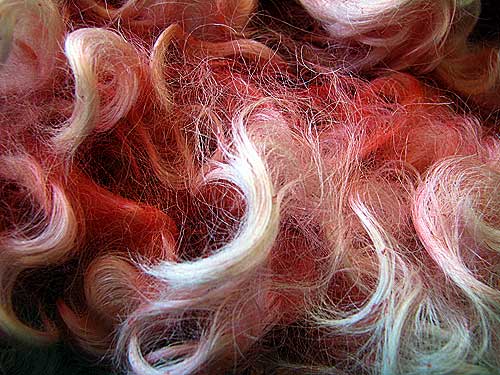
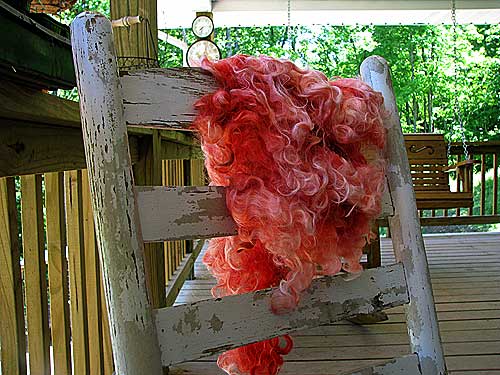
Washed and dyed wool–in Tropical Punch Kool-Aid.
One of the great benefits of having sheep, other than watching them dot (or clump, in the case of my sheep), is having all that lovely wool at your disposal. Unfortunately, sheep are dirty, so you have to clean it. If you’ve never washed a fleece before, it can seem a bit daunting, but it’s actually an easy process. You can wash a whole fleece at once, or wash it in batches.
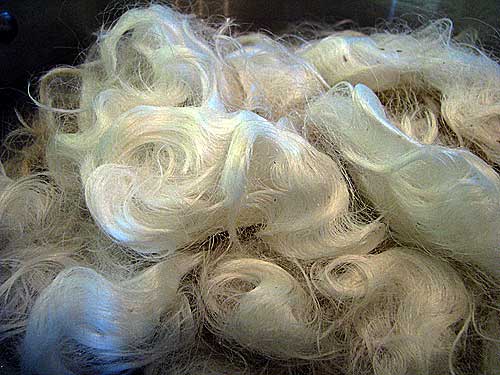
Washed Cotswold wool, left natural (undyed).
Methods for Washing Wool at Home:
To wash an entire fleece, a common method is to use a washing machine for the soaker tub. Personally, I’m not into this method. I don’t wanna put a dirty fleece in my washer. I’m just too finicky for that. If I had a spare washer that I could dedicate to fleece-washing, I’d do that, but since I don’t, I prefer batch-washing.
Detergent and Vinegar:
Most commercial laundry detergents are too harsh for washing wool, but you can use Era. You can also use specially prepared detergents such as Orvus. (Look for it at feed stores.) Pure soap is not recommended as it may stick to the wool and be impossible to remove.
To wash a full fleece in the washing machine, I use Era with 1 3/4 cups detergent for the detergent bath and about a cup of white vinegar for the vinegar bath.
For the batch process, I use 1/4 cup detergent (Era) for the detergent bath and a couple of tablespoons of vinegar for the vinegar bath.
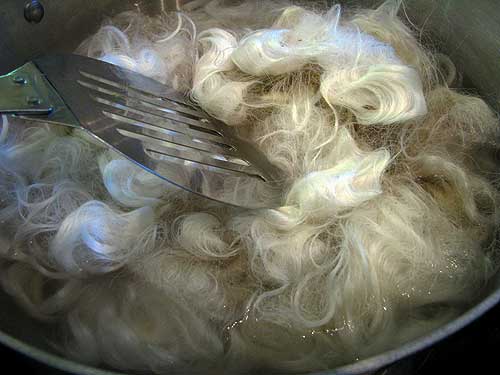
How to Wash Wool:
However you choose to wash your wool–by the fleece or by the batch–you’ll follow the same general steps, washing the wool in detergent followed by a couple of vinegar baths then a rinse bath.
To remove batches from your fleece, carefully separate a piece that will fit in your pot. Remember that the better skirted your wool is to begin with, the easier your wash will be. Take the time to do a pre-wash final skirting even if the wool has been through an initial skirting.
Steps
1) Soak the wool in a detergent bath for about 10 minutes. Use hot water, anywhere between about 110 and 140 degrees. The melting point of wool grease is between 95 and 104 degrees–you want your water above that melting point, but not higher than 140 degrees as that could damage the fibers. Take the temp of the hottest water out of your tap. If it’s not hot enough, simply heat the water briefly on the stovetop.
Important: Never scrub or agitate the wool, and do not apply or pour water directly onto it. Fill your pot with hot water first then add the wool and soak only.
2) Drain (using a colander) if washing in a batch on your stovetop, or spin out if using your washer.
Important: Skip over the first stage of the spin cycle! Water still runs into the washer at the start of the spin cycle and you can’t pour water directly over your fleece. Place your spin knob at the very end of the spin cycle.
3) Fill your pot or washer with water again. Add vinegar then add your wool. Let soak for about 10 minutes. Vinegar helps cut the detergent.
4) Drain as in Step 2.
5) Repeat the vinegar bath as in Step 3.
6) Drain again as in Steps 2 and 4.
7) Soak the wool one more time in plain water for a rinse bath, for about 5 minutes.
If you’re not satisfied with the cleanliness of your wool at this point, repeat the entire process.
Washing in batches, I still do a final spin-out of the clean wool in the washer to completely remove all the bath water before moving on to dyeing the wool. I also go over the wool one more time to remove any pieces that didn’t wash out well.
Important: Never take wool from hot water to cold water. Only transfer it from like temperature to like temperature or to a warmer temperature.
TIP: For the first (detergent) bath, you can leave the wool soaking overnight to dissolve stubborn dirt. Continue on with the steps to washing wool from there.
How to Dye Wool:
Use any specially prepared dyes or use unsweetened Kool-Aid, which is cheap and fun!
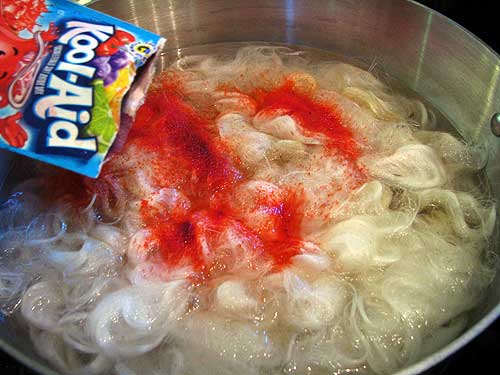
Place your wool back in a pot of hot water out of your tap. Use at least two or three packets of Kool-Aid to dye a pot of wool. You can use more if you want deeper color, and you can also use multiple colors to get a variegated effect in the wool. Dyeing wool is a creative process, so have fun! You can also leave your wool natural for a homespun look.
Let the wool sit in the dye bath for about 10 minutes–more for deeper color. Drain and move to a dry towel. After the towel has soaked up a good bit more of the water, you can either place your wool outside on a nice day–hang it on a chair or whatever is available–or allow it to dry on a rack inside (which will take longer). A nice breeze outdoors can dry a fleece in a few hours.
Now your wool is ready! Card it, spin it, felt it, or use it for other craft purposes. Look at this pretty wool! (Dyed in Grape and Black Cherry Kool-Aid.)
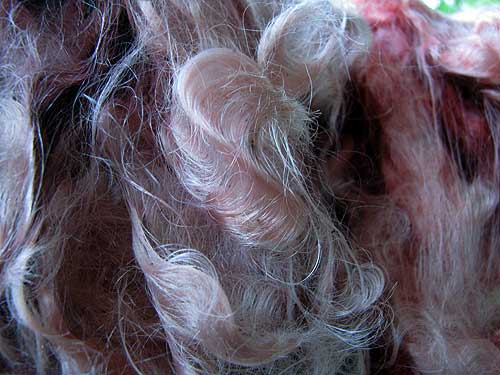
My sheep and I made that!


Stellina says:
this may seem like a stupid question. But won’t the koolaid fade or run? My mother in law has goats and sheep here in Italy. She makes goat cheese and ricotta but she does nothing with the wool. I have all the wool I could ever want at my disposal! It would be cool to dye it if kool aid if it works. thanx
On May 22, 2009 at 3:35 am
Suzanne McMinn says:
Stellina, I don’t have a long experience with it myself, but the lady who showed me how to do it this way when we went to the spinning class has been working with wool most of her life. She recommended using Kool-Aid.
On May 22, 2009 at 4:50 am
Kathryn says:
You and your sheep did a very good job!
On May 22, 2009 at 4:11 am
Sheila Z says:
Beautiful! I love the luster of Cotswold. Is it soft?
From what I’ve read, some Kool-Aid dye can fade if left in the sun. Otherwise it’s pretty good. I dyed some yarn 7 years ago with Easter Egg dye. The baby socks and slippers I knit from the yarn are still the same bright pink as when I dyed them. They haven’t seen a whole lot of bright sun though. Food coloring will also work. The Wilton cake dyes are really concentrated. The nice thing about using food safe dyes is you can safely do the dyeing in your kitchen using cooking utensils because everything is nontoxic. Although I don’t feel comfortable eating a whole lot of food coloring myself. The only colors I’ve been able to do are always these bight pastels. Not many earth tones in Kool-Aid. It sure is fun though, especially doing the dyeing with kids.
On May 22, 2009 at 4:50 am
Marilyn says:
I love doing small batches of dying using Kool Aid!
If you use vinagar – a cup or- in the water it will help make the color more stable – set the color faster. I have found that the color in the wool will however fade if left in the sun.
Colors can be combined for more shades.
If you type Dying with Kool Aid in your search area the internet will suply lots of articles on this process.
Marilyn
On May 22, 2009 at 5:09 am
Connie says:
Wow!
Connie
On May 22, 2009 at 5:35 am
Lynda Dunham-Watkins says:
I use the natural for Santa wigs and beards. Your’s looks really nice. Do you plan to sell any?
On May 22, 2009 at 5:41 am
Suzanne McMinn says:
Yes, I do, once I get it all washed then weighed out in portions! Hopefully soon. I’m working on it. I’m planning to leave most of it natural so I can sell it undyed for people to do what they want/need to. I’ve been dyeing some for myself, for crafts, and I’ll sell some of it dyed, too. I’ve got a Jacob fleece to prep, too.
On May 22, 2009 at 6:15 am
Lynda Dunham-Watkins says:
Great! I’ll watch for it.
On May 22, 2009 at 7:43 am
Bev says:
You and your sheep are a great team
On May 22, 2009 at 6:10 am
Christine says:
A cheerful teenager? Isn’t that a mythical creature, like Bigfoot? Or do you have one of those in your woods too? 😆
On May 22, 2009 at 6:10 am
Cyndi Lewis says:
Kool-aid… Cool! :purpleflower: Now you need to work on your next farm project. A dyer’s garden full of herb and plants to obtain your dyes from. Cool beans!
On May 22, 2009 at 6:21 am
Leah says:
I love those colors! How is the knitting going? A winter hat,scarf,mitten set would be nice made from your dyed wool. Have fun with it!
On May 22, 2009 at 7:46 am
Mim says:
I think that I might try to dye my white llama fleece with Kool Aid this weekend..Bought Kool Aid a couple of weeks ago but thats about as far as that went. Really like the black cherry & grape color.
Everyone have a nice safe Memorial Day weekend..
On May 22, 2009 at 8:08 am
Bethrusso says:
Wow, I am VERY impressed! I’m happy I can make regular Kool-Aid – I can’t imagine sheering a sheep and dying the wool with it. I do have a bread machine, so we do have semi-homemade bread sometimes. I’m really working on being more domestic – someday… And by the way, my dog is named Annabelle! I’ve never thought of doing anything with her fur, but you never know. Love your site ~
On May 22, 2009 at 8:52 am
IowaCowgirl says:
Awesome and beautiful.
I wish you would take up weaving next, as I want to learn how…
On May 22, 2009 at 9:06 am
Elcie says:
You should note that the most important thing about using the washer to spin out water is to put the fleece in some kind of bag – a pillowcase with the top tied closed or a lingerie bag, for example. You should avoid the mesh laundry bags unless they’re a fine mesh – those cheap ones at Walmart have holes that are too large and a lot of fiber gets out, which can really damage your washer machine.
On May 22, 2009 at 10:55 am
The Retired One says:
Looks like a wig (Lucille Ball’s) hanging on the fence!
On May 22, 2009 at 12:32 pm
LauraP says:
Sounds like you’re off to a happy start with the fiber addition — and you’ve probably already figured out just how addicting the fiber arts can be.
Elcie is so right, too, about bagging the wool for the spin out in the washer. The wool that escapes with the dirty water can really goof up the parts and leave you with hefty repair bills.
On May 22, 2009 at 12:41 pm
Lola-Dawn says:
What a talented team you and your sheep are! I really wish I could fondle … er … handle that Cotswold fleece. My favorite hand knit socks are from wool dyed with 3 different Koolaid flavours. They have faded a bit over 4 winters, but not as much as I expected. Of course, I don’t leave my feet sitting around in the sun during the winter …
On May 22, 2009 at 4:47 pm
Sheryl - Runningtrails says:
Love that Tropical Punch coloring! Really, really gorgeous! You did such a good job. Looks like fun too. I would one day like to have a couple of sheep, some angora rabbits and cashmere goats.
On May 22, 2009 at 5:08 pm
Claudia W. says:
That’s some pretty stuff. I am amazed at all I have learned from you! Thank you!
On May 22, 2009 at 6:08 pm
Laughing Orca Ranch says:
Thanks for this fun and very simple-sounding tutorial. I really appreciate. I learned to spin last year and can’t wait to process the wool I recently harvested from my llamas, sheep and angora goat.
Do you have some clever combination colors for the kool-aid, too? How about dying with flowers and herbs?
~Lisa
On May 22, 2009 at 8:56 pm
M says:
For those interested in dyeing instructions …. Google “Paula Burch hand dyed”
link:
https://www.pburch.net/dyeing.shtml
Paula has a number of pages of instructions.
Silk and wool are proteins that are dyed with acid type dyes and vinegar is needed to get the dye molecules to adhere. Silk works a bit different than wool … read thru her site it is very helpful.
Do take note that she also includes instructions for cotton and linen … which DO NOT necessarily use food safe dyes.
M
On May 23, 2009 at 3:00 pm
Dee T says:
:snoopy: I can’t wait to try the Romano. Not sure I can stand to wait a whole year before tasting it. At my age (old) a year is uncertain. 🙂
You are a clever young woman. I love that you are experimenting with all the different things that I did in my youth.
Thanks for sharing your experiences. They look just wonderful.
On February 16, 2011 at 5:27 am