
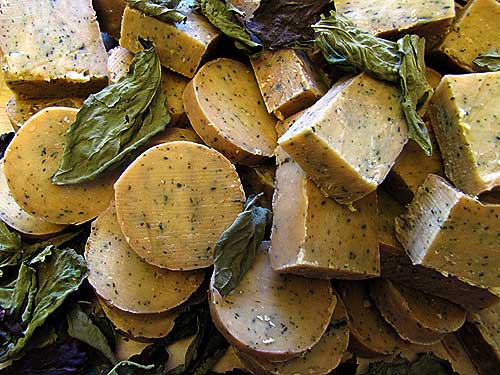
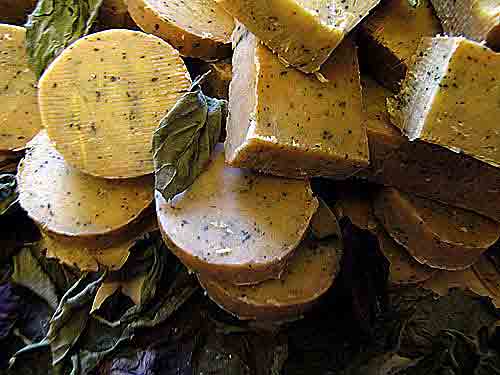
Since I have all that basil, I spent the weekend making three batches of soap with milk and dried, crushed basil. Homemade soap with milk from my cow and herbs from my garden–what could be better?
I also did a few experiments. Every time you make soap, in fact, it’s an experiment. There’s always something new to try, and something to learn. This time I tried making some small round (guest bath, decorative size) soaps using a paper towel roll as a mold.
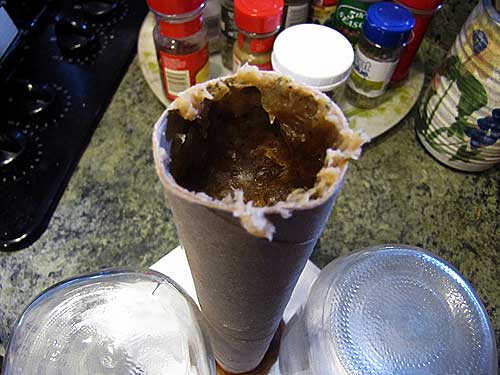
That worked great! The thin cardboard peels right off and you can cut the soap into cute little rounds.
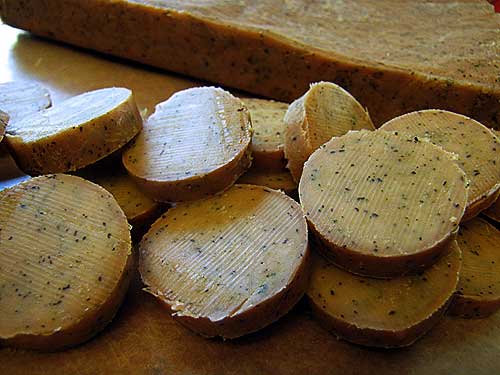
It’s fun to look around the house and think of all the things that could be a soap mold. (I’d love to hear your ideas!) The world is your soap mold.
I also did some experimenting with a “soap press” to make the top surface of soap in a flat pan turn out nicer. When I use a 9 x 13 pan as a soap mold, I line it with freezer paper. No matter how much you smooth the top, it’s uneven. I’m not looking for perfection–I like a rustic bar. But I’d like to make it a little smoother. This time I tried placing freezer paper on top of the soap after putting it in the pan then loading books on top to press.
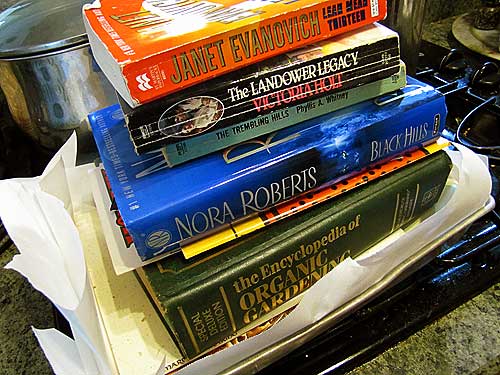
This works pretty good, but it was a rudimentary experiment. I need a piece of heavy cardboard or plywood cut to fit the 9 x 13 pan, place that on top of the freezer paper, then the weights (books) for a more even result.
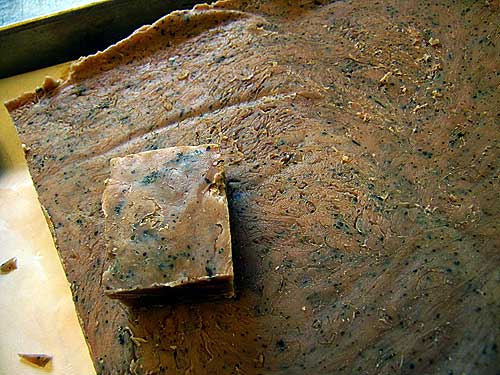
In any case, I can see that it will work, so I’ll refine the technique next time. Now for the recipe!
If you’ve never made soap before, you can find my step-by-step soapmaking tutorial for hot and cold process soap here: How to Make Soap.
Read more about the different processes of making soap and what goes into soap here: Getting Ready to Make Soap: Part 1.
See all about the scary lye here: Getting Ready to Make Soap: Part 2.
And find out all about the necessary tools and utensils here: Getting Ready to Make Soap: Part 3.
One more finger-wagging note: Wear safety gloves and goggles and always follow safety guidelines when making soap!
Remember, when making soap with milk, get the milk icy cold before adding the lye. When the lye is added to the milk, the chemical reaction with the sugars in the milk will burn the milk if it’s not very cold. Measure out your milk in a container. Place it in the freezer before making soap. The milk is ready to use when it’s icy-slushy. Add the lye gradually, stirring constantly.
ADD LYE TO MILK. NEVER ADD MILK TO LYE. (Same procedure as when using water.)
This is a creamy, conditioning soap with the soothing touch of basil. Make it by either the cold or hot process method. (See how to make soap.) Fragrance oil of your choice can be added if you like–use 1 fluid ounce. You can make this soap as designed below, or use it as a basic milk soap recipe to make other milk soaps by changing up the additives. (To change the fats, you must re-calculate the recipe.)
 Printer-Friendly
How to make Milk & Basil Soap:
Crisco — 16 ounces or 453.529 grams
lard — 10.56 ounces or 299.371 grams
coconut oil (76-degree melt point) — 5.44 ounces or 154.221 grams
milk — 12.16 ounces or 344.73 grams
lye — 4.455 ounces or 126.297 grams
Additive
1 tablespoon finely crushed dried basil
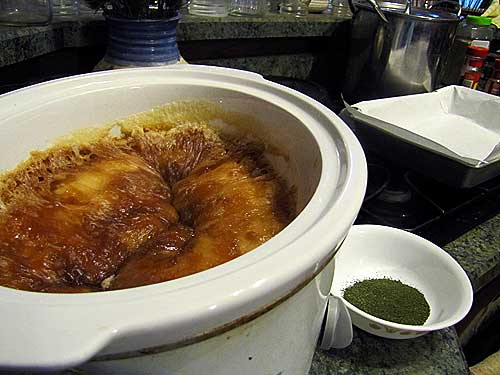
Soap with milk takes longer to come to trace than soap with water, and it also takes longer to cook in hot process. For me, this recipe took 12 minutes to trace and 3 hours, 15 minutes to cook in the crock pot. Continue cooking your soap until it tests within the safe range with a pH strip.
I made several batches and cut it all up in sample size bars, which I’ll be giving away at this year’s party on the farm. We’ll also be having a soapmaking demonstration during the party. We’re going to have so much fun!
Find my Crafts archives here.
See all my soapmaking posts here.


Rachel says:
I prefer to use all vegetable based oils, do you have any suggestions of something similar in nature to lard that is vegetable based? I’d love to try milk soap, I’ve heard it’s great and yours looks beautiful! Thanks for the idea about the paper towel tubes, genius!
On September 21, 2010 at 6:01 am
Suzanne McMinn says:
Rachel, you could use olive oil, or use another solid fat like shea butter or cocoa butter. I haven’t had a chance to buy anything like that yet, so haven’t worked on any recipes including those. There are all kinds of neat “butters” that are vegetable-based and very moisturizing. (You’d need to run the recipe through soapcalc replacing the lard with shea or cocoa or whatever to get the right amounts.)
On September 21, 2010 at 6:18 am
lauren says:
Gorgeous soap!! 🙂 I was wondering if you could substitute rosemary for the basil in this recipe?
On September 21, 2010 at 6:19 am
Suzanne McMinn says:
Lauren, you could substitute any herb you prefer!
On September 21, 2010 at 6:48 am
lauren says:
Great Thanks :)my basil didnt do well but the rosemary this year was VERY happy 🙂
On September 21, 2010 at 6:51 am
Runningtrails says:
Rachel, I use shortening, like Crisco, instead of animal fat to make vegan soap. I use shortening instead of oils because hard fat makes a harder soap that doesn’t dissolve in water so quickly and lasts longer.
PVC pipe greased with vasoline makes a good round soap too and is reusable, however, you sometimes need to push it out with something when it gets hard as it can be difficult to remove. I once had a wooden plunger to exactly fit the pvc pipe mold. Hubby made it for me. I’m going to try the paper towel and tp cardboard rolls. Sounds easier. I have boxes of them saved for starting fires in winter. Thanks for the idea, Suzanne!
Do you grease the cardboard roll first?
Just a tip here I have learned the hard way about using fresh herbs in soap: If you don’t grind them smooth enough, they’ll be scratchy. This does make a good foot scrub soap. Ditto for instant coffee, dissolve it in boiling water first.
On September 21, 2010 at 7:36 am
jackie c. says:
The soap turned out really pretty. Several hints on using plastic PVC pipeing (or other materials) when greasing it with oils. The oils will saponify with the soap as it cures helping it to stick like glue to the PVC. Also using a mineral oil or petroleum based product does defeat the idea of a natural soap, just suggeesting a soapmaker think about it. Also the method that I use to smooth the top of the hot process soap, uses alcohol which many people don’t like including in the soap.
Anyway, here is how I smooth hot process, glop soap into mold smooth as best can with ladle, then spray with rubbing alcohol and cover with saran wrap or the heavy weight glad wrap and use a damp sponge to wipe the top of the covered soap. Don’t be in a rush with this, the coolness of the sponge seems to help the smoothing process as well. The soap can be squished down with the sponge to get the sides right. The style of soapmakers recently is to leave all the tops lumpy,but dang is that tough on the skin.
Hope that helps. :happybutterfly:
On September 21, 2010 at 8:39 am
Suzanne McMinn says:
Thanks, Jackie! I’ll try that for smoothing! Re PVC pipe, I haven’t tried that yet but was thinking of trying lining it with freezer paper.
On September 21, 2010 at 8:42 am
KentuckyFarmGirl says:
I posted the paper towel roll idea on our new Facebook soap page yesterday! Thought I’d use them as samples. Great minds think alike. Someone else added to keep your TP rolls as well! I had to buy 8 feet of 3 inch PVC pipe just to get the 3 8-inch pieces I needed so I have lots of PVC pipe now. I have heard that if soap does not come out of the greased PVC pipe well you can put it in the freezer for 5 – 10 minutes then it will come out easier. Your soap looks wonderful! I am heading to the Amish trading post today to pick up more essential oils and they have very finely ground herbs there of all kinds. Can’t wait to pick up a few new ones.
On September 21, 2010 at 8:44 am
jackie c. says:
:happybutterfly: Me again, I didn’t suggest the PVC tip. When making round soap using PVC or other, take a piece of freezer paper and slide it into the pipe cylinder. Pour in the hot process soap, you will have to bang the soap onto something hard to get all the air bubbles out of it. Cold process works in this lining method too. Shiny side of paper to the soap. When cool or after 24 hours, it should (maybe,sorta,sometimes,usually)slides right out of the tube.
On September 21, 2010 at 8:44 am
Amy I. says:
I use old cookie cutters that I inherited….make different shapes for different people! So much fun.
On September 21, 2010 at 8:49 am
Wendy B. says:
My neighbor gave me around 3-4 gallons of goat milk recently, but this time the milk tasted kind of “off”. I’m not sure if it’s what they’re eating or if the milk was a little old? Anyway, I am loathe to let it go to waste, but no one will drink it now. Sooooo, I thought…SOAP! I have the other milk soap recipe and now this one. And although I’m a little scared to try my first batch, I’m willing to do it! Now I’m wondering about a mold idea I have. I have been saving those cool plastic containers that Crystal Light drink mix comes in. I have no idea why, yet, but they seem like they should be handy for something. Could I use these for a soap mold. They’re kind of like an oval tube and the plastic seems tough enough. What do you guys think?
On September 21, 2010 at 9:31 am
Suzanne McMinn says:
Wendy, that would work!
On September 21, 2010 at 9:49 am
Tina says:
I am so inspired! I want to make my own soap; I’m weary of spending $4 on the wonderful goats-milk soap I use! Aside from the overall trepidation of making one’s own soap for the first time, I’m wondering where in the world I could get scents that smell as great as the store-bought soap!? The smell is fabulous! Any suggestions?
On September 21, 2010 at 9:32 am
jackie c. says:
:snuggle: My fav fragrance suppliers are: brambleberry.com, or thesage.com,or snowdriftfarms.com.I use thesage and snowdrift mostly. Brambleberry always sends great smaples with each order.
Be prepared to be overwhelmed the variety is so huge. Oh, for essential oils I like Mt. Rose herbs in Eugene Or. I think it is http://www.mtroseherbs.com but maybe not. They also have the bestest catnip ever says the Big Guy cat.
On September 21, 2010 at 9:40 am
Nancy says:
https://www.mountainroseherbs.com/
I love their herbs! But Brambleberry is my favorite for fragrance.
On September 21, 2010 at 10:02 am
KentuckyFarmGirl says:
Wendy, I have some of those saved too. I was just looking in the cabinet and realized that Little Debbie oatmeal cream pie boxes are a perfect shape for bars! Do you think they would be thick enough if you stood them between something to keep the sides from pressing out when you fill them?
On September 21, 2010 at 10:59 am
Christina says:
Yay!!
Suzanne, I just LOVE making soap thanks to you 🙂 I’ve made about six batches this year!
My most recent batch I made using coconut milk and coconut oil. It smells SOO good! As an additive I made a thick sauce of vanilla and coco powder and added that. It made a lovely dark chocolate marble affect and added to the smell. The soap smells like chocolate coconut brownies!!
I have to hold back form eating them….!!
Thanks for teaching me to make soap! I haven’t bought any at the store this year 🙂
On September 21, 2010 at 11:02 am
Lisa says:
I thought the title of this post was “Milk and Basil SOUP.” I thought “eeeeuuuww…that can’t possibly be good!” but my faith in you is so strong, Suzanne, I clicked over to check it out anyway! I was very glad to see my mistake, regardless.
On September 21, 2010 at 11:34 am
AA says:
Have you sent the confirmations out for the party day yet? I am planning on coming. I’ll be paying close attention to the soapmaking!
On September 21, 2010 at 3:49 pm
Suzanne McMinn says:
I haven’t sent out another email yet as I’m still waiting to hear back from a few people, but will soon, within the next couple days!
On September 21, 2010 at 4:04 pm
Linda Ferguson says:
When do you sleep?? I get tired just hearing all the things you do. I guess when I was younger I had all your energy. Now I just love reading about all these wonderful things. Thanks for making my day!!
On September 21, 2010 at 5:16 pm
Victoria Sturdevant says:
I just read about adding used (& dried) coffee grounds in soap for grimy hands. Here’s the link: https://www.bloombakecreate.com/2010/03/third-soap-citrus-coffee-hand-soap/
On September 21, 2010 at 7:29 pm
Emptyhead51 says:
You didn’t mention what kind of basil you used. Have you ever made it using lemon basil. The fragrance of the lemon is sooo strong.
On September 21, 2010 at 9:47 pm
Suzanne McMinn says:
Emptyhead51, I used sweet basil.
On September 21, 2010 at 10:08 pm
Cousin Sheryl says:
How about lining an aluminum foil or wax paper box with wax paper and molding the soap in that? It would make nice, little, square bars.
See everyone at the CITR party!
:shimmy:
On September 21, 2010 at 9:59 pm
LisaAJB says:
I got so excited when I saw the picture with the books. I’ve been reading a bunch of Janet Evanovich lately. Small world. 😀
On September 22, 2010 at 8:07 pm
Renee says:
I am so intrigued with the idea of making my own soap, but it seems to me it would cost more than buying it. Am I way off here? Someone please comment. Thanks!
On October 9, 2010 at 3:26 am
Suzanne McMinn says:
I haven’t done a cost analysis, but I can’t see how it can cost more. (Comparing to purchasing homemade soap. Store soap is probably cheaper, but…. It’s store soap.)
On October 9, 2010 at 7:40 am
Mary Johnson says:
Palm oil is also a good sub for lard if you’re making an all-vegetable soap. Sometimes you’re lucky enough to find it when you look at ingredients on store-brand vegetable shortening (Piggly Wiggly store brand used to be palm oil), lately I find it in the organic foods (usually as vegetable shortening)
BTW, re your lye cautions, someone told me, when I was first learning to make soap, to remember “snow on the lake” to help me remember to add lye to liquids – and perhaps because it’s such a nice turn of phrase, so far I always have!
BTW, your soaps look great – and when I saw the “edge” on your smooth top soap, I thought “trim it off and use it in laundry soap” LOL 😀
On January 16, 2011 at 12:43 pm
Homemade Momma says:
I made my first batch of crockpot soap. Scary!! Then not so scary once it was finished. I love your tutorials and humor. Thank you for making soaping soooo easy.
On November 5, 2013 at 3:53 pm
Homemade Momma says:
Renee, in my opinion it doesn’t matter the cost. Atleast you know the the ingredients are safer than most store brands. Some of us are fortunate to have our own lard from hogs and plant additives and homemade colorants from natural sources. So cost should not be an issue. Besides it’s just plan fun to do this.
On November 5, 2013 at 3:59 pm
GreenGardenGal says:
Couldn’t you nest one 9×13 pan on top of the soap in the other 9×13 pan instead of using cardboard or plywood?
On November 19, 2013 at 10:36 am