

Beeswax is produced by honeybee “worker” bees. They secrete it from glands on the underside of their abdomens then chew it up and mold it into the cells of the combs. That’s why they call them worker bees. It’s a big job for the beekeepers, too, who collect it from the hives and melt it down into cakes. (At least they don’t have to chew it.) The reason beeswax is a bit pricey is because for every 100 pounds of honey harvested, a beekeeper will get only one to two pounds of beeswax. It’s not easily come by, but maybe that’s also why beeswax is so very, very wonderful.
In candles, beeswax smells delicious, requiring no added scent, and it burns longer and cleaner than other waxes. It also has beautiful, natural color.
My latest batch of beeswax candles.
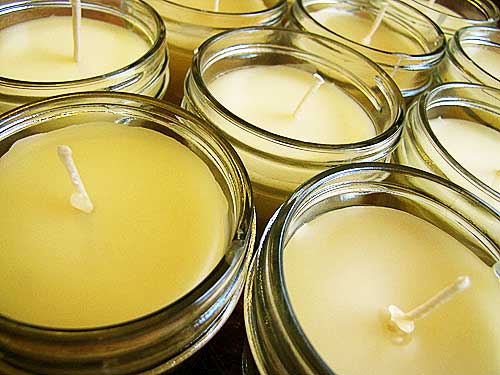
Beeswax has a melting point of 143-148 degrees. I prefer it for container candles. For tapers, you need a wax with a higher melting point. The best way to make beeswax tapers is to buy pressed beeswax sheets and roll each sheet tightly around a wick. (Dipped beeswax can make messy tapers that puddle. I prefer to use taper wax–see Hand-Dipping Tapers.)
You can also use beeswax to make lip balms, skin creams, and herbal salves. When I was researching beeswax, I found the same recipes in multiple places, so I’m not sure of the original sources. (Probably our great-grandmas.) The recipes I’m posting are ones I’ve experimented with and found useful. The first one is for a beeswax cream that is really nice for the hands in the winter.
You can print this post:  Printer-Friendly
FYI, these measurements are by volume, except for the beeswax, which is by weight (weighed before melting).
Beeswax Moisturizing Cream:
4 ounces sweet almond oil
1 ounce beeswax
2 ounces water
8-10 drops essential oil (optional)
8-10 drops Vitamin E
Melt the almond oil and beeswax. Remove from heat and stir in the water. Stir in remaining ingredients. Stir as it cools–before it becomes too cool to pour, transfer to a container (or divide between smaller containers).
You can also make a super easy “Vaseline”-type moisturizer by combining 1/2 cup baby oil per ounce beeswax. After you melt the beeswax, remove from heat and stir in the baby oil. (You can add a few drops of essential oil, too, if you want more scent. I really like beeswax just how it smells naturally.)
There are beeswax lip balm recipes all over the place, but this is one I like that is a Burt’s Bees knock-off.
Beeswax Lip Balm:
1 teaspoons grated beeswax
2 teaspoons coconut oil
1/2 teaspoon lanolin
liquid from one Vitamin E capsule
2 drops lemon or orange essential oil (optional)
1 teaspoon honey
Melt everything together with the beeswax in a microwave-safe bowl (except for the essential oil and honey). If you don’t want to use the microwave, you can also place the ingredients in a little custard cup inside a pot of water on the stove; heat gently to melt. Remove from heat and stir in the essential oil and honey. Transfer to a small container. (This even tastes good.)
You can make a healing salve with different essential oils, depending on what you need, such as tea tree oil (good for cuts and burns).
Beeswax Salve:
2 ounces beeswax
1 ounce jojoba oil
3 ounces sweet almond oil
1/2 ounce vegetable oil
essential oil*
*Research the specific essential oils you are interested in before determining the safe quantity to use for your purposes.
Melt beeswax together with jojoba oil, sweet almond oil, and vegetable oil. Remove from heat. Stir in essential oil, if using. Transfer to a container. You could also mix in various crushed herbs instead of using essential oils.
Beeswax is also the ultimate furniture polish.
Beeswax Furniture Polish:
2 ounces beeswax
1/2 pint turpentine
1/4 ounce lemon or orange essential oil (optional)
Melt the beeswax. Remove from heat and immediately stir in the turpentine. Add the essential oil, if using, and keep stirring as it cools. Transfer to a container. This makes a creamy polish that is great to lovingly rub into wood.
Aside from polishing, beeswax is a great protectant and waterproofing agent for wood. I love this recipe for “Spoon Oil” that was posted on the CITR forum by Buckeye Girl here.
Spoon Oil:
16 ounces mineral oil
4 ounces beeswax, cut in chunks
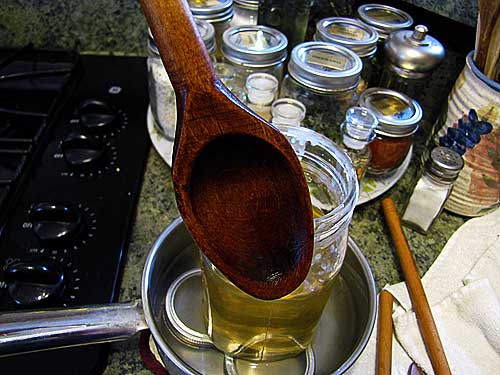
Warm the mineral oil by placing the container in a pot of warm water. Place beeswax in a wide-mouth jar and melt in a double boiler. Remove from heat and slowly pour the mineral oil into the melted beeswax. Stir as it cools. Use to rub into wooden spoons. Also great for reviving cutting boards.
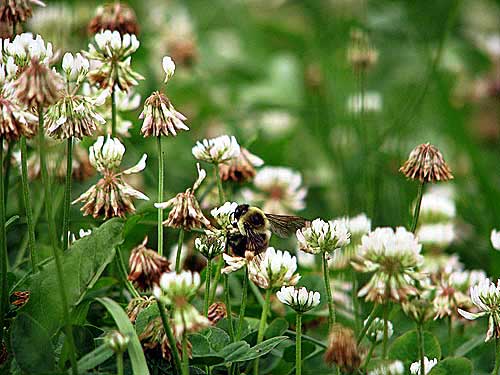
Bees always scare me a little bit, but I love their stuff!
*Make things with beeswax safely–see my guidelines and precautions for melting wax here. You can find beeswax online at craft and candle suppliers, etc. Lanolin, coconut oil, jojoba oil, and sweet almond oil can be found online at health and beauty suppliers, and a lot of the same places where you buy soapmaking and other craft supplies including essential oils. (These are not expensive supplies other than the essential oils, if using.)


Gem says:
LOVE it! Printer in motion… 🙂
On February 7, 2011 at 8:09 am
Angela P says:
Heres another plus for Top Bar Hives. The wax is the most sought after, gorgeous, creamy white! Perfect!
On February 7, 2011 at 8:27 am
Lisabeth Olson says:
Saving to recipes, and printing also. Loving the possibilities.
On February 7, 2011 at 8:38 am
Lisabeth Olson says:
Printing done, not saved! Duh
On February 7, 2011 at 8:40 am
Runningtrails - Sheryl says:
I have read that top bar hives generate a lot more beeswax. When and IF I get bees, I will use top bar hives. They are healthier for the bees too, since you take the entire comb and the bees build a new one from scratch each time. There is no tray or holder for the honey, other than the comb built for it – less to become infected with disease or invading parasites.
When it is harvested the comb is pressed to remove the honey then you have the entire comb harvested too. It can be melted down into a ball of wax, or so I have read.
Love the recipes! I would love to have my own honey and beeswax!! Maybe, one day…
On February 7, 2011 at 8:47 am
Jane says:
I wouldn’t blame you if you didn’t believe me on this, but I was thinking before I got up today about bees – and you! Basically I was wondering to myself if bees would do well in forest land, which then made me think of you and I wondered if you had ever considered getting bees, while all the time thinking you should. Now, that is not so weird on it’s own, but I find it really strange that every time I think of you doing something, you have a post about it! I must be physically joined at your hip (poor you!). Anyway, it’s not bees you have to be afraid of.. it’s WASPS. They are just pure evil. My father did a stint of beekeeping. It was never a problem (but he had all the gear) and quite interesting.
On February 7, 2011 at 8:52 am
Jane says:
Um, I didn’t mean physically – I mean like physic (lly) joined at the hip… We’re actually several states apart;)
On February 7, 2011 at 8:54 am
Karen Anne says:
Poor bees. All that work and then someone makes off with not only their honey but the wax?
On February 7, 2011 at 9:11 am
Patty says:
Your picture is of a bumblebee, not a honeybee. Beeswax is a useful, and sustainable natural wonder. Great recipes!!
On February 7, 2011 at 9:18 am
Suzanne McMinn says:
Thanks, Patty! It’s just intended to be a pretty picture of a bee…. Only one I could find!
On February 7, 2011 at 9:26 am
Joy says:
Bees are truely the most marvelous creatures–pollinate our crops and produce honey and wax. Jane is right that wasps are the truely bad stings that we often blame on bees. I have some friends that keep bees in their suburban backyard. They have fruit trees and flowering bushes and lots of flowers to provide nectar for the bees. They’ve never had a problem with stings nor have their neighbors. And the honey! Lord knows that is good stuff–great on burns and causes them to heal faster, tastes delicious, can relieve coughs and has lots and lots of folk medicine uses. You might want to consider adding a hive to Stringtown, Suzanne.
On February 7, 2011 at 9:28 am
Ramona says:
Interesting info. That lip balm recipe sounds so good.
On February 7, 2011 at 9:34 am
drucillajoy says:
I have bees…I LOVE my bees…everyone should have bees… :sun:
On February 7, 2011 at 9:53 am
susan says:
we have been thinking about putting 1or2 hives in our vegetable garden. I know we wound’nt get a lot of wax, but you don’t need a lot to make lip balm ect. thanks for the recipies.
On February 7, 2011 at 10:22 am
Kat says:
Honeybees are quite sweet, really, and are very unlikely to sting a human who doesn’t over-react to the bee. I finally started my own hive last year, and I just love it!
On February 7, 2011 at 11:50 am
Sheila says:
I’ve made several things with bees wax though it’s mostly been lip balm and salves , I’d like to find a recipe for making bees wax candy as I heard it’s pretty good , kind of like the bit o honey candy :).
On February 7, 2011 at 3:25 pm
Sam Jones says:
Hi! Can you post directions for your poured beeswax candles? Or have you already done that somewhere? I made poured candles recently and the wicks floated up from the bottom of the molds when I poured the hot wax in, making them burn unevenly. How do you cement your wick tabs to the bottoms of your jars? Thanks for any help you can offer. I love your blog, it makes life seem, well, quite nice.
On February 7, 2011 at 6:26 pm
Suzanne McMinn says:
Sam, I make my beeswax candles the same way I make other container candles. You need tacky wax to make your wicks stay down! See this post:
https://chickensintheroad.com/crafts/how-to-make-container-candles/
Also–there are other ways without tacky wax, such as pouring only a very little bit of your beeswax (or other wax) into the jar with the wick. Keep the wick stable until the wax dries–if it’s only a small amount, it will dry quickly. Then pour in more wax once you’ve got the wick cemented. However–tacky wax is easier.
On February 7, 2011 at 10:03 pm
Kelly in TX says:
Yep – beeswax is pretty amazing stuff. Cleaning it after it’s removed from the hive and the honey is taken out is a messy job but it’s worth it because it does have so many uses. I need to make some of that furniture polish…thanks, Suzanne!
On February 7, 2011 at 10:43 pm
kerri says:
Interesting post, Suzanne. Bees are fascinating little creatures. We had a hive in the barn wall 2 summers ago. Sadly, they were gone the next spring. They were wonderful in my gardens that summer.
I love your bee in the clover. Ah..spring…and summer…. :sun:
On February 8, 2011 at 10:38 am
lavenderblue says:
We buy honey from a local beekeeper. A few mason jars full of honey on his sunporch and an “honesty jar” is his store. The last time we were there he (or his enterprising kids) were offering little “hockey pucks” of beeswax, molded in a muffin pan, for sale at a dollar each. I bought one just for the scent of it. Looks like I’ll have to go back and get a couple more so I’ll have at least enough to try the lip balm recipe. :yes:
On February 8, 2011 at 5:34 pm
Karen Edelstein says:
Suzanne, have you figured out a recipe for waxing cheese using mostly beeswax? I tried a bunch of things, and the beeswax was always too brittle and cracked, letting mold in. Let me know if you have a secret for this to share.
On February 15, 2011 at 11:54 pm
Kristin Cunningham says:
I have a beeswax candle question for you. (I need to troubleshoot.) I poured pure beeswax into a jar with a regular wick (wick tab and tacky wax) from Michaels. I get VERY little flame from it. It just barely shows up at all. Any thoughts? If you’ve already answered this somewhere I apoligize.
On February 19, 2011 at 4:45 pm
Suzanne McMinn says:
Kristin, this actually sounds like a wick problem to me, not a beeswax problem. I quit buying wicks (or ANY candlemaking supplies) from Michaels because of quality issues. You will get much better quality from a soap/candle supplier, such as Brambleberry, Wellington, Cajun Candle, etc, online.
On February 19, 2011 at 6:06 pm
Kristin Cunningham says:
Thanks so much! I’ll try ordering some.
On February 19, 2011 at 6:54 pm
Gini says:
Suzanne, I don’t have any mineral oil at home but I do have some solid coconut oil….do you think that would do for spoon oil, with the beeswax?
On March 17, 2011 at 11:34 am
Suzanne McMinn says:
Gini, I don’t know, I haven’t tried that. If you try it, let us know! Only thing is I think it would make a really hard mixture. The spoon oil does solidfy after it cools anyway, even with the mineral oil being a liquid. You use it warm and you have to warm it up each time you use it. I just think that would take longer with the coconut oil, and I’ve never heard of using coconut oil that way. Mineral oil by itself is often used for wood. The addition of the beeswax makes it extra restorative.
On March 17, 2011 at 11:54 am
Marsha says:
Hello!
I love your posts and I just found it today!! I have been dabbling with beeswax candle making. I have tried 3 online suppliers for wicks and each time I do burn testing the wicks aren’t up to the challenge. They make a little pool of wax and then drown in it. What kind of wicks do you get? I’ve purchased from Bramble Berry, candles and supplies.com and candle wic.com and none of their suggestions have worked for me. 8)
On April 29, 2011 at 3:52 pm
Suzanne McMinn says:
Marsha, I’ve been buying my wicks and wax from Wellington Fragrance. wellingtonfragrance.com
On April 29, 2011 at 4:37 pm
Marsha says:
What size? Kind? Thanks for your response.
On April 29, 2011 at 5:44 pm
Suzanne McMinn says:
Marsha, I buy the large container ones and use them for everything. FYI, beeswax candles don’t burn great in any case–but mine don’t pool and go out. Mine tend to burn down in the middle leaving wax on the sides. I use the leftover wax on the sides of the jar for other wax projects like spoon oil or lotions.
On April 29, 2011 at 6:38 pm
Marsha says:
Thank you thank you thank you !!! 🙂
:sheepjump:
On April 30, 2011 at 9:38 am
homeskoolmoma45 says:
Where do you get your beeswax? And, research question for you, what is the difference between the beeswax that is used in candles and in lotions or lip bslm? I’ve tried but can’t find the answer.
On November 10, 2013 at 7:06 am
Suzanne McMinn says:
You can find beeswax at craft stores, or online. I use the same beeswax for everything.
On November 10, 2013 at 8:38 am