
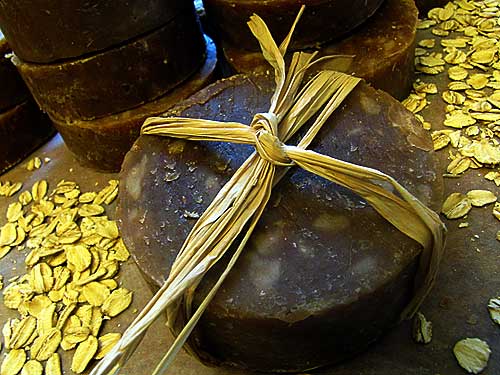
I’m making soap with milk! I’ve been using Beulah Petunia’s milk, but soon I’ll be milking Clover and making goat milk soap, too. You can make soap with any type of milk–cow milk, goat milk, buttermilk, coconut milk, almond milk, soy milk, etc. Soap made with milk is extra soothing and nourishing. This post will show you how–and it’s a twofer because I’m going to tell you how to make round bars, too!
If you’ve never made soap before, you can find my step-by-step soapmaking tutorial for hot and cold process soap here: How to Make Soap.
Read more about the different processes of making soap and what goes into soap here: Getting Ready to Make Soap: Part 1.
See all about the scary lye here: Getting Ready to Make Soap: Part 2.
And find out all about the necessary tools and utensils here: Getting Ready to Make Soap: Part 3.
If you want to develop your own recipe or test a recipe you’ve found online, use a soap calculator: SoapCalc. Do not make changes to a soap recipe without checking it through a soap calculator.
One more finger-wagging note: Wear safety gloves and goggles and always follow safety guidelines when making soap!
How to make soap with milk:
Making soap with milk isn’t very different from making soap with water. You can exchange milk for water in any soap recipe. However, there are a couple of things to keep in mind.
Get the milk icy cold before adding lye. When the lye is added to the milk, the chemical reaction with the sugars in the milk will burn the milk if it’s not very cold. Measure out your milk in a container. Place it in the freezer before making soap. The milk is ready to use when it’s icy-slushy.
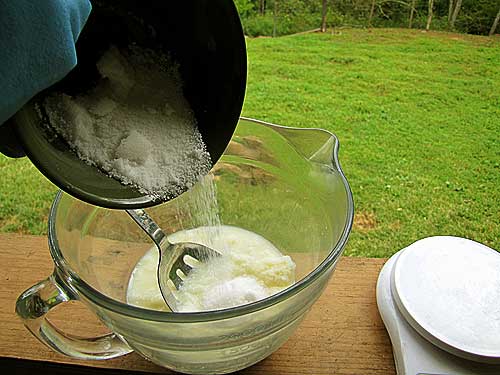
ADD LYE TO MILK. NEVER ADD MILK TO LYE. (Same procedure as when using water.)
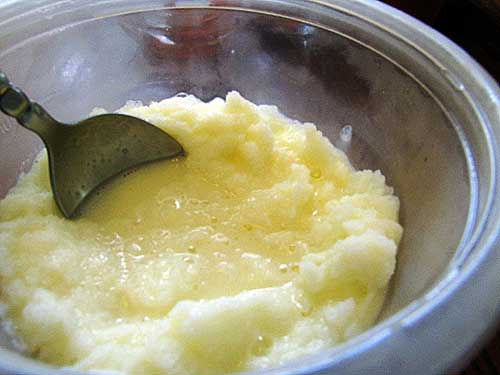
The lye will heat up the milk and melt that icy-slush very quickly. The mixture will turn a golden color and have a slightly curdled look to it. That’s normal. What you don’t want is for the mixture to turn brown and smell scorched. To prevent scorching the milk, always make sure your milk is icy-slushy cold before using!
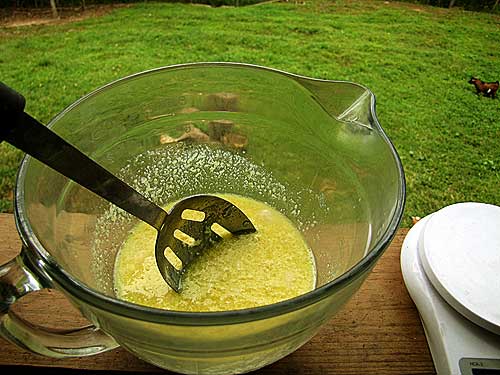
Add the milk/lye mixture to the fats in your crock pot and continue on following all the usual soaping procedures.
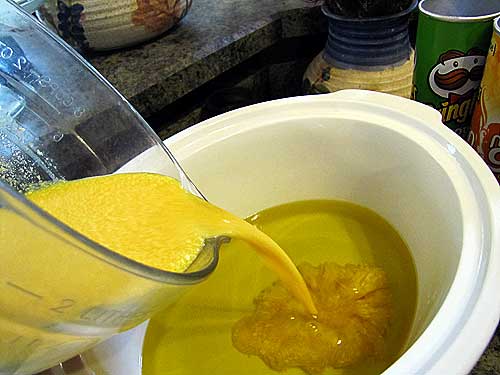
Soap with milk takes longer to come to trace, and it also takes longer to cook in hot process. The recipe below (Oatmeal, Milk, and Honey soap) took 15 minutes to trace.
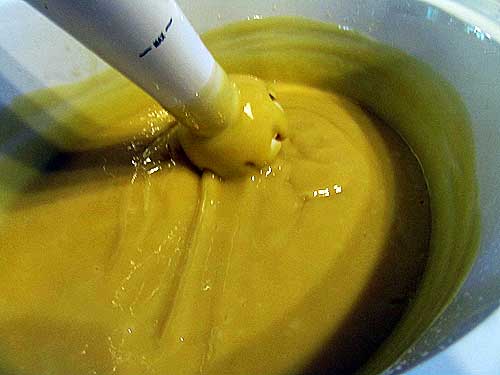
It took 4 hours to cook by hot process in the crock pot. (Hot process in the crock pot is my preferred method for making soap.) When using milk in any soap recipe, don’t be concerned with the time it takes to cook. Continue cooking your soap until it tests within the safe range with a pH strip.
How to make round soap bars:
To make round soap, you can…..
1) Buy a round soap mold from a soapmaking supply company.
2) Buy (or salvage from your barn or garage) some PVC pipe. (Getting it out of the PVC pipe is the trick. The best advice I’ve seen for that is to line the PVC pipe with a sturdy silicon mat. Make sure several inches of the mat stick up out of the top of the pipe. When the soap has set, pull the mat out to remove the soap.)
OR…..
3) Eat some Pringles!!!! (This method sounds the most fun already, doesn’t it?) DO NOT USE PRINGLES CANS AS MOLDS FOR COLD PROCESS SOAP. Pringles cans have an aluminum lining. They are only safe to use as molds for hot process soap because by the time soap goes into the mold in hot process, it is already soap. Soap made by the cold process method is still saponifying when it’s placed in the mold and cannot be placed in molds containing aluminum.
Just one of the many reasons to make soap by the hot process method.
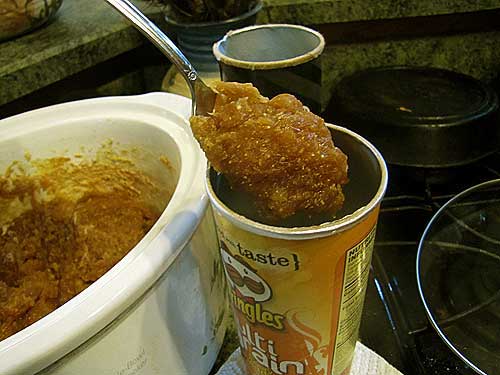
Spoon cooked soap into the cans. Fill each can no more than about two-thirds to three-fourths full so that you have room to work with the can when you are removing the soap. Bang the cans down on your counter to settle the soap. You can also insert something like a can of air freshener or oil spray to tamp down the soap. (You’ll have “air pockets” or holes in your soap if it’s not tamped down well.) For the 2-pound recipe featured in this post, I used two Pringles cans.
Allow the soap to set up for about 12 hours before removing from the cans.
To remove the soap, cut a slit at the top to get started.
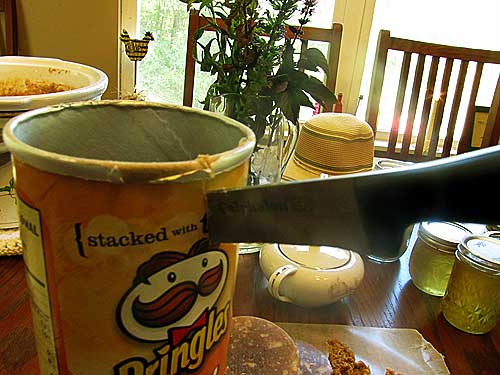
From there, you can easily tear away the can by hand.
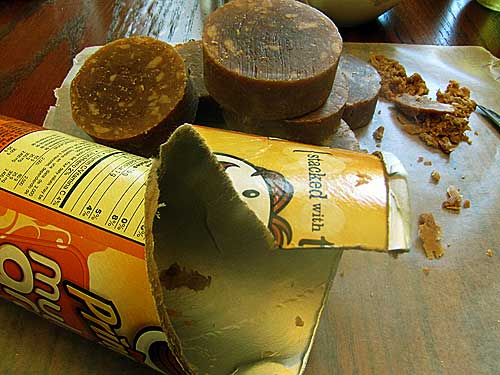
And now you have a beautiful round log of soap.
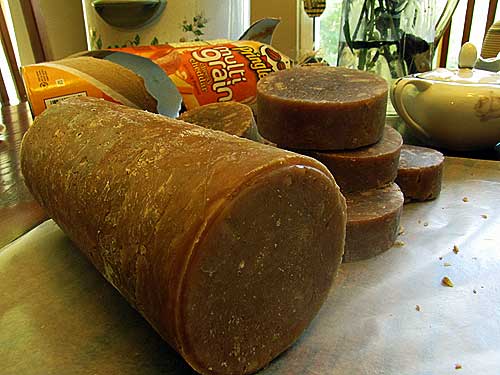
Slice into bars.
Would you like to make the recipe pictured in this post?
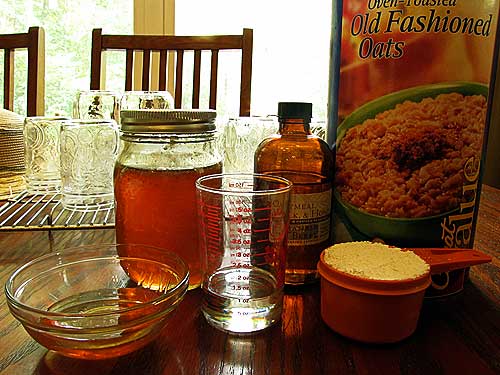
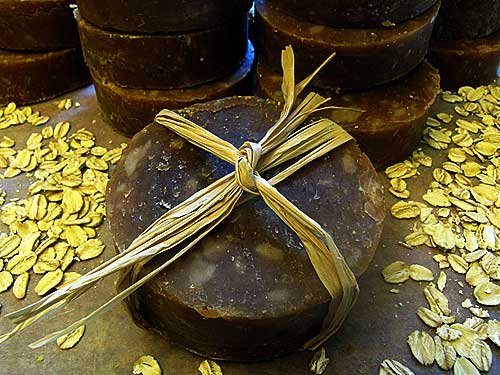
This is a creamy, soothing soap made with milk and honey and a little finely ground oatmeal for light conditioning. Make it by either the cold or hot process method. (See how to make soap.) Fragrance oil is optional. You can make this soap as designed below, or use it as a basic milk soap recipe to make other milk soaps by changing up the additives. (To change the fats, you must re-calculate the recipe.)
 Printer-Friendly
How to make Oatmeal, Milk, and Honey Soap:
Crisco — 9.6 ounces or 272.155 grams
olive oil — 9.6 ounces or 272.155 grams
lard — 6.4 ounces or 181.437 grams
coconut oil (76-degree melt point) — 6.4 ounces or 181.437 grams
milk — 12.16 ounces or 344.73 grams
lye — 4.463 ounces or 126.524 grams
Additives
1/2 cup finely ground oatmeal (old-fashioned oats)
2 tablespoons honey
1 fluid ounce oatmeal, milk, and honey fragrance oil
This makes a deliciously sweet-smelling soap that is ultra-soft and healing for the skin.
Find my Crafts archives here.
See all my soapmaking posts here.
Thank you to CindyP, who worked with me in calculating and testing this recipe, and is owed all the credit for the Pringles mold idea. Check out her homemade soaps here: Chippewa Creek Soaps.


Christina says:
Fantastic!
I’ve made soap three times since reading how to do it on your blog, and I’ve been just itching to make ROUND soap! I’ve read that you can also line your PVC pipe with parchment paper (wax paper), but I’ve not tried it yet. I like the chip can idea. That’s a bit easier. I think I’m going to make some more soap tomorrow! I’m almost out!!
I’m going to make some coconut chocolate soap…! My last batch was Eucalyptus, it was great. 🙂
On September 6, 2010 at 2:03 am
Becky says:
I make blender soap. It is so easy and quick. tracing happens very quickly, under a minute.I use pvc, slide it out after it sets up a little bit. check out free blender soap recipes.
On September 6, 2010 at 5:34 am
glenda says:
I make our soap but have never tried the hot process crock pot method.
I have never had soap turn that much darker as it aged, either goat’s milk or cow’s milk. Interesting.
Wouldn’t a spicy fragrance oil be perfect for that color.
On September 6, 2010 at 6:33 am
becky3086 says:
I haven’t made soap in a long time. We can’t buy Red Devil Lye here anymore and I haven’t found any other lye. I know there is a liquid kind but not sure how to use that.
On September 6, 2010 at 7:13 am
Roz says:
I have only made cold process soap – when I want round bars, I use a frozen juice can (the cardboard kind, not the plastic) and it takes about 3 cans for a pound of soap recipe. I didn’t know not to use the aluminum lined cans for cold process, thank you!
On September 6, 2010 at 7:15 am
Prairie Mother says:
I would love to make milk soap! It looks great. Thanks for all the step by steps, tips and hints. I probably won’t be making soap any time soon though, i 3 small kids in the house. But I’m definitely keeping this site bookmarked til i can!
On September 6, 2010 at 7:59 am
lauren says:
I’m dying to try this!!! right after we make the cheese from the cheese kit I just ordered 🙂
On September 6, 2010 at 8:04 am
judydee says:
We have also used the Pringles cans and juice concentrate cans to make round candles. I’m looking forward to trying this soap!
On September 6, 2010 at 8:06 am
CindyP says:
Great job, Suzanne!!! :woof:
Roz — juice cans! Great idea! May take more than a pringles can, but it would be recycling!
On September 6, 2010 at 8:07 am
Melinda says:
This may sound like a stupid question, but …..does homemade soap go rancid? ANd if not, if it safe to use indefinately?
On September 6, 2010 at 9:13 am
Suzanne McMinn says:
Melinda, no, it doesn’t go bad! It’s cooked through to soap. And yes, you put the lid on the crock pot while cooking.
On September 6, 2010 at 9:22 am
Melinda says:
oh and one more question…..do you put the lid on the crockpot during the cooking down process?
On September 6, 2010 at 9:15 am
Connie says:
I’m going to try this. I’ve got my own goats milk so why not?! Thanks, Suzanne!
On September 6, 2010 at 10:24 am
Barbee' says:
Pringles cans: what a neat idea, makes it just the right size.
On September 6, 2010 at 10:40 am
KentuckyFarmGirl says:
I have my PVC pipe and everything ready to do goat milk soap and I am soooo glad I read this first. I was worried about it sticking in the pipe. My husband left for work a few minutes ago and I told him to buy a few things of Pringles. He said why I said, soap molds….he just shook his head…glad he loves me and puts up with all my “crafty adventures”!
Thanks for posting this!
On September 6, 2010 at 11:14 am
claudia w says:
What a great recipe! I can’t wait to smell my own when I make it!
On September 6, 2010 at 11:40 am
melinda says:
Thanks for the answers! Sometimes I feel so stupid but I have never done half of the things I have done since I started reading this blog so I’m always a little nervous.
Case in point……the chickens hid 74..yes you read that correctly 74 eggs and I had to throw every single one of them away and reconfigure the hen house so there were NO HIDING spots! It looked like a mountain of eggs! I wondered why I was only getting three or four eggs a day our of ten chickens!
On September 6, 2010 at 12:08 pm
Suzanne McMinn says:
Melinda, that is terrible about the eggs, but funny. I have had similar incidents, but I don’t think with quite that many!
On September 6, 2010 at 12:19 pm
melinda says:
They had been laying for weeks and weeks and like I said……stupid me I just thought I had lazy chickens! :hissyfit:
On September 6, 2010 at 12:40 pm
Miss HomeEcs Daughter says:
I just ordered the book for soap making…never (there is that word) thought I would even consider this. But with Suzanne’s help I will be giving out all homemade goodies for christmas this year. Jellies, jams, pickles, crochet dishclothes and maybe just maybe homemade soaps too. Heaven help me, I’m having the time of my life.
Brenda
On September 6, 2010 at 12:49 pm
Suzanne McMinn says:
You can do it, Miss HomeEcs Daughter!!! I never made soap before this year!
On September 6, 2010 at 1:33 pm
KentuckyFarmGirl says:
I just read the part about the Pringles can being Cindy’s idea and wanted to say thank you to her too!
I went on a scavenger hunt in the cabinet to see what I had for molds. I buy lots of those sugar free Kool-Aid stick that make 1/2 gallon. They come in those round containers so I’ve told everyone to NOT throw them away!
On September 6, 2010 at 2:39 pm
Sue, a Florida Farm Girl says:
I LOVE goats milk soap. Been using it for a while and don’t know if I’ll ever switch back.
Mama used to make lye soap in her iron washpot out in the yard. Pretty much the same process but lots more basic and just eyeballing when it was ready. Wonderful soap, though. Wish I had written down her instructions exactly during one of our conversations.
On September 6, 2010 at 3:00 pm
farmershae says:
It looks so beautiful! Perfect for gift giving!!
On September 6, 2010 at 4:34 pm
rowellsl says:
Now I’m definitely going to have to try making soap before the holidays. Using the Pringles cans as molds are what make it so appealing to me. I’ve never made soap before, but you make it look so simple and you explain eveything in detail. (I’m a visual learner – so the pictures are worth more than words throughout your blog.) Also, the directions you provide about using cold and hot process methods are exactly what a beginner needs to know. Even I couldn’t mess this up! Thanks!
On September 7, 2010 at 12:05 am
Nancy says:
Is there something that I could substitute for the lard? I want to make my soap without any animal fat. Is there a ‘typical’ substitute for Lard?
On September 28, 2010 at 10:29 am
Suzanne McMinn says:
Nancy, you could use Crisco instead–but recalculate the recipe using soapcalc!
On September 28, 2010 at 10:40 am
Connie says:
Hi Nancy, I had the same question so contacted CindyP who so generously did the calculation for us! I have a hard time with soapcalc. Cindy said she would work on a post that walks through how to use it (yay!). In the meantime, here are her non-lard recipe amounts.
6.4 oz. of 76 degree coconut oil
16 oz. Crisco, new w/palm
9.6 oz. olive oil
12.16 of water or goat milk
4.44 oz. of NaOH lye
Thanks, CindyP!!!
On September 29, 2010 at 1:32 pm
cathe barron says:
I have never made soap before but have always been interested to do so. I have bookmarked your site for when I am ready. Thank you for making these step-by-step directions for us. I have a question about your additives; you stated that you added 1 fluid ounce of oatmeal milk & honey fragrance oil. Is that the full name of it or did you mean 1 ounce of each of those flavors? (oatmeal and honey and milk)…sorry, I don’t know anything about fragrance oils. Thanks…your soaps are beautiful! And I love the idea about the Pringles can…great idea! cathe.
On December 27, 2010 at 12:18 pm
Suzanne McMinn says:
cathe, that is the full name of the fragrance oil. It’s a combined fragrance.
On December 27, 2010 at 12:21 pm
Sheila says:
I’ve only ever made melt and pour soap , but I would eventually like to branch out and start making other types of soap as well , like goatsmilk and coconut milk (those would make great xmas presents 🙂 ).
On December 27, 2010 at 5:47 pm
vintagekym says:
I have never been so inspired in all my life and I have read tons of blogs in the past 8 years,
I have many favorites in my book marks but
this blog makes me feel ALIVE and inspires me to try so many things. :hug:
On August 15, 2011 at 11:10 am
cristihelena says:
I just have a few questions about the additives:
When do you add them?
Is there a certain limit to how much should be added per how much soap the recipe makes?
Also, if I were to add honey, when would I add that? And do have a suggestion as to how much?
I just don’t want to goof this up!
Thank you!
On November 12, 2012 at 5:29 am
Suzanne McMinn says:
https://chickensintheroad.com/house/crafts/hot-process-soap-in-a-crock-pot/
Check that post, toward the bottom, there is a listing of how much additives, fragrance, etc, with more info.
On November 12, 2012 at 6:28 am
cristihelena says:
Oops…just saw the honey amount!
On November 12, 2012 at 5:31 am
cristihelena says:
Thanks for answering my question even though it was all there in your post:) Sorry about that!
I do have another question now, though:
I think I burnt the milk…the oils separated pretty quickly after I got it to trace, so I stick blended them back together. They are staying together now, but it all smells a bit burnt and is really dark. They haven’t been cooking for long…maybe 20 minutes.
Will it still become soap if it is burnt?
Thanks for being so helpful!
On November 12, 2012 at 5:55 pm
lovemypets00 says:
I have been trying to find a milk goat in my neighborhood, but nothing so far, but I did find Goat’s milk at WalMart ($3.98/quart) so I thought I’d give it a shot. I even bought the scent from Brambleberry! So far, so good – everything looks exactly like the pictures above.
I’m only concerned because I reached trace at 7 minutes, not 15. My blender really started to strain, and I had definite trace. It’s in the crock pot now, so I’ll just keep an eye on it.
I’m so excited to see how this turns out, and wish me luck on finding a cooperative goat!
On November 18, 2012 at 2:18 pm
lovemypets00 says:
Hi, a final update – my soap was ready in about 2 hours, and after I mixed in the honey, oats, and scent, looked exactly like the pictures above when I spooned it into the Pringles cans. 🙂
I just want to say I love this website. I’m trying new things, I made soap, and yesterday I made some hand salve. I even made a container candle! Thank you so much!!
On November 18, 2012 at 4:17 pm
theserene says:
Can;t find the article now, but you asked for tea coloring ideas. What about rooibos tea? Its orange colored more than brown. Was just a thought. My girl wants to make body spray and when I did a google search your page came up. Bookmarked the page for when we get our supplies in! But I had to register before I could leave a comment. I am ordering some MP soap since I have never made any before, but we are getting supplies for lip balm, lotion bars, etc. may as well order MP soap too! Look forward to getting emails from you. Very well written articles and awesome page! Thank you for all your effort!
Christine
On October 16, 2013 at 7:57 pm
Homemade Momma says:
can another oil be used in place of crisco ? I have rendered lard from pig we butchered, can i use in place of store bought lard?
On November 1, 2013 at 2:00 pm
Suzanne McMinn says:
To change an oil, you will need to use a soap calculator. You can’t replace one oil with another in the same recipe without it changing the recipe and quantities.
On November 1, 2013 at 2:02 pm
Homemade Momma says:
I don’t understand how to use soap calc. Can recipe use lard in place of the amount of crisco. And still follow the rest of your recipe as stated.
On November 1, 2013 at 3:00 pm
Suzanne McMinn says:
Homemade Momma, no, you can’t replace lard in the recipe and follow the same quantities. It would have to be re-calculated.
On November 1, 2013 at 3:02 pm
Evie Dawson says:
Thanks for sharing…. The difference is these homemade soap bars are actually good for your skin, and are good for the planet. 8)
On April 2, 2014 at 3:49 am
ArtisanSoaper says:
“but soon I’ll be milking Clover Milk”….This is the statement you said at the start of this Blog. Wow, I am so interested on how somebody would milk clover. please teach us, or at least tell me how to do it. I have WHITE Clover all over my yard. I would love to use the flowers and leaves for soap making. I need help. Yes, I am a soaper, but never used clover. Thanks much, ArtisanSoaper
On June 21, 2015 at 7:30 pm
Suzanne McMinn says:
Clover was the milk goat I had at the time, so I was talking about making milk soap from my goat! Not from clover the flower, though I do make soap now with clover from the fields. I dehydrate and put it in soap!
On June 22, 2015 at 7:47 am
TrishaO says:
I’ve made a few batches of cold processed soap. My oils are a bit different but same basic ingredients. I decided to make hot processed soap this time. I was a bit freaked out when the usually beautiful creamy soap turned dark brown until I found your site. Any idea why it turns so dark? The cold process stays the creamy white. Also I super fatted (by mistake) by 8% because I didn’t put 2 oz of grapes seed oil in the lye calculator. My soap never “bubbled”. It went straight to the gel stage after about 45 mins. Any idea if it was because I over fatted? Thanks in advance for your response.
On July 2, 2015 at 3:53 am