
“Artisan” may be one of today’s most misunderstood (and mis-used) foodie terms. The word “artisan” is used to sell cookbooks, foodie blogs, TV food shows, and, of course, bread. In other words, it’s a marketing term. Artisan bread means hand-crafted, rather than mass-produced, bread. Its most (only) functional use is in differentiating bakeries offering hand-crafted bread vs. mass-produced so that the consumer knows what they’re buying and understands the higher price for that quality. Many times, those artisan bakeries are using hearth ovens and preparing a delectable assortment of whole grain breads, and most particularly the popular uber-crusty breads, but those details don’t make up the basic meaning of the word. Artisan means hand-crafted and is properly used by crafters (of all kinds) marketing their handmade work. As cooks and bakers at home, unless we’re using box mixes, everything we make from scratch is by definition artisanal.
Your great-grandma made artisan bread. If you told your great-grandma you were going to make some artisan bread, she’d either laugh fondly at you or swat you out of the house with her broom.
Depending on what kind of great-grandma you had.
The term has been swiped from small artisan bakeries and manipulated by internet foodies, cookbook authors, and Food Network hosts into something that carries a certain cache that, of course, the mere “homemade” word can’t offer. Homemade isn’t good enough. It must be artisan. That’s so much fancier. And trendier.
I’m going to tell my chickens about it because they lay artisan eggs and don’t know it.
If you’re baking homemade bread, you’re already making artisan bread. If you have a hankering to make a special kind of bread, you don’t need an artisan cookbook. Save your money. If you’re yearning for the specifically popular super-crusty “artisan” bread, I’m going to tell you how to make it.
And as long as we’re using the word artisan, we might as well say baguette while we’re at it. (We feel even more important that way!)
So-called artisan breads are usually made with either sourdough or a sponge, though this isn’t absolutely necessary. (Remember, artisan means hand-crafted.) The sourdough or sponge association hails back to where “artisan” bread comes from–the past, before commercial packaged yeast was widely available as it is today. You know, back when all bread was homemade bread and they’d never heard of the word artisan. Artisan bakeries often offer up a variety of Old-World style breads made of few and simple ingredients, such as baguettes, ciabattas, focaccias, and so on. Artisan cookbook authors and foodies especially like these breads because they get to use French and Italian words, which adds to the fancy aura. Grandmother Bread is an old Americana “light bread” but that’s not nearly as tantalizing to the tongue. Or to sales.
As for that crispy crust, artisan bakeries often use hearth ovens, which yield a result difficult to replicate in the typical home oven, but if you are looking for that particular crust that you find when you buy a loaf from such a bakery, try a baking stone. For the truly crispy crust, add some steam. None of these techniques are new. In fact, they’re quite old. Artisan loaves are often sold in round or other shapes because back in the old days, they didn’t have loaf pans. The oft-seen slash across the top is no gourmet technique either–it comes from the days when communities or villages shared ovens. To recognize their own loaves when they came out of the oven, each person would mark their bread with their slash, like their signature, to be sure they took home the right loaves.
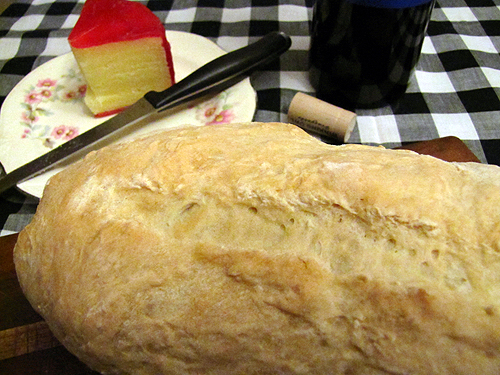
This recipe is based on my French Bread recipe, which yields a crusty finish even without the special tweaks I’m adding here to make it even crustier. Note that here, I’m making it with a sponge, and rapid-rise yeast should not be used. The French Bread recipe as posted (at the link above) is for the quick and easy version.
 Printer-Friendly
How to make a Crusty Artisan Baguette:
1 cup warm water
1 tablespoon yeast
approximately 2 1/2 cups flour, divided*
1 teaspoon salt, divided
*You can use any flour, or combination of flours, you wish, but if you’re using whole grains, be sure to add dough enhancer. (Find my homemade dough enhancer here.) Gluten contributes to a crispy crust. Other factors that aid in creating a crispy crust include high heat and steam.
I’m starting this bread with a sponge, which is not necessary for a crispy crust, but I’m just going all “artisan” on you here. A sponge is sort of an abbreviated sourdough. It adds a bit of that flavor, but not quite so strong, and it only takes a few hours rather than days or weeks to develop. You can adapt any yeast bread recipe to the sponge method. Usually, I’m too impatient for that, but here goes. To make a sponge, place the cup of warm water in a large bowl. Add the yeast. Let sit about 5 minutes then mix in one cup of the flour and 1/2 teaspoon of the salt. (You aren’t imagining things–this recipe includes no sugar. Contrary to popular belief, you don’t have to use sugar to make a yeast bread.)
Let the sponge sit and spongify. (I made that word up. I think.) You can let it sit anywhere from two hours to overnight. Since I’m impatient, two hours is usually all I can stand unless I’ve really planned ahead and it’s not almost dinnertime. The longer you let it sit, the more flavor you’ll get out of it. Find a warm place. Near the wood stove is good if it’s winter. (NOT ON TOP OF IT. That’s TOO hot and you’ll kill it.)
Sponge after sitting for a couple of hours:

When you’re ready to go on with the bread, stir in the remaining salt and gradually add flour until the dough is stiff enough to knead. Knead dough until smooth and elastic–-a few minutes. Place dough in a greased bowl; cover. Let rise until doubled.
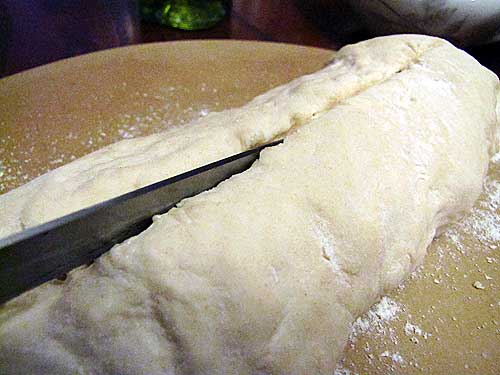
Shape the dough into a long, thin baguette and place on a baking stone. (Dust baking stone with cornmeal first if desired. No need to grease it.) Let rise 30-40 minutes. Preheat the oven to 450-degrees and heat a small pot of water. If desired, slash the top of the loaf with a sharp, greased knife.
Brush the top of the loaf with water (NOT egg white and water, just water).

Place bread in the oven along with the pot of hot water for 10 minutes at 450.
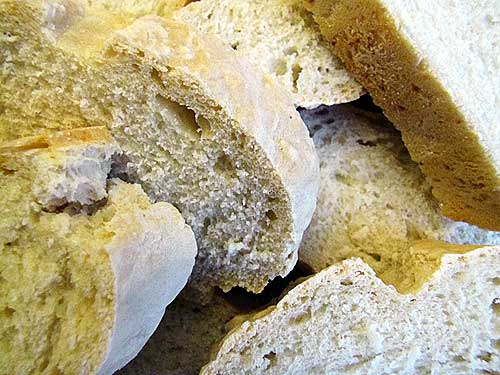
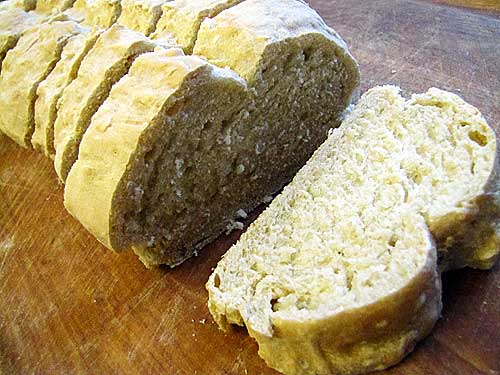
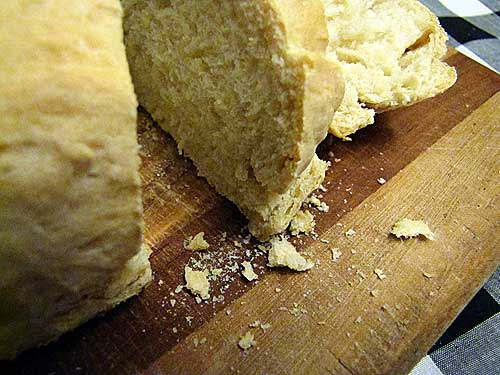
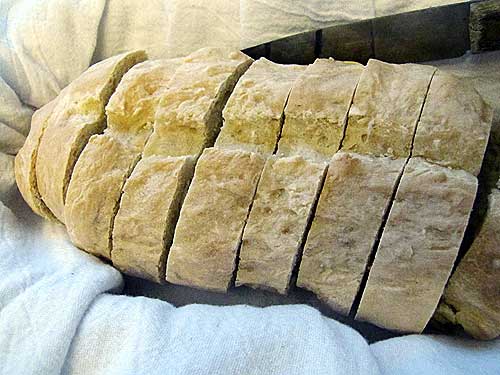
Turn the oven down to 375-degrees and remove the pot of water. Continue baking for another 20-25 minutes or until done. Let cool 15 minutes on a wire rack before slicing it with a bread knife. This crust is so deliciously crisp, it will make a crunchy sound when you cut into it. Inside that crisp crust, it’s tender-chewy with a light sourdough flavor.
Call Pa and tell him to put on his Sunday overalls. He’s having artisan bread for supper!
P.S. For storage (what? you have leftovers?) do not seal it up air-tight. It’s best stored in a paper bag, like a brown lunch sack, to preserve the crustiness.
See this recipe at Farm Bell Recipes and save it to your recipe box.


Lindsay says:
Lucky! I just can’t seem to get the hang of baking bread, and our oven’s been broken for a while so I can’t practice anymore (the oven is seriously old and replacing it just isn’t an option right now – $$$). I’ll just imagine biting into a piece of artisan bread, it’ll have to tide me over til we fix the oven lol.
On January 13, 2011 at 1:39 am
CasieD says:
I’ve started using the No-knead bread recipes and technique. It’s so very simple and gives me great results! For Christmas I was given a Romertopf clay baker. My bread crust is nice and crispy now with out having to mess around with a pan of water in the oven or spraying water in while it’s baking. I love making Artisan Bread!! :happyflower:
On January 13, 2011 at 7:42 am
CindyR says:
Thanks for the common sense approach to trendy food! Personally, I don’t care for a crust so crispy that it spews all over everything when you cut or bite into it but now I can call my regular homemade bread “artisan”–la di da.
On January 13, 2011 at 7:44 am
Carmen at Old House Kitchen says:
I laughed at the term Artisan, too! Did you know you also make Artisan Cheese, Suzanne? LOL! Oh and Artisan yogurt?! 😀
I did get a few good ideas from that one popular book, though. If anyone is interested I have a way that I adapted that, but I use it mostly for pizza dough, bread sticks, etc. It seemed a bit too heavy for a loaf of bread (even one of those fancy round ones). Not sure if it’s o.k. to post links here, but if you click on my name and do a search on the blog for “dough” it’s the Simple Dough recipe.
I’m going to try your bread recipe, though, Suzanne. It looks so yummy!
On January 13, 2011 at 7:45 am
CindyP says:
I’ve never tried the short ferment…will have to give it a try!
That baguette looks perfect 🙂
On January 13, 2011 at 8:01 am
I Wanna Farm says:
I would definitely add that it’s best to put the baking stone in the oven while it heats up, because putting a cold stone into a hot oven can cause it to break. I had this happen once, and so did my sister. I either slide my bread off a pizza peel onto the stone or just pick up the loaf and set it on there.
On January 13, 2011 at 8:40 am
Rose says:
Thank you sooo much for the recipe!! I can’t wait to try it, it seems so easy and sounds so delicous!
Thanks for sharing 😀
On January 13, 2011 at 8:51 am
Angela P says:
Wowzers! My friends and I are all Artisans. I knew they were but me??? Yes! I am! Thanks Suzanne for demystifying .
On January 13, 2011 at 9:22 am
mrkittysmom says:
I started the year making Grandmother Bread – because the local Publix was out of my favorite *store bought* due to a lot of ice and snow. It is good to get back to making real bread – and one forgets how good it tastes – kneading is a meditation.
As an aside – never try the CrockPot Grandmother bread in a big old over pot – what a mess! But the birds liked it…
On January 13, 2011 at 9:28 am
skippymom says:
I think if you written artisan one more time my head would’ve exploded.
Wow. Nice research. The bread looks tasty.
On January 13, 2011 at 9:58 am
skippymom says:
*had written. oops
On January 13, 2011 at 9:59 am
Ramona says:
You make it look easy.
One day, I’ll get over my phobia of using yeast and try some home made breads.
On January 13, 2011 at 10:20 am
glenda says:
My feeling exactly about the foodie (I hate that term too!) breads.
Just think how much product has been sold to new bread makers by using these downright silly terms.
No matter what you call it, it tastes delicious and if the marketing got more people to make their own bread, then it was a very good thing.
Your bread makes me want to get up right now and make a loaf.
On January 13, 2011 at 10:20 am
heidiannie says:
Demystifying the term “Artisan”- well done.
I do use a sourdough in my breads- sometimes (if I have time,instead of yeast. Sometimes, in a hurry, along with a small amount of yeast.) And when using real sourdough I would suggest NOT using the enhancer because it interacts and makes the bread break open during baking. Also, when using sourdough- the idea is to do a slow raise in cooler temps to give the dough a chance to develop more flavor.
I’m kind of halfway in between your Grandmother bread and the European loaves- I like a crusty chewy loaf- but my family likes sandwich bread. 🙂
It’s all about who you are serving your bread to, I think.
I use a brick lined oven with water infused during baking because the bread has a beautiful oven raise and decent crust- but I LOVE sourdough rye with caraway seeds and so I keep feeding my sourdough starter weekly.
Bread is a blessing and shouldn’t cause controversy, in my opinion. 🙂
On January 13, 2011 at 10:22 am
Deni says:
I am a vendor at the local farmer’s market where I sell baked goods, jams and jellies. There is one man there that has these amazingly beautiful crusty “artisan” breads that he sells for a fortune. I am always so envious because I had never been able to get that great chewy crusty bread that I love. So it was one of my New Year’s resolutions to learn how to make this yummy bread. I’m getting close, but I’m not completely happy with the recipe I’ve been using, so I will give this a try! Thanks!!!
On January 13, 2011 at 11:13 am
Michelle says:
Hey, my chickens are laying artisan eggs too! One of the last times that I was at the Pike Place Market, they were selling “heirloom” eggs for $8/dozen. I asked them what constituted an heirloom egg. They stammered – “Oh you know, they can go outside, they’re happy…” Well heck! I’ve got heirloom chickens, bunnies, kids…. 😉
On January 13, 2011 at 11:45 am
Suzanne McMinn says:
Wow on the heirloom eggs for $8/dozen!!!
On January 13, 2011 at 12:07 pm
EightPondFarm says:
Whoa, that looks like some bread. I heat up my oven with a cast iron pan (plus baking stone) in it and throw about a cup full of ice cubes into the pan when I put my bread on the stone. They hiss and steam for just about the right amount of time. It saves me the hassle of removing a pan of hot water. My oven is in a too-small area and when the door is open it is hard enough to figure out where to stand to get anything in or out, so I don’t ask for more trouble! Pan usually needs a touch up afterward due to hard water.
On January 13, 2011 at 12:02 pm
Gini says:
Anybody count up all the occurrences of the word “artisan?” 🙂 Clearly this is close to your heart, Suzanne…
On January 13, 2011 at 12:05 pm
Margaret Diggs says:
I get tickled at all the new terms that come around to help people sell their products! Thanks for the article I love buying the bread at Dellao’s when I’m in Pittsburgh and now I’m gonna try and make my own.
On January 13, 2011 at 2:42 pm
Yvonne says:
Double Wow on the $8/dozen heirloom eggs….they must sell them to rich people!
Suzanne, I think I’m going to have to try making bread. You make it seem so easy! Thank you. :heart:
On January 13, 2011 at 5:07 pm
Dina says:
Oh my goodness, you are killing me over here. ANOTHER recipe I can’t live without! Thank you
On January 13, 2011 at 8:26 pm
ibrew4u says:
Instead of wrapping it, stand my bread on the cut end. In the morning, the end is still soft and the crust crunchy.
On January 16, 2011 at 11:14 am
Country Girl @ Heart says:
I tried this today – delicious! I can’t wait to try it again and let it sit longer.
On January 17, 2011 at 10:18 pm